Podcast: Download (Duration: 59:42 — 48.5MB)
Subscribe: Spotify | TuneIn | RSS | More
What's the difference between a bundle, a box set, an anthology, and a collection? How can being part of an anthology be creatively interesting and useful for marketing? With Jamie Ferguson
In the intro, Amazon Kindle increases the 70% royalty share; audiobook marketing tips (Voices by InAudio); The Builder’s Creed [Seth Godin]; Future Vision XPrize; Researching the dark side of travel [Anna Sayburn Lane]; Photos from Bruges @jfpennauthor; Bones of the Deep: A Thriller – J.F. Penn.

Today's show is sponsored by Bookfunnel, the essential tool for your author business. Whether it’s delivering your reader magnet, sending out advanced copies of your book, handing out ebooks at a conference, or fulfilling your digital sales to readers, BookFunnel does it all. Check it out at bookfunnel.com/thecreativepenn
This show is also supported by my Patrons. Join my Community at Patreon.com/thecreativepenn
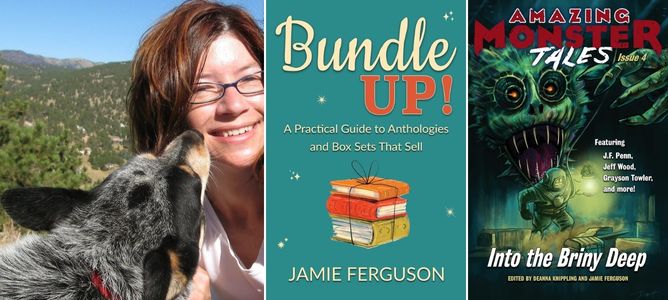
Jamie Ferguson is a fiction and short story author, editor, and publisher, with over 20 anthologies and multiple ebook bundles through her own press. Her latest book for authors is Bundle Up! A Practical Guide to Anthologies and Box Sets That Sell.
You can listen above or on your favorite podcast app or read the notes and links below. Here are the highlights and the full transcript is below.
Show Notes
- The difference between bundles, box sets, anthologies, and collections
- Why a multi-author project means lots of people promoting the same book, not just you
- How to find and pitch for anthology opportunities, and what editors look for in a contributor
- Contracts, rights, and royalty splits explained for short fiction
- Why Kickstarter and special print editions are changing the anthology game
- Inkwren, the publishing management tool Jamie built for backlists and anthologies
You can find Jamie at JamieFerguson.com.
Transcript of the interview ith Jamie Ferguson
Jo: Jamie Ferguson is a fiction and short story author, editor, and publisher, with over 20 anthologies and multiple ebook bundles through her own press. Her latest book for authors is Bundle Up! A Practical Guide to Anthologies and Box Sets That Sell.
Just for context too, one of my short stories, “The Dark Queen“, is in the Amazing Monster Tales: Into the Briny Deep anthology. So I'm excited to talk about this today. Welcome to the show, Jamie.
Jamie: Thanks for having me, Jo.
Jo: Lots to talk about. But first up—
Tell us a bit more about you and how you got into writing and self-publishing.
Jamie: Well, I wanted to be a writer since I was at least six, maybe before then. So it was just something I always wanted to do, but I always did it on the side.
I had a year, many years ago, where I was really busy with work, and I just felt like I didn't write anything the entire year, and I thought, “I'm going to give it up.”
Then the next year—that was 2011—I started seeing more about self-publishing, and that really invigorated me and made me feel like, “No, why am I giving up something I've wanted to do since before I went to school?”
So I got back into a novel I had worked on years before. I went to a writing workshop with Dean Wesley Smith up in Oregon, back in the day, and then I had my energy back. I've been writing ever since. Still on the side, unfortunately, but someday.
Jo: Hopefully!
Tell us a bit more about what kind of genres you write.
Because balancing your own books with also doing these anthologies and things is quite difficult.
Jamie: Yes, it definitely is. I'd say I primarily write contemporary fantasy, but I'll write anything in any genre if I'm really excited about it. I also have a soft spot for Westerns. They take a little more time because I like to research all the facts, but those are really fun to write.
Creating anthologies on your own is actually quite a bit of work. One of the things I also do is work with two other authors, DeAnna Knippling and Tami Veldura, and create more anthologies with them.
That's really fun because then we can each take a different piece. There's also always somebody to talk to, as opposed to doing it on your own.
Jo: Let's start with the terminology, because I definitely struggled with this, and I think people still do. We've got bundles, we've got box sets, we've got anthologies, we've got collections—and are these in ebook, audiobook, or print?
Can you start by explaining what all of these words actually mean?
Jamie: Yes. In my book I actually use the term “multi-author collection” or “multi-author project”, because there are so many different permutations and it does get confusing.
From my perspective, I think of a bundle as a collection. It could be a collection of ebooks. Technically it could be a collection of print books, although people generally use “box set” for that—but then a box set can also be a box set that's all ebooks.
An anthology, I usually use for something that's a collection of short stories where there's an editor who's actually edited all the stories. I have had stories in anthologies where somebody didn't edit them, and they would technically be called a curator.
So it is definitely confusing. I have not done anything with audio collections, but that certainly is another area that I actually think is pretty interesting.
Jo: I also think that a single author… so I've done a short story collection, but an anthology is multiple authors. Is that right?
Jamie: Yes.
Jo: I think when I came into the indie space, there were a lot more multi-author… we all called them box sets back in the day, when it was just ebooks, right? And now we can actually do boxed sets with boxes through things like BookVault. So it feels like the term “box set” has also gone out of fashion.
So if people listening are thinking of doing any of this, you do have to figure out what is the thing you might be signing up for. So let's talk about the multi-author projects, as that's where you specialise.
What are the benefits for an author to be involved in a multi-author anthology project?
Jamie: The biggest benefit is that you are one of multiple people promoting the same project, whether it's print or ebook or whatever. If I put out a short story collection on my own, I'm the one promoting it, and maybe I can get a couple of other people to write about it, but it's really just me.
If I'm part of an anthology with 15 other authors, that's 15 other people who are promoting the same project. That's more newsletters, more Facebook posts, maybe something on their Patreons, whatever it is.
You get more synergy, and you get more touch points with potential readers. Then hopefully that translates into sales as well. So that's definitely the biggest part of it—the promotion.
Then I also personally really enjoy these types of collections because it's just fun to work with other people. There's a nice energy when everybody's like, “Oh, I put this in my newsletter, and I put this here, and I put this here,” and you feel like you're part of something bigger than just your own piece.
Jo: What about the creative benefits?
Especially with short stories, often people will write them for a collection or for an anthology project.
Jamie: Yes. I've definitely written some stories that I never would have thought I'd write, because somebody I knew asked if I would be interested in being in their collection—whether it's an ebook bundle or a print anthology. So at least for me, that's been really fun.
One of the ones that stands out is that I was asked to be in a dinosaur collection once, and I was like, “I don't write dinosaur stories.” And then I did. I set a dinosaur story in London, and it was really fun to write, and I never would have come up with that in a million years.
Jo: Let's say we've got 12 authors. They've all written short stories, and now it's in this anthology. But what is the market for these kinds of things?
Have you found that there is a readership for short story anthologies that carries over to the author's longer work?
Jamie: There is. I like to think of it as: if I have a story in a collection or an anthology—whether it's one I'm editing or somebody else is editing—that's one more place for people to find me. A lot of times anthologies will take reprints as well, like your story. “The Dark Queen”—that was a reprint.
We asked if you'd be interested in participating in the Amazing Monster Tales series. And I actually really like printing stories again that have already been published, because there are a lot of stories out there that can be hard to find. Or if it's an older book.
I have one author I've known for, like, 30 years. I reprinted one of her stories that was originally published in, I think, 1999, and the anthology it was in was out of print. You couldn't find it, and it was a fantastic story.
So it's fun to be able to give new life to those stories and give them more opportunities, and also just have more ways for people to find you.
Jo: Yes, I definitely think it's a long game. I don't think appearing in a short story anthology in one particular month is going to mean that your whole back collection just sells, right?
Jamie: No, definitely not. It's more about avenues to be found. I know there have been some anthologies that have made quite a bit of money, but in general you're probably not going to make as much money, but you will have those extra places for people to find you.
Jo: I always feel like yes, there is maybe a small amount of money, but it is more about almost a marketing thing in itself.
So let's say an author is listening and they're like, “Do you know, this sounds like a great idea.”
How can they pitch for things like this? How do they find out about opportunities, or get noticed to be asked?
And what are the expectations for them?
Jamie: The biggest thing is networking. There used to be a couple of opportunities where you could make people aware that you had stories that you were interested in potentially having picked up for something. I'm not aware of anything like that now.
When I create a collection, I have a mailing list that I send out, and it includes authors I've published before. It includes a couple of extra people who somehow found my mailing list. And I'll publish, like, “Here's what I'm doing.”
There are also authors I've met at writing workshops. I've been able to read some of their work, I'll approach them and say, “Hey, I really liked such and such a story. Would you be interested in writing for this?”
Then there are a couple of other websites, like Duotrope, and places that advertise markets and calls for submissions.
Jo: Yes, I've found them also on small presses that do these kinds of projects. They often put up one call for submission a month or something, and you can write for their particular thing. In general, the short story markets are the places to keep an eye on.
Jamie: Yes, definitely.
Jo: If an author wants to pitch to have their story as part of an anthology, do you want to know things like platform, or is it just the story itself?
Jamie: I personally look at the author's platform. I do make exceptions—there are actually two authors I've worked with a couple of times who don't have websites. They are people I know personally and they are very, very good writers, so I'll make an exception for things like that.
But otherwise, if somebody submitted a story to me and I didn't know that person, I would check out their website, I would check out their social media, I would see what else they had done.
Part of what you're doing when you're creating a collection is thinking not just about how you, as the person organising this, will promote the collection, but how the authors who are participating will help promote it as well.
If it's somebody who has a lot of fans, even if they're not very active on social media, that can help a lot too. There are a lot of different factors, though.
Jo: So then talk us through the project timeline.
How long do things take, and what sort of involvement do the authors have along the way?
Because it's a lot to juggle.
Jamie: Yes, it is a lot to juggle. I can give you an example with the Monster Tales series. We'll come up with an idea, and we also like to try to get the artwork done early on in the process. We don't need it that soon, but it's really great to have that taken care of.
We'll contact authors. I think for this one we used my mailing list, but we've also contacted a number of people individually that we know who write the style of stories we like.
Then, as the submissions come in, we usually wait until we have a nice chunk of them to start going through, and then we'll pick some right away. Sometimes it'll be like, “Oh my gosh, of course we want this story,” and we'll wait to fill out the other slots.
Then we'll negotiate sometimes. Sometimes it's like, “I want this story.” “Well, I want this other story.” And we have to figure out how the word count works.
Once we finalise the stories, then usually what happens with that anthology is that DeAnna—who is a very, very good editor—will make the first editing pass, and then I'll make the second. And now Tami's involved, so Tami will make the third, and then we'll iterate.
Once all three of us have gone through the first time, then we'll send the story back to the author for edits. So the most the author has to do for most of the process is just wait for us to edit their story, and then work on their edits and get them back.
Then, once we get closer to launch, we'll give them information about what we're going to do. For example, we're going to launch the next issue with a Kickstarter. So our authors know that we have a Kickstarter coming, and we'll give them more information as we get closer to the actual launch date.
Jo: So how long might an author expect before their work is out there?
Jamie: It really varies. I've had some collections published very quickly—let's say a couple of months. Some have taken longer just because somebody ends up having some life issue and things get delayed. So I'd say ideally it would be more like three to nine months.
Jo: Yes, I think… depending on the—
Jamie: —collection and the complexity.
Jo: Yes, exactly.
Jo: And you did mention word count there.
Just give us a range of what word count you like to get.
Jamie: So these days I'm shooting for between 75,000 and 80,000 for the total word count for a collection. That includes the stories, but it also includes the opening, the introduction.
For one we're working on now, we're going to have some interstitials, where we have little bits of things we're going to write in between each story. So that's the overall size of the collection.
I'll keep track of the word count as the stories come in, and then as we edit the stories, sometimes they grow, sometimes they shrink. Sometimes that's a big enough difference where we're like, “Okay, we need one more story to fill it in.” But that's the target.
Jo: And how much for each individual story?
Jamie: That varies. I've done a bunch of different things. These days, what I'm advertising is between 3,000 and 8,000 words. I also always tell people: if you're outside this range on either side, just check with me, and if it's something that's really an excellent fit for the book, I'll make an exception.
The one that's coming out, I think we have a 1,500- or 2,000-word story that was just amazingly perfect for what we wanted. There was another story, actually I think it was the issue that you were in, that was at least 12,000 words, but it also was a perfect fit for the theme. So I will make exceptions, but within reason.
I wouldn't put a novella inside an anthology, because then you'd have a 22,000-word story next to a 3,000-word story, and I personally feel like that's really jarring for the reader. You don't want to go from something super short to something super long. It just doesn't feel like it flows well to me.
Jo: No, absolutely.
Jo: We'll come back to the making of it because you mentioned some really interesting things there.
But just on the contractual side—a lot of indie authors don't necessarily do any publishing contracts for their work, unless it's signing the terms and conditions when uploading on Amazon or Kobo. So tell us a bit about the contract side.
What rights are we talking about here? Any red lines in contracts around this kind of thing?
Jamie: For contracts, I would recommend people read Kristine Kathryn Rusch's posts on this. She is way more informed about this than I ever will be, so when I have questions, I'll look at her posts. I've asked her a couple of questions.
What we're doing for the Amazing Monster Tales… this is the first time that I've actually had authors sign contracts. Prior to this, I've used PubShare, which handles royalty splits and all of that, and that was really great.
We want to do direct sales and Kickstarters and have lots of other options. So we did put together a contract this time. I'd have to pull it up, but I think we asked for first worldwide rights in English—I'm getting the terminology wrong here—but that was basically it.
Jo: Or, I guess, reprint rights if the story's already been licensed.
Jamie: Correct. We have two contract templates, one for original stories and one for reprints. We made sure to make that distinction, because it is definitely a distinction.
In the book by Kristine Kathryn Rusch—it's called Closing the Deal… on Your Terms—I highly recommend that for anybody interested in learning more about contracts.
Jo: Yes, that's great. And just for people listening: when you said you didn't have contracts before, you just used PubShare. So in that way, the author still retained the rights and you just split the royalties—it was more of a co-writing thing.
Jamie: Correct. When you publish stories through PubShare, the author signs an agreement with PubShare, and then I, as the editor or organiser, would also sign a separate agreement. So each of us has an agreement with PubShare. We don't have agreements with each other, if that makes sense.
Jo: Yes, so it's very different to move into Kickstarter.
So tell us about what you're now moving into.
Jamie: Well, Kickstarters are a new world for me personally. I have many friends who have had Kickstarters. I've supported Kickstarters. I watch them. But it's something where I'm very happy to have two partners who have done Kickstarters before.
I'm not sure how many Tami's done—I think Tami's done the most at this point. So this is all new to me. But it's very exciting.
At this point we have a backlist, so part of the plan, for the Monster series, is to offer issues one through four as part of the rewards when we launch issue number five. That's really exciting, because I never had a backlist like that before.
Jo: Yes, and in fact the money is in the backlist, as ever, and those add-ons or bundles as part of Kickstarter are great.
So are you going to do special print editions, or is it digital only?
Jamie: We are talking about special print editions. You mentioned BookVault earlier—we've been looking at BookVault.
Our other anthology series that hasn't come out yet will also launch with a Kickstarter. It's dragon-themed, and Tami actually did the cover work, which is beautiful. BookVault just gives you so many options that we never had before, so I'm very excited about that.
Jo: Yes, I think it's a really good idea. I did gorgeous hardbacks for my solo author collection, so I think it's a great idea.
So from the publisher side, let's come back to that. You've mentioned you have to write things like an introduction and interstitials, and you're trying to balance the stories.
What are some of the other things that people might think about if they want to organise their own anthologies?
Jamie: Oh gosh, where to start? There's the basic setting up of the anthology, so you have to define the table of contents.
You might get a bunch of stories that are really awesome, and you might have to tell somebody who has a wonderful story—and maybe even who's a good friend of yours—that you're going to pass on it because their story doesn't fit with all the other stories.
Every time I have to do that, I feel kind of bad. But being on this side, it's really interesting to see how you can tell which stories fit together and which don't.
There's also the editing process, which can be a lot of work. Part of what I like about working with Tami and DeAnna is that DeAnna really loves editing. I feel like I'm a good editor, and I can do it, but for me it's more of a job.
For DeAnna, she loves it, so she does the bulk of the editing, which is great. When I do it on my own, I feel like it's a task I have to do.
There's lots of cat-herding. Sometimes people take a while to get their edits back. Sometimes they have life events, and you have to delay things because you're waiting on them.
There are all the little tiny pieces of organising things—like, if you're reprinting stories, you need to make sure you get the copyright attribution correct. A lot of times I'll have to go and look up where something was originally published.
An author might say, “Oh, it was published in this year,” and I'm like, “Okay, actually it was published in this other year, by this other publication first.” So I'm trying to be organised there.
henT one of the things that very infrequently—I think it's only happened to me twice—every once in a while, you're in the middle of editing a story and you have to pass on it, even though you've already accepted it, because the editorial vision and the author vision for the story are not the same, and you can't reconcile that.
Jo: I think that's really interesting, because so much of what you're talking about there—you mentioned vision—it's almost taste. You're saying which stories fit.
It's not just a case of, I don't know, a pirate anthology and then picking 10 stories about pirates, right? You seem to be thinking about this in a more artistic way. So can you talk a bit more about that?
How do you decide on a theme, and then how do you know that a story doesn't fit?
Jamie: In the beginning, I was not this selective. In the beginning I'd say, for example, “Hey, I'm putting out a collection about fairies. Give me a fairy story,” and that was it. As I've edited the stories, it's become easier to see how things fit.
So, for example, if I have 10 stories in an anthology and I have an 11th story, and they have different tones—let's say the 11th story is really funny and all the other stories are very serious—then that would be a fit thing.
That's not necessarily taste; it's just that you don't want one funny story if everything else is really dark and scary or serious.
As far as picking a theme, the theme could be very broad. With this dragon anthology we're working on, we decided we wanted it to be called A Hoard of Books. So the theme was: has to have dragons, has to have books, and that's pretty much it. And then we were like, “Let's just see what we get.”
We were very surprised at what we got. We thought we'd have more serious stories, and it turned out most of them were very light-hearted and really fun. And we're like, “You know what? That actually changes the way we're looking at the whole series,” because we did not expect that.
With the monster series, we'll pick a theme. So, for example, the next issue is Monsters in Love, and for those it's more like, let's just see what happens.
Sometimes I'll have a more specific theme. The next anthology I'm publishing on my own is called Fairy Bargains, and I wanted people to obviously have fairies, but I wanted there to be something related to the mythology and lore of having a bargain with a fairy—and there's a lot of stuff about that.
So for some things like that, when I put out a call, I'll provide information. I might say, “Here's a link to a Wikipedia article. Here's some mythology that might be helpful for you,” just because I want things to stick a little bit more to the theme itself.
Whereas with Monsters in Love, there's a very wide range of stories, and that was very fun to work through.
Jo: Oh, yes. There's a lot of monster, on the spicy side as well. But were you doing a clean Monsters in Love, as opposed to in lust?
Jamie: Yes, this is a clean one. That's pretty funny. But boy, when you give authors the room for these types of things, you get all kinds of stories, and it is super fun to work with those collections.
Jo: As you're talking, I definitely want to do more short stories. It's really interesting, because you can actually generally get paid more for a first print—first print rights on a short story—but I often want to just publish it myself.
Then I was really happy to be in yours, because it was a reprint anyway. So I was like, well, there's absolutely nothing to lose if it goes in as a reprint. So these things can be really interesting.
Talking of the finance from your side of things: you have a small press and you're doing this publishing yourself, but you're paying all these authors and doing a lot of work.
So how does it work as the publisher, in terms of these anthologies, financially?
Jamie: With the ones we've published so far, because we've gone through PubShare, it's been a royalty split. As the editors, we would take a percentage, and then we pay for the artwork, and of course all of our time.
I think what we were doing there was saying 70% of the royalties would be split equally between all of the authors and the stories. So, for example, if I had a story as well, I would get part of the author split—the same percentage as everybody else in the collection—in addition to the editor split.
For what we're doing now, we've changed this a little bit, and I believe we said 60% goes to the authors, and then we're going to keep a share of the proceeds for the business because we want to be able to pay for the artwork out of the business account.
We want to pay for advertising, whatever we need to do—like setting up our store, or if we wanted to invest in anything, we want to be able to do that as the business, as opposed to it just being us doing this on our own. We're just trying to treat it a little bit differently.
Jo: And I know it's so much work—a crazy amount of work.
How many anthologies and books do you have to do in a year to make it worthwhile financially?
Jamie: Oh, I don't know. I would say, unless you get an opportunity—like, for example, to have an anthology in a story bundle or something like that—you may not break even. But if you're going to do this, do it more for the marketing, do it more because you enjoy it.
Now, going forward, I think that will change, because we are looking at Kickstarters, we are looking at direct sales. We're very motivated to try to make this more of a business thing than a fun side project. So, ask me in a year.
Jo: Yes, hopefully more. I do think Kickstarter is great for short stories. I actually buy quite a few collections on Kickstarter. I think they're actually really hard to discover through, say, Amazon—it's a place that is quite hard to identify short stories.
Whereas I've found I've bought collections on Kickstarter because there's so much more of a sales page—there's so much more rich media that tells me how I'm going to feel about the stuff.
I've bought short story anthologies and collections from people I don't know. So I think it's a really good thing to do. There is an audience there.
Jamie: Yes, definitely. And it does feel like the anthologies on Amazon don't sell as well—you don't make as much as you used to. I've been doing this for, well, gosh, 10 years now, and I feel like the sales numbers on Amazon in the past year were noticeably lower than they would have been six or eight years ago.
So I am very excited about Kickstarter. Plus, Kickstarter just feels really fun. You're not just throwing your book up; you also have all the extra stuff with the page, you have the rewards, and it just feels really exciting.
Jo: No, I agree. I really love it. I didn't do it for a long time, and now I just love it.
Jo: So, staying with the publisher side of things—
Any practical formatting and production tips?
Because in these types of projects, all kinds of people just send you different stuff.
Jamie: I have a style guide. So whether it's me or it's the group project, once all the edits are complete, I'll do a formatting pass, and I'll make sure I use curly quotes and the same em dash format and everything, just so everything in the book is formatted the same way.
Every once in a while there's an author who has something particular that they want, and I can work around that, and that's fine.
I also work with a lot of Canadian authors, and I'll let them keep their Canadian spellings. I don't think everybody does that, but I feel like that's their voice in a way, so I don't correct those. I might check some things there.
I think the formatting is important—it makes things look better if everything has the same style. Then I use Vellum, which makes things really easy. I love Vellum.
Because I publish so many authors at this point, I have a Vellum file where I store their biographies and their links, so when I publish a new anthology I'll just go grab, say, Jo's “about the author” page from that collection and put it into the new file.
Then I also track when the last time was that I checked with the author about their biography. If it's been more than a year, I'll check in with them and say, “Hey, do you have an updated biography you want me to use? Here are your links—do you have any different links now?”
So that makes it a lot easier from the formatting standpoint.
Jo: And you mentioned Vellum—having done box sets on Vellum, you can just drag a whole book in there if you want to do a three-book box set, or three short stories, whatever. It's much easier to just drag things in, and it makes it easier to format.
So I would say to people: you don't need to worry too much about that. There are lots of things that can help you.
But even with doing the print stuff for the Kickstarter—people have opinions, don't they? So in terms of authors' opinions and managing—you mentioned herding cats—how do you manage all of that side of things?
Jamie: I haven't actually had a lot of trouble with that. The authors I've worked with seem to feel like they gave me their story, and then once the edits are out of the way… I haven't had anybody have any issues with the covers. Usually they love the covers, especially for the Monster series. So, no problems there.
Jo: Oh, that's good. Well, I would say a tip would be to make sure you're communicating, if you're somebody who's organising.
So talk a bit about communication.
Jamie: Communication is very important. What I try to do is send regular updates, especially if I'm in the middle of edits or working on something and I'm not ready to launch. I'll send an update email out to the authors and just say, “Here's what's going on, here's what the plan is.”
Or if the plan has to change, if the launch date has to change for some reason, I'll let the authors know about that.
Actually, with the upcoming Monsters in Love issue, we were originally not going to do a Kickstarter. That was a late decision, so I contacted all the authors and said, “We've changed our plans. We're going to launch this with a Kickstarter. Please confirm that you're okay with this.”
One author was not comfortable with the Kickstarter idea, so he pulled his story, and then we found a replacement story for that. But I just feel like the communication piece is really essential. It's really important for the authors to know what's going on.
Jo: Yes, absolutely. So, we've talked about how marketing is a good thing, in terms of there being lots of people marketing.
How are you effectively marketing these kinds of books, as the premise is quite different to a single author project?
Jamie: Right. There's the usual—write a release post, write posts on social. I do additional things, so I'll publish what I call a story spotlight for each story in the anthology. That's just where I talk a little bit about the story, I provide an excerpt, and then I provide the author's bio and links to find them.
Those are really great, because they're very quick to put together. The hardest part is getting a short excerpt that shows enough about the story to be engaging. But that really isn't that much time, either. Then those are also nicely evergreen.
I've actually searched for authors before, when I'm trying to research them for an interview, and I've found my own spotlight posts and my own interview posts with authors come up at the top of the list, which is kind of funny.
I also do interviews with as many of the authors in a collection as are willing to participate. Sometimes people just don't have the time—I don't make this required—but I usually get 80 to 90% of the authors participating.
So, for example, this year I'm in a couple of bundles on StoryBundle, and I'm doing interviews for people there.
It's also really fun, and you're not paying for advertising—you're just creating something that the authors are excited about and they want to share. So it promotes the collection, but it also promotes the author, which I find really nice.
It's a nice networking thing too, and I'm happy if someone wants to interview me. It's like free publicity for each person, in addition to the collection.
Jo: I love that you've used the word “fun” quite a lot, which I find amazing. You're obviously a super collaborative person. I've co-written a number of books—
I've been part of some collections, and I really think that there are two personalities.
One is like me, where we really love the creation stuff and the publishing stuff, but we're hyper-controlling. And then someone like you—you're very collaborative, and you're doing such a great job.
To people listening, I would say: if you're more like me, don't organise an anthology. What you want is Jamie, or somebody who actually finds it fun to organise a big group of authors.
Jamie: Yes. It is definitely interesting working with other partners in this, because when I publish an anthology on my own, I make all the decisions. I pick the artwork, I pick the theme, I do everything, I decide the table of contents. But when you're working with other people, you do need to negotiate.
So we've had a couple of times where it's like, “I want this story.” “Well, I want this other story, I don't like the story that you want.” And so we have to barter, in a way.
Aside from that, it is nice, because you get to split up the tasks. I could focus on things like the organising—I do the Vellum files, I do the final cover and everything. For the Kickstarters, actually, Tami's got more expertise, so Tami's going to be working on the Kickstarters for our collections together.
If I had to do all this on my own, it's a ton of work. It's a ton of work. So it is nice to split it up.
Jo: And of course, one of the things is managing so many moving parts—and you've actually built a tool to manage all this.
So tell us a bit about that tool, and how it might be useful for people with big backlists as well as anthologies.
Jamie: I built what I think of as a publishing management application. The original idea is that, for years and years, I wanted a software tool that would do catalogue management, because I was managing my own catalogue, and I was also managing—at this point I've published at least 20 anthologies, so that's a lot of authors.
Then last summer, I had an author who I'd published a number of times, who was going to, I think, WorldCon, and she asked if I could give her covers for five anthologies she'd been in, so that she could make some promotional material.
I was like, “Oh, sure, I can do that.” And then I was like, “Well, wait a second—is this in Notion?”—because I started trying to use Notion last year—”or is it in a spreadsheet?”
It turned out her information was in, like, three different places, and I had to work to pull it together. And then I was like, “You know what? That's it. I'm just going to finally write this application.”
So Inkwren manages your stories. As an author, I can manage my stories—I can track which are published, which are drafts, which are just ideas. I can track my publications.
From the publisher standpoint, it's really helpful, because I can track each anthology I've published and what I'm working on. I can track the edits, I can track the contracts.
I can upload contract templates—so we talked earlier about the original and reprint contract templates that I use. I upload those, and they have placeholders in them.
When I generate the actual contract, the author's name will replace the placeholder—I'll have the text “author name” in the contract template, and it'll get replaced by, like, “Joanna Penn” or whatever. So that saves a lot of time.
Then I also added in task tracking, because I started to feel like, well, now all my stuff is in one place, but my tasks are somewhere else. So now I can associate tasks with a publication.
For example, for the book I'm working on right now, I know which tasks I need to do for the cover, and which for the interior, and everything. I have a template of tasks.
Then I can also track tasks related to promotions. For example, the story bundle I'm promoting right now, I have a task for each interview I'm doing with the authors, and I have a calendar view. I can see when I'm going to publish them and know that they're all spread out. It saves me so much time, and it's so much easier.
Jo: I do think building tools when you actually need the tool yourself is very useful. Just say the name again, and spell it out for people.
Jamie: It's Inkwren. My own personal publishing company is Blackbird Publishing, and I wanted something related to birds and writing. So I came up with Inkwren, which is I-N-K-W-R-E-N, and it's just inkwren.com.
Jo: And it is available for other people to potentially buy and use?
Jamie: Yes, it is.
Jo: Well, I think that's super useful, because it's very hard when people are starting out and they think, “Oh, I've only got one book—why would I need any kind of tool to manage it?” But over the years, your backlist grows, especially with short stories.
So I love that you've built this, and there's probably more that you can add over time as you expand the business yourself. So much potential. So we are at the end.
Where can people find you and your books and everything you do online?
Jamie: My author website is JamieFerguson.com. And then, obviously, I mentioned Inkwren earlier. My publishing company is BlackbirdPublishing.com. And then the projects I'm doing with Tami and DeAnna—we have a couple of websites, but the easiest way to find us is our press, which is BorogrovePress.com.
Jo: Fantastic. Well, thanks so much for your time, Jamie. That was great.
Jamie: Thanks, Joanna.