Podcast: Download (Duration: 47:38 — 38.8MB)
Subscribe: Spotify | TuneIn | RSS | More
Is AI really the end of creativity, or the biggest emancipation of creative energy we've ever seen? How can authors thrive in a time of super abundance, when anyone can make anything? What happens when publishers become technology providers, and agents start shopping for books on our behalf? With Nadim Sadek.
In the intro, my AI-Assisted Artisan Author webinars.
This show is supported by my Patrons. Join my Community and get articles, discounts, and extra audio and video tutorials on writing craft, author business, and AI tools, at Patreon.com/thecreativepenn
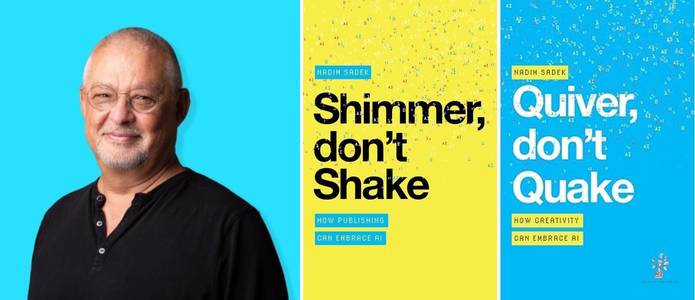
Nadim Sadek is a serial entrepreneur and the founder and CEO of Shimmr AI, an AI-powered book marketing company, as well as the bestselling author of children's books and non-fiction books, including Quiver, don't Quake: How Creativity Can Embrace AI.
You can listen above or on your favorite podcast app or read the notes and links below. Here are the highlights and the full transcript is below.
Show Notes
- Using AI as a research partner, editor, and constructive critic when writing a book
- The ratio of dreaming to execution
- Why publishers still draw red lines at AI-written words, and why that may change
- Inside Shimmr's three-engine advertising system: Strategizer, Generator, and Deployer
- Multimodal interactivity, agentic purchasing, and the idea of the Panthropic
You can find Nadim on LinkedIn or at NadimSadek.com.
Transcript of Interview with Nadim Sadek
Jo: Nadim Sadek is a serial entrepreneur and the founder and CEO of Shimmr AI, an AI-powered book marketing company, as well as the bestselling author of children's books and non-fiction books, including Quiver, don't Quake: How Creativity Can Embrace AI. So welcome to the show, Nadim.
Nadim: It is lovely to be here. I feel very privileged to be invited onto this. Thank you.
Jo: Oh, I'm excited to talk to you today, and we're really talking about AI. I wanted to start with the fact that you do seem to have a sort of relentless optimism.
How do you remain so optimistic about AI when the publishing industry that we both work in seems so overwhelmingly negative?
Lift our eyes to the horizon—what is the bigger picture?
Nadim: Oh my goodness. That is a big one. I think my optimism is quite confined actually in the area of publishing. If you were to ask me to speak about AI more broadly—which you're not, but I'm going to give you a little bit of it—I've got lots of concerns.
That includes the advent of autonomous weapons and economic singularity, where the wealth from AI as an industry is going into just a few hands, and energy usage, and cultural homogenisation, I suppose, and the potential for brain rot.
There's a whole pile of stuff which is really not very good about AI, and all the normal things about fraud and theft and so on.
However, if you recognise that and then you say what's going on in publishing, then the obvious thing that you first have to deal with is what did happen with copyright. Is it appropriate to say that things have been stolen and taken without permission and so on? It is.
It's going through the American courts at one pace. I saw that Penguin Random House have started a case against OpenAI in Germany, where there will be a much faster legal conclusion—a judge's conclusion, I think.
This will begin to put parameters on how copyrighted materials can be used, and possibly also some retrospective judgment about what has happened to this point and what can be done about it.
So it's good that you've asked questions so early in our conversation, because I think —
It's important to contextualise my optimism.
It is whilst noting with regret the behaviour of the AI industry—the models themselves—in not dealing with copyright in the most generous or appropriate fashion.
I think we should also recognise that copyright probably wasn't designed for machine learning in the way that it is. Probably the industry wasn't terribly well prepared to note, negotiate with, and navigate the very fast-moving technological culture of AI companies. So I think lots of mistakes have been made on both sides.
When you put all that to one side, what's left for me is an amazing emancipation of creative energy and also a huge efficiency being brought to the publishing industry. We can talk about both those things further, but for me that is what's going on.
The efficiency of bookmaking and publishing generally—the whole workflow of getting a book out of somebody's head and into a reader's hands—I think is immensely streamlined and improved by AI.
Actually, if you talk about it carefully, which I'm sure we will do, the ability of creators to share and let others experience their creative endeavours becomes so much better, so much fuller, so much richer. So that's why I'm excited about it.
Jo: Well, let's get into those two things then. You mentioned the emancipation of creative energy, and you've worked with various AI tools as part of your creative and business processes. You've said that AI can be a creative companion. So specifically when it comes to Quiver, don't Quake, for example—
How are you using the various tools in such an emancipated way?
Nadim: Well, just to put a bit of a broader context on it, we're an AI-native company at Shimmr, and separately I wear a hat as an author.
You mentioned the AI books and the children's books. I'm also writing a book about the psychology of motorcycling. So it's a very odd authorial footprint, but it means that I kind of tramp around the place and learn different things.
What I've noticed, even within Shimmr, is that the whole team has been using AI tools very differently. Lots of people are very bright in the company. They're all brighter than me, and I salute them and love them. But they've all used AI to become more creative in their own ways.
For example, our Chief Commercial Officer is very numerate and logical, and not loquacious. She prefers to say things straight and simply. She has become an unbelievably creative financial modeller and analyst because she uses AI in lots of different ways.
So she has flourished and grown so much, and is creative in a way that she never could be before—not only around numeracy and financial matters, but in thinking through new concepts for sales and marketing and for our commercial development.
I've just noticed all around me this going on. When it comes to me, I prefer to express myself through writing. I talk a bit as well, as you can tell, but my favourite means of communication is just writing.
When I was writing Quiver, don't Quake, I would use AI in a number of different fashions. One would be for research.
One of the chapters is about the psychology of creativity. I'm a psychologist, so I tend to come at things from a psychological perspective. What is the psychology of creativity? Well, here comes a million-word answer from an AI—this person said this, this person said that.
Then I kind of focused my research in particular areas and assembled them by drawing from the outputs of several AIs about what has been said about AI, what the science says about it, what sociology says about it, what particular creatives that we're all aware of say about it, whether they're in the advertising industry or musicians or artists or whatever. So that was a very rich way of researching things.
I would often put a chapter in—this is a slightly different use—a manuscript that I'd written and say, “Read this as if you're somebody just coming across my book, and tell me where the reader might struggle between one paragraph and another, or where there's a logical fallout, or where the concept isn't really very fully excavated and developed.”
It would occasionally prompt me to say, “You could probably do with a line that brings the reader from this point to that point.” And usually I listened to that and then wrote something new.
In another use case, I eventually gave it the whole book and said, “I think I've done an okay job here and I quite like the flow and I'm sort of satisfied enough, but before I send it to the publisher and say, ‘there you go,' what do you think? Are there any ways in which this book could become a better and more interesting read?”
It came back fairly promptly and said, “Well, what you haven't really done is considered what all the naysayers would say. You've done your dark moments of militarism and all that stuff, but what about some of the other stuff closer to publishing or creativity?”
So off I went on a new round of research, and did some myself and used the AI for other bits.
The funny thing, really the ironic thing here, is that the book is much better, and most people salute the book for the eighth to ninth chapter that talks about the constructive critics.
I assemble them all and articulate all their arguments and say how hideous AI is and how terrible it is for the world and all of us. And then I try to repudiate some of them, not in a defensive way, but just to say, actually, yes, that's one perspective and here's another one.
That chapter, ironically, about how AI is terrible was prompted by AI. It said, “You should really have a go at me.” And so I did. So that was another use case.
Then finally—perhaps I'll say this—I have a friend who is, I think, the Editor-in-Chief of Penguin in India. I got to know her at a book fair or something. We started chatting, and I told her about my kids' books. I said, “I could really do with an editor on these ten books that are due to be published.”
She very generously, amiably, and very constructively gave me feedback on each individual book and then on the whole set. I was really happy with it. I said to her, “That was a delight.”
She said, “You'd be much better off working with Editrix.”
I said, “What's Editrix?”
She said, “Well, it's an AI platform I've created where you can go and self-edit.”
I said, “You must be kidding. I'd much prefer chatting to you and our interactions.”
She said, “Yes, well, go and try it.”
So I got an account for the Editrix AI. Off I went, gave it my books, and lo and behold, it came up with some incredibly sophisticated and subtle observations on the books that neither Meru nor I had seen.
For example, there's a story where a boy who lives in a house on a hill meets another boy on a bridge, and they end up in a silly confrontation. They're young and foolish, and it sort of transpires that the other boy lived in a local village.
Now, I suppose in retrospect, it's pretty obvious that this could be seen to be colonialist, imperialist, and a sense of entitlement from the boy at the top of the hill crossing the bridge first and so on. Hadn't crossed my mind.
The AI said, “I can tell from the rest of your writing that you don't really have a sort of racist or imperialist or superior attitude to things, but in this story, there could be a misapprehension that you do.” I thought, wow, what a great warning. So I changed it.
There are almost endless ways—and I can tell you others, because I'm writing a book about clouds at the moment—in which AI can help you as an author. I've just shared some of those with you.
Jo: Yes, well, I love that. I also use it for research. I definitely use the “give me feedback as a reader avatar, as a reader of this type of genre” or whatever.
Nadim: Yes.
Jo: I use different tools as well, so I agree with you. All of that is, I think, what a lot of people are doing. You also said you did a lot of the writing and rewriting, so the human was very much there.
This was not an AI-generated work in any way. It was using an AI as a sort of collaborator—a creative companion, to use your words—which I think is great.
One of the things that AI-positive people like us are finding is that there's so much negativity around the traditional publishers, around other authors, around supposedly negative backlash from readers. I think there's a lot of very noisy people who are probably making this sound worse than it is.
Since you are so embedded in traditional publishing in so many ways, how are publishing people thinking about this?
Do you think it's just different in terms of the creative side versus say the marketing side? What is happening there, and what do you recommend for authors?
Nadim: What I'm observing is that there is increasingly confident adoption of AI for corporate efficiency, which is a polite way of saying where one can see profitability being improved.
Could you streamline legal contracting? Yes. Can you manage royalty payments better? Yes. Are there better sustainability prospects with managing a warehouse and distribution and so on with AI? Yes.
Could you improve your marketing by looking at competitive titles and trends, and optimising your metadata and your SEO and now your GEO, all using AI? Yes, yes, yes, yes, yes. All of these things can be assisted.
Can you manage much more of your backlist, where you don't have the human or financial capital to manage all of those titles in a truly respectful and invested way? Yes, yes, yes. So wherever there's corporate efficiency, I see publishers being increasingly bold about saying they have integrated AI into their workstreams.
What's much more tentative and hesitant is where there's discussion of authors—and I do hesitate to use the right words here—being assisted by, employing, working with AI. I kind of shorthand it as creative emancipation. It really means very many different things.
Let me give you the example that I referred to briefly a second ago of Cloud Land, which is probably my first real novel. I'm very lucky. I sit working every day at a desk that's got three windows, and I look at the sky, and every day it's different, and I'm fascinated by it.
I've been flying around the world since I was very young—my father worked for the World Health Organization, we moved between many countries—so I've also seen clouds from the sky a lot. I've noticed that in different parts of the world there are different cloud formations.
It came to me one day that it would be very interesting if the clouds were somehow sentient, and that there is a cloud society, and that Cloud Land lived above human land and absorbed and observed us.
Actually, the more I started thinking about it, the more I thought, well, we kind of evaporate. We give off vapour all the time and it rises up to clouds and maybe we're sending DNA signals to it, and it condensates and sends rain and storms and winds and lightning and thunder and all.
There's a huge amount of interaction between Cloud Land and human land if you think about it.
So I went into an AI. I said, “Hey, I've been thinking about this, blah, blah, blah. Any observations on what I've been saying so far?” I think one of the first things it said to me was, “You are actually playing with quantum physics.”
I had no idea what quantum physics were really. I thought, well, this is interesting. I went and researched quantum physics, and actually there is some of that in it. If you count Cloud Land as a creative notion—
The original idea, the creativity, came wholly from me, and then the development of it has been assisted by working with AI.
I as a creator have spent much more time originating ideas about a story than would historically have been true.
I probably would have gone to a library, tried to find the right geography textbook, read up about clouds, discovered what the nomenclature is, thought about whether I could put characters to cumulonimbus versus stratus something or other, and kind of worked my way gradually through it.
There is something that I refer to in Quiver, don't Quake, which is what I call the ratio of dreaming to execution.
I think previously, without AI, creators would probably spend 80% of their time researching and trying to get information and assembling things and editing documents and spell-checking and doing a whole pile of different tasks
None of which I actually dismiss, because I think sometimes those difficult and
“menial” tasks give you time to let ideas percolate and flourish and grow. It's just part of the process.
But whereas before, I think we probably spent 20% of our time originating and 80% of our time assembling, I think it's inverted now. You can probably do 80% of the time you want creating and 20% of the time fiddling about getting your act together.
So I feel that that's a huge emancipation of individual creativity. There's also—and we can talk about this if you wish—I think a much broader sociological phenomenon going on, which is really about every person in the world, all 8 billion of us, being creatives. That's the way I see the world.
I think that only a minority of that 8 billion have the gift of craft that we recognise—of writing or drawing or making music or being an architect or a biomedical scientist or something that's creative and assembling things. And AI gives you courage and helps you to identify what you wish to make.
I really don't mean creating the artefacts. I don't mean painting or making a song or writing a book. I just mean helping one to express and articulate oneself so that one's creative idea is shareable and experienceable by others.
Jo: Well, it's interesting. I mean, everything that we've discussed, you're really saying that the main line is the actual writing of the words, because none of us can articulate how ideas come.
Especially with Claude, we might have a creative spark, but I'm sure you've found the same: if I go to Claude, which is my favourite, with my creative spark, by the time we've discussed it, possibly over days, I've lost track of who said what.
The idea definitely started with me, because the AI at the moment doesn't have its own creative spark in terms of its own drive to write a book, for example. So it starts with me, but then it goes back and forth, back and forth—sparks new ideas, something it wrote makes me think about something else.
I think the difficulty with how publishing seems to be doing this at the moment is that it is just the written words on the page that is their red line around “have you used AI to generate a book?” But even that, I just think, surely that will change.
For example, in the publishing industry, ghost writing—or writing dead authors, like Wilbur Smith—I was going to say Wilbur Smith is a good one. I mean, we've seen them, just different dead authors essentially writing in the voice of those people.
So I just see that there are many possible places where publishers might want this kind of tool. I don't know—
Do you see any openness to the actual words themselves?
Nadim: I think you're right to identify that that is the place that it gets stickiest. What you kind of do in your private time—imagining and dreaming things up and interacting—it's a facsimile for talking to your friends or another author or something. It's just an AI companion.
So I think that that is, you're right, less scrutinised. It is when one examines the words on the page.
It's funny—it's almost as if it's a measure of how hard did you work to do this? Or did you just splatter it down on the page by pressing a button somewhere? It's almost as if, as creatives, we have to evidence that we have suffered, you know?
I think there's a different form of suffering when you write with AI. It's true that if you command AI in some way to write for you, the default writing will be pretty anodyne, pretty bland, pretty mundane. It is deliberately so.
AI is created and it is tuned to be inoffensive, to please most people, to be accessible to most readers and consumers of it.
So it's another thing that I encourage people to do: don't approach AI with a kind of Google mindset where you just do a question and answer—”what time is it in New York now?” “Well, it's five hours behind” or whatever.
Instead you say, “Hey, listen, I'm thinking about clouds, but I want a bit of spittle going up and down between the two, and I'd quite like a crazy cloud that harasses us.” Well, now I'm putting in some of my idiosyncrasy and my eccentricity and my personal perspective.
The more you do that, the more that even if you did press a button and say, “Command, I want you to write this book,” that will no longer be a bland and mundane bit of output. It'll be very tuned by your interactions, and it'll exhibit some of your nature.
So I think there probably are factories—there's always factories. They're probably—and actually I know this—writing a lot of romance, writing a lot of porn, things which are fairly well parametered.
You know what happens in both of those genres more or less, so it's pretty easy for a machine to emulate what an author might write there and go and do it.
But if you get into something like, “a sand dune was my cousin”—like, okay, well that's a bit different. What do you mean? And there it becomes a much more interesting bit of writing. So I think we're going to see a spectrum.
To come back to your question about where publishers draw red lines, I think it's where they just see straight away mundane output that doesn't feel like it had a lot of craft or ingenuity or hard work to it.
But I believe that as we go on, that's going to become harder and harder to establish. As we become more sophisticated users of AI, and AI's capabilities to understand us and to work with us become better, then I don't think it'll be such a big question where the words came from.
What we'll feast on with each other is our creative ideas and how they're expressed, but not how they were produced.
Jo: I mean, I always say to people, I'm not a word generator. That's not what makes me or my books worthy. It is what I do with it. It's the stories I tell, or it's the personal things behind it.
So generating millions and millions of words, whether you generate them by typing or handwriting or AI or whatever, it isn't the word generation that is the point. It's all of the things that make that finished thing what it is.
So anyway, let's come back to the other thing, because you mentioned that publishers seem very happy around corporate efficiency, anything that drives profitability. You also mentioned that Shimmr is an AI-native company.
Now, I, and many people listening—we are a one-person company. So I run my own company. It's a publishing company. I do all my publishing, I do all my marketing, I do all my business as just me. So I also use AI for a lot of this stuff. I wondered—
How do you see publishers changing to become more AI-native? How can we as individual author-publishers do that too?
Because it feels like a massive mindset shift, not just plug in Opus 4.7 here.
Nadim: I have been found saying at various publishing events—and it is deliberately a little bit provocative—that I believe that publishers have always been technology providers to creatives. It's not only what they do, but it is a part that they don't seem to embrace very hard.
Even if you just go back to Gutenberg—I mean, here's a printing press, it's a bit of technology. “I'll make your book, I'll make your words into books.” It started there, and it's always been. That applies to distribution and e-commerce and audiobook manufacture and all sorts of other things along the way.
So I encourage publishers to accept the notion that what they should do to attract authors in the future is partly—only partly—develop their own house AIs. It can be as ethically trained as that house wishes to deal with the copyright furore.
It can be tuned to do editing in a particular way. It can have a specific way of copy editing. It can have a collaborative notion. It can have an assistant that helps you understand genres and hotspots and competitive titles.
It can help you to think about, as Americans might say, what's hot and what's not in the world at the moment. So you might be more attuned to what the market demands, if that affects you at all. Some writers don't care, and that's fine.
It can certainly help with all the marketing then. How can you produce social media content that's appropriate to your book, and all the rest of it. So I think there's a way in which publishers could massively enable authors.
I talk to tons and tons of authors clearly about Shimmr, and what they all resent, I would say, is finding their time stolen by trying to flog their work rather than make it.
Jo: Yes.
Nadim: So the marketing process is just theft of creative time for most authors, and they hate doing it, and they're often not very good at it, because it's a completely different skillset from creating great stories or writing non-fiction books about particular subjects.
So I believe that authors should be embracing the notion that publishers will create their own house AIs. And goodness me, we might even decide which publisher we prefer to go to on the strength of their AI position. Wouldn't that be interesting? But that is what I see the future being.
Jo: Yes. I mean, definitely there's some quite significant authors—Dean Koontz, probably one of the biggest—who went to Amazon because of their technical ability around publishing and marketing.
He was like, “Yes, I want this because of this.” Not that he'd be in bookshops or whatever—of course Dean Koontz is—but yes, so I think you're right there.
For individuals also, as you know, we can use AI to help us market. I upload my books to Claude when they're finished, and I've just been marketing today. I'll say, “create 10 Midjourney images based on this book and give me all the marketing copy.” So I think we can use it now to help us be more efficient.
On the other side of that, I think the bigger thing that's starting to happen is marketing is now much easier in one way.
Nadim: Yes. Mm-hmm.
Jo: So it's getting fuller, or even more.
Nadim: Yes.
Jo: So how do we deal with this? Because Shimmr is an AI marketing company.
How are you thinking about the predominance of very, very good AI marketing now?
Nadim: Yes, and it gets better all the time. It's a great question. Obviously, strategically, as an enterprise, we've really had to think about this one. If I go back one step, I always believe that innovation succeeds when it starts in a narrow space.
So when Shimmr launched, we put ourselves forward and were quickly embraced, I have to say, as automated advertising that sells books. Nothing particularly more complicated than that. “Okay, you do ads, you automate it for me, and it'll help flog my books. Yes, that's it.” We had a rush.
We've worked with about 250 publishers. As you might anticipate, it started with smaller ones, then got bigger. We now work with the biggest as well.
That notion of automated advertising selling books was successful. Actually, that was about three years ago—a bit shorter than three years ago. What's happened in that time is that we have now collected a ton of data, and meanwhile the AI models have become more sophisticated and competent.
Maybe I should just pause briefly and say what Shimmr actually does. We've got three main engines that are all chained together, to use pretty old language.
The first one is what we call the Strategizer. It reads the book, it understands what we call its book DNA. So it's the structural elements of what the narrative is, who the protagonists are, and all the rest of it.
It's also a psychological study of it—what's going on, what are the emotions or the values, what are the interests, how they intersect, where are the tensions, all those sorts of things.
The Strategizer decides, “Well, reading everything between the covers of this book and understanding the author's intent, this is the best way to put this book forward because here are its strong points.”
It hands that off to the second machine, which we call the Generator, which says, “Thanks for the creative brief. I'll make you the ads now.” It does videos and music and captions and all the rest of it.
Then it presents its newly baked campaign to the third machine, which is the Deployer, that says, “Okay, well, I know where to find the audiences for this. If that's the DNA of the book and this is the campaign that manifests it, then I know where to find these people.”
It goes and autonomously deploys it in various media channels to specific audiences who might be interested in that content.
So that's what we started doing, and that generated a huge amount of data. Where we've got to recently—really in the last six months—is understanding that, as you've just said, most people can generate their own stuff. So in some ways they can look just like a mini Shimmr.
The thing that differentiates the content is always the strategy.
What we have learned to do now—and it's because of an agentic framework—is we've moved beyond what's between the covers of the book to look at life. We look at culture, what's going on, what are the trends, what's in and what's out.
Even if you take a particular trend—let's say, fascism—what's the language associated with it that's being treated positively and respectfully, and what's the stuff that leads to it being dismissed straight away? All those sorts of nuances around everything.
But equally, as well as going deep with a set of agents on what fascism might be in today's culture, we also go wide and say, “Well, how does that sit next to loyalty or hedonism or ambition or something else?” So we get this very, very circumspect analysis of the market.
Then, indeed, if you do write a book about—I'm really going off-piste here, but you know, the hedonism of fascism, like, God, that would be a weird book—you discover that actually you're not really competing with another book, but you are competing with that specific podcast and this movie that came out, and another movement that's born in Italy but it's moving across Europe now or something.
So we were able to produce strategies which now lead to a much broader offer, one which is much more sophisticated and much more likely to drive success in a book or in a creative enterprise.
It informs product listings, metadata, author communications, PR, SEO, GEO, and of course the thing that we started with, advertising.
So things that you see made by Shimmr should be much more resonant and much more attuned to the world, and commercially much more likely to drive success, than simply saying, “Here's a book, make ten Midjourney images out of it.”
Jo: Mm-hmm.
Nadim: It's really about the quality of the briefing and the quality of the assets that you're able to produce by having a much more sophisticated Strategizer.
So we've gone back into the intellectual property and the human analysis, in a way, of the world. To understand where a specific piece of creative work sits in culture and society has become a much bigger proposition.
Jo: Right. So you did mention podcasts there. So as in, you might present to a publisher “these are the podcasts that they should pitch” for example?
Nadim: There's that, of course, but it's also, don't think that this book is competing with these three titles which your team put together. It's more that, if people want to listen to hedonistic fascism, they can listen to that podcast before they read this book.
Jo: Okay, that's interesting. Interesting times.
So we don't have much time left, but I think one of the biggest questions that people have—even if they're AI-positive, as I am and many people listening are—it's not that we're worried about AI replacing us, because we know we're individuals and all that, but we are slightly concerned about the volume of books in the market.
And not just books, but TV shows and YouTube and TikTok. It's very hard to stand out.
You do say in the book: “When anyone can make, maybe creativity lies not in the making, but in making others care.”
How can I move up the value chain? So for many of us who make an income this way, what are your recommendations?
Nadim: Great question. And actually I think it's really central. My latest catchphrase is that in a time of super abundance, we need super discoverability.
So it's exactly as you just said—tons of work, tons of movies, tons of podcasts, and tons of everything. If you believe in what I've been saying, which is that we're emancipating the creative spark of 8 billion people, there's going to be even more.
So I believe that the solution is what I call multimodal interactivity. That doesn't mean multimedia—it means multimodal. Multimodal means you can engage with an experience in different modalities—the same idea.
So my conviction is that if you write a book or make a painting or have a piece of music that you've come up with—or anything really, creatively—and you wish it to both survive the first six weeks of its birth and then thrive in a more perpetual way in society and culture, then people have to be able to experience and engage with your idea in multiple modalities.
I would always write a book, because that's what I do. Others produce a podcast or write a piece of music—whatever the same sort of things. Any one of us needs to make sure that that reappears and is experienceable and interactable with in different modalities.
So my book should have some Instagram reels. There might be YouTube shorts, there might be a podcast, there might be a piece of music associated with it, it could be a movie. It could be a game, it could be an app.
You really have to think about allowing your creative idea—more than your creative artefact—to live in culture. Sure, you want to make an income from the artefact that you are good at producing.
As many of your listeners, and I, would be writers of books, we want that to persist as a revenue stream, and it should do. I would simply argue that making sure that whatever you've produced in your book is manifest, and people can interact with it in other modalities, is the surest way to get it seen and discovered.
Jo: Yes, it's interesting.
I've actually started looking at making my non-fiction books into skills.
Nadim: Yes.
Jo: And also making markdown MD files—books as markdown files for agents to buy.
Nadim: Very good. You are way ahead of the curve.
Jo: Well, I sell on Shopify, as do many listeners, and Shopify, as I'm sure you know, is now enabled for agentic purchasing. We are in ChatGPT. So it's really interesting to think, well, if the agents go shopping for people now and in the future, what you want is to be able to find it.
Also, I haven't actually put an explicit licence, but people email me and say, “Can I upload your books into an LLM?” And I'm like, “If you buy a copy from me, then yes, you can.”
Nadim: Yes.
Jo: So I think it's changing. And as you say, I do think that people are more and more going to want to say “buy the PDF and put it in NotebookLM” or use it as a skill.
Nadim: That's right.
Jo: That kind of thing.
Nadim: Yes, and then they go on a walk with their dog and they listen to the podcast about your book, which they've created on NotebookLM. It's exactly that.
I think my worst fear for publishers is that they lose so much of the value chain—distribution, creative collaboration, all sorts of things along the way—that the worst position they could end up in is simply as book manufacturers, which would be just one small manifestation of a creative idea.
Jo: Well, I'm excited about the future. I hope you are too. I think you are.
What are you particularly excited about in terms of the changes coming?
Nadim: Well, if I can be my most extravagant now, my greatest excitement about AI and the changes that are coming are that it'll produce what I describe as the Panthropic.
The Panthropic is a way of seeing AI not as a companion or some anthropomorphic being, but instead the repository of everything that humans have ever thought or felt or created or shared, accessible to us all in an anonymised way. It's just a repository of interactable information.
My excitement about it is that the liberation that that gives to information—which becomes knowledge, which of course we all know leads to some power—should result in truly new thinking, new philosophy, new spiritualism, possibly new questions about what it is to be a human being and what life on Earth is all about. New economics, new employment, new education.
I think one can too easily underestimate the massive liberation of intellectual consideration and creativity that's about to surf across the globe, and I'm so excited by it.
Jo: Mm-hmm. Yes, me too. Very interesting times ahead.
So where can people find you and your books and everything you do online?
Nadim: I think the easiest thing is just to go to LinkedIn and find me there as Nadim Sadek.
You can also go to my personal website, which is NadimSadek.com, and that'll take you wherever you want on different journeys and different parts of my career. It'll also give you links to books.
Of course, they're available in all formats—audio, paperback, ebook—and in many different languages, all through Amazon and other platforms, and Spotify and Audible and all the usual things.
Jo: All the usual things. Well, thanks so much for your time, Nadim. That was great.
Nadim: It's a pleasure. Thank you so much for having me.
Thanks for talking about AI. For me, AI has become a genuine blessing — making the impossible a reality. My dear friend is a 92-year-old retired physician and nonfiction author who has had several strokes and, with macular degeneration, can no longer read, or type. He has two books he wants to finish, but couldn’t — until now.
I flew out to see him several months ago and offered to help, but had no idea where to start. What followed was a lot of trial and error — no small amount of gnashing of teeth — before I stumbled onto the right combination of tools. I use Plaud to record and transcribe our daily phone calls. SuperWhisper lets me create documents and notes hands-free by transcribing my voice. And Claude acts as project manager. Working from three pages of detailed instructions we created for Claude, he keeps us organized and on track by documenting our concerns and to-dos, and flagging issues such as missing examples and redundancies.
After more than 100 hours of collaboration, we have 39 well-drafted chapters — and a hopeful goal of a polished manuscript by the Fourth of July.”
Fantastic! What a great way to work.