Podcast: Download (Duration: 1:02:31 — 50.8MB)
Subscribe: Spotify | TuneIn | RSS | More
How can you build a backlist of timeless non-fiction books that never go out of date? And how do you sell more copies through a dozen shops than through Amazon? John Martineau shares what he’s learned from more than 25 years running Wooden Books.
In the intro, Audible’s Read and Listen expands; Audible audio discovery; Audible account merge; Paid ads are starting up in Audible as an open beta; ACX has a new royalty model, and shares early results; Plus, Spotify expansion; and US authors can use ElevenLabs for AI audio on Spotify.
Plus, Harper Collins revenue gain [Publishers Weekly]; YouTube possibly expanding to audiobooks [Wall Street Journal]; Launch on Kickstarter and fulfil with Shopify; ChatGPT app within Shopify; Businesses in ChatGPT; ChatGPT Wallet; ChatGPT Ads; and join me for my AI-Assisted Artisan Authors webinars.

Today’s show is sponsored by Bookfunnel, the essential tool for your author business. Whether it’s delivering your reader magnet, sending out advanced copies of your book, handing out ebooks at a conference, or fulfilling your digital sales to readers, BookFunnel does it all. Check it out at bookfunnel.com/thecreativepenn
This show is also supported by my Patrons. Join my Community at Patreon.com/thecreativepenn
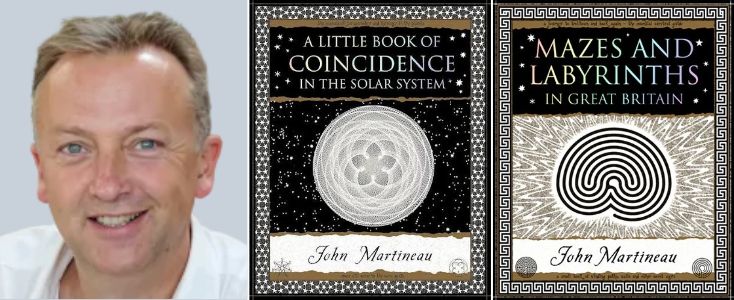
John Martineau is the founder, editor, and award-winning publisher of Wooden Books, which has sold more than three million copies of its distinctive nonfiction books in 20 languages since 1999. He’s also the author of the bestselling A Little Book of Coincidence: In the Solar System.
You can listen above or on your favorite podcast app or read the notes and links below. Here are the highlights and the full transcript is below.
Show Notes
- Why Wooden Books publishes pocket books on subjects that never go out of date
- How a pound on the price and foil on the cover tenfolded sales
- Building a team of editor-designers who all earn the same hourly rate
- Printing in India rather than China, and why 500 copies is the most horrible number
- Why over half of UK sales happen in a dozen shops
- The best time ever to start up as a publisher
You can find John at WoodenBooks.com.
Transcript of the interview with John Martineau
Jo: John Martineau is the founder, editor, and award-winning publisher of Wooden Books, which has sold more than three million copies of its distinctive nonfiction books in 20 languages since 1999. He’s also the author of the bestselling A Little Book of Coincidence: In the Solar System. So welcome to the show, John.
John: Thanks, Jo. It’s really nice to be with you today.
Jo: Yes. I am so interested in everything you do. First up—
Tell us a bit more about your background, how you got into publishing, and what kinds of books you do.
John: I did a philosophy degree at university, which I think was the beginning of the problem. You come out after a philosophy degree really wondering what to do with your life. I nearly became a tree surgeon. I did all sorts of things.
Then I did fall into publishing some ideas that I had. I was fiddling around with books, and finally went off and did a master’s degree at the Prince’s School of Architecture, as it was back then.
I published my thesis there at the end. I published 2,000 copies of it, which was about geometry and harmony in the solar system, and the book just sold out. I thought, “Crumbs, this is really easy. I’m going to be a publisher.” So that was the beginning of the second stage of the problem, really.
I then discovered the hard way that it’s not that easy, in fact, to make money in publishing. The business went through some convulsions, which I can describe to you if you want.
Jo: Well, just before we get into everything else, just—
Explain to people who might not have seen your books, what kind of things do you do?
Because I think you have managed to stay in a lane, but a pretty broad lane.
John: Yes, that’s right. When I finished my master’s degree at the Prince’s School, we’d been schooled in what’s now known, I suppose, as sacred geometry. Geometry and harmony, the Renaissance arts, the liberal arts.
I looked around and I thought, there’s no one really operating in this space at all. Then one night I had a vision to set up as a publisher and do this properly, and to specialise in very small works packed with information about subjects that wouldn’t go out of date.
So that was baked in from the beginning, because I suppose we’d been taught at the Prince’s School about the idea of the perennial philosophy, and that there were at its core subjects that just never really date. The meaning of numbers, rhetoric, logic, harmony, aesthetics.
There are a lot of subjects at the core of the arts and the sciences that evolve very, very slowly. So I thought, “Well, if we can make pocket books on these subjects,” which no one was really doing at that time.
There was something called the Art and Imagination series, edited by Jill Purce for Thames & Hudson. They were large format, like A4 books. I thought, “Well, some sort of miniature version of those that you carry in your back pocket might be a good idea.” I set about designing the series then.
I wrote the first one myself, which was Mazes and Labyrinths in Great Britain. A friend wrote the second one, which was on ancient British rock carvings. Then I wrote the third one myself, which was on the harmony of the spheres, that old idea.
Then slowly it began to evolve. At that time we were publishing hardbacks. They were small hardbacks, 64 pages, black and white only, lots of white space, and I wrapped them in a kind of brown wrapping paper. They had these very simple covers. They were very, very aesthetic. They were priced at £6.99.
I was printing in the UK, and they just didn’t really sell very well. I kept on going, though. They were really beautiful objects. Everyone told me how beautiful they were, and they were quite lovely, but they didn’t really sell.
I carried on like that for a few years until eventually the money ran out, and I started to wonder whether I, in fact, should have become a tree surgeon after all.
Then I sold my house and I moved to Glastonbury, where I had a lot of friends, feeling a bit of a failure, really.
As a last attempt to make a go of it as a publisher, I came out of printing expensive hardbacks, with what was then a seven times mark-up, I think I was going for. Five, six, seven was the best I ever got. And I moved to these little paperbacks with a 10 times mark-up, or even 20 times, later, on the production costs.
I redesigned the covers. I spent ages redesigning the covers for this, the same covers pretty much as today. I had some advice on that from Nick Robinson, who owned Constable & Robinson at the time, and who I’d met at a book fair.
I’d been lucky as well in that I’d sold foreign rights quite early in the series to what was then Walker & Company in New York.
A man called George Gibson, a really excellent fellow, had spotted our books in the Science Museum who’d always supported us, and the British Museum, who’d always supported us as a small independent UK publisher.
He liked them a lot and bought the US rights to the series, and it was actually that that kept me afloat in those years. He’d introduced me to Nick Robinson. I went to Nick Robinson just as it was all getting a bit washed up, and I said, “What would you do with this if it was yours, Nick?”
He had some ideas for the covers, which I then implemented. Then with his advice, and various other people’s, we got the covers right.
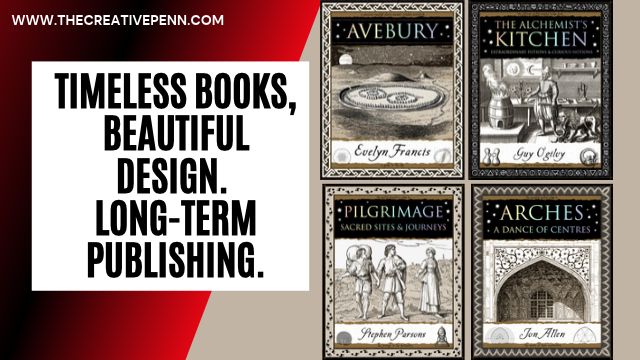
The test book for us has always been our little book on Avebury, which sells at Avebury. I tried all kinds of different editions of this book. We had the hardback one. We had a £3.99, very cheap paperback of exactly the same book with a very plain cover.
Then eventually we put the price up to £4.99, and we put this rainbow foil on the cover with more black and brown, and we saw a 10 times increase in sales on exactly the same book. So we put the price up a pound and spent money on the cover, and our sales tenfolded.
I think that’s when I realised that the cover’s quite important.
Not as much as what’s in it, but particularly with gift books. Really, from that moment on, the company became what it is today, as a slowly growing list of, I hope, timeless books.
Over time as well, our information density has increased, I’d say. The books are more highly edited than ever. We pack more into the space than we ever have.
We specialise in miniaturisation and the idea that the books reward rereading and function in some way as a very small reference book, actually, as much as a read. They are little reference books that you can go back to when you need the information.
Jo: They are brilliant. It was so funny you mentioned Mazes and Labyrinths. I have the Labyrinths one, and I’ve got the Avebury one. I’ve actually got quite a lot of your books, and that’s why I was so thrilled when I heard about The Story Book. Amy was on the podcast, and by the time this goes out, her interview will be out.
So to talk to you is a real joy, and there are lots of people listening who love learning. I feel like your books are just so brilliant for people who are obsessed with learning about weird things, like you said, the harmony of the spheres, or you have all the various architecture things.
There are so many interesting topics that you cover, and I love this because it’s almost like you’ve used your interesting fascinations as a person. But how do you balance that? Because obviously you’re interested in so much, and the brand is strong around the topics, not just the physical design.
When do you know that it’s worth doing a book, and when do you go, “No, that’s just too niche,” or, “Not in my lane”?
How do you make those decisions as a business?
John: With some difficulty, but also with a very open mind. Not all books that we publish, we publish expecting to make money. Some of it is simply because either we think a book’s worth doing in itself, or at other times we pick books that we’ve decided we need to fill the gap.
I’m just looking through the list of books we’ve got coming up. We’ve got quantum theory, mathematical tilings, Kabbalah, songwriting, a book on the line. See, that might not go very well. The line in art. Ancient games, meditation, memory, financial mathematics, the art of war, megalithic Malta.
Megalithic Malta’s never going to sell, but I love megalithic Malta. I’ve been to Malta a few times. And then there’s animism. So you’re right. There’s a real blend of things that interest me that probably aren’t going to interest very many other people. Our list is a good mix of esoterica and science and maths.
Our weak spots are probably geology, geography, and biology. So those are our weak sciences. We don’t cover religion as such. We’re doing books on gods. We’ve got a nice one on the Greek gods, Pantheon by Pippa Lewis, which is a lovely book. And we’ve done Norse Paganism, which covers the Norse gods.
We might do the Indian gods, but we haven’t really got into religion as such, mostly because I don’t know how to handle it editorially.
We’ve got six coming up on lore, and we’ve probably got another six coming on psyche, emotions and things like that. We tend to think in sixes as well, because when we get six books that fit very well together, we’ll bind them up into one of our larger books, like Amy’s Story Book.
In fact, Amy’s book was unusual in that it was the first book we’d ever designed to be a sixer from the start by a single author. We are doing more of those now, actually, but Amy’s one was the first one.
In the past, we’ve tended to combine six books that weren’t ever meant to be together into a single book. So we did the Trivium and the Quadrivium. They were logical. Quadrivium‘s probably our best-selling book at the moment globally.
I wish I’d planned it more carefully at the beginning, but it’s fun. I still absolutely love it. It’s a fantastic job, and you learn as you go.
Jo: That’s the most important thing. I think finding it fun is still really good, and also profitable, so presumably it is profitable.
I did want to ask you about that, because the books are very heavily designed, beautifully designed. Not just the cover. So you’ve mentioned the cover, but there’s also the interior design. So to me, they look more expensive.
If we think about people listening, like myself as well as a small publisher, we often do a lot ourselves. We might work with freelancers to do design, and it can be expensive to do this kind of thing.
How do you do the various team elements? Because obviously you can’t do everything yourself, right?
John: No, I don’t do everything myself. I can do everything myself, because we are a small press and it used to just be me, so I know every bit of the publishing cycle.
Over time we’ve assembled a really cool team, mostly of friends, and most of those people are editor-designers all in one. At the moment we’re recruiting, actually, trying to find a few more people, because our backlog’s growing.
So really important skills for working on our books are that you need to be really confident at editing text, you need to know the subject that you’re editing, or at least be prepared to really research it quite deeply, and you need to be a good designer, all in one. Not everyone’s got both those skills.
In fact, I’ve just been interviewing only yesterday, and I’ve got another interview tomorrow, so we’re closing in on a few people who maybe have these skills. Almost everyone we interview tends to be biased either towards the visual elements, the graphic design and layout, or towards editing.
Finding people that have got both those skills and are confident in both those skills is really, really difficult. I think we could have more people, but at the moment we’re four or five, I would say. Everyone works whenever they like. We’re not deadline-driven. We don’t crack whips.
If books don’t make it, they don’t make it. So it’s quite a relaxed company. Everyone gets paid exactly the same hourly rate, whether they’re at the bottom or the top, which is a Scandinavian model.
It’s a lot of fun. It really is. We all get together a couple of times a year. People come and work in the office for a week or two and then disappear. In the old days in Somerset, everyone was in one room, but that’s gone now. So it’s a lot of fun.
Jo: So it’s interesting, you started out in 1999, and you talked there about how you ran out of money at one point.
What’s so interesting with small presses, both here in the UK and in the US and all over the world, I guess, is that most small presses don’t make it as long as you have. I’ve been an author for 20 years. Most authors don’t make it either.
So what are your tips for longevity in a publishing business?
John: I don’t know if they’re translatable tips, but I can go through why I think our books sell and have carried on selling.
First of all, it’s that thing I said at the beginning, that we chose to publish books on subjects that wouldn’t really date.
So if you look at our books on, let’s say, comedy or mathematical curiosities, the content in them isn’t very different to a book on the art of comedy or mathematical curiosities 20 years ago, 30 years ago. We set out from the outset to produce books whose content wouldn’t date.
Then to add onto that, we chose fonts that were already very, very old. We used Trajan on the covers, which is on Trajan’s Column in Rome, 2,000 years old. We used Bembo, a very old font, hundreds of years old. We don’t use any photographs. We only use 19th-century illustrations that are already old.
So everything about our books is pre-aged. The material we’re dealing with is timeless. It will continue to be, we hope, as true in 100 years’ time as it is today. Our design, we hope, won’t go out of date. It’s very simple. Our typefaces won’t go out of date. So the entire product is designed not to date. That is very, very important.
We’ve also got an aesthetic that is our own, and that we increasingly adhere to. I think we’ve felt our way towards this slowly, but we’ve got an aesthetic. It works. It’s not rocket science. There’s nothing complicated.
There’s almost nothing trendy about what we do. We’re almost anti-trendy. If something’s a passing fad, it’s not going to be for us. We’re simply trying to make something timeless.
We do relatively well in Japan. Our overseas markets that have done okay are Japan and the Czech Republic. Probably those two are our main two that we’re still alive and kicking in. We’ve been in lots of other markets, and we still are, but those are our two real backbone overseas markets.
I did ask our Japanese publisher, Sogensha, when I met them at the London Book Fair one year, why he thought our books went down so well in Japan. He said, “The Japanese love very small, well-designed things.”
Jo: Very beautiful things.
John: And so I think we’ve done well on that front.
We’re very, very badly marketed. We don’t have a marketing department. We’ve simply based our business on our relationship with the outlets, with shops. We have a really good team of reps.
We use Signature in the UK. In America, we’re using Red Wheel Weiser at the moment. Our main emphasis is on getting our books in front of people, and if they like them, they’ll buy them.
So getting those outlets right and getting our point of sale right. They’re essentially gift books. We sell many more books in shops than we do online. Amazon’s probably only about 15% of our sales. So it’s an interesting model. It’s not going to work for every small press, but it will work for some.
Jo: I think that’s fascinating. Well, one of the things I was interested in, looking at your online shop, I know you said that’s very small, but you do have these options like make your own box set with lots of the little books, for example, where customers can select what they want to include.
While that is very cool, you also have this huge backlist of different titles, and I was just thinking, goodness—
How do you do management of printing and fulfilment with such a big backlist?
Most of us indie authors, we use print-on-demand, or we do print runs for, say, a Kickstarter, and some authors now have warehouses, but it just becomes this big nightmare when you have a bigger backlist.
So how do you manage your printing and fulfilment, and even, I guess, with the stores and things? Because you can’t sell every title in every store.
John: No, you’re not selling every title in every store. I think there are a few places that do try and do that, but they’re pretty thin on the ground. So mostly we’d have a pack. We might have a music pack or an art pack, and outlets that suit those titles will take those.
Yes, it is quite a lot to manage. In the early days, when we printed in the UK, we printed with the Cromwell Press, and they went bust in the big meltdown in 2008. At that time we were probably printing 3,000 copies each print run. Then when the crunch came in 2008, our distributors went bust as well around that time.
We went to Frankfurt. The Frankfurt Book Fair is highly recommended for anyone that’s never been to Frankfurt. It is quite daunting the first time you go, and then you start to enjoy it.
It’s a really, really good way to solve a problem in the publishing world. Any part of the publishing cycle you need help with, there will be people there that can help you with it.
The first time I went to the Frankfurt Book Fair, I met some very nice Chinese printers who had a very small stall, and they were hoping to pick up some work. They managed to match our paper exactly. They matched everything. It was incredible. They did a really, really good job. No one’s ever managed to do that ever since.
We started printing with them, and the price was so much cheaper than we’d been paying in the UK. I mean, we couldn’t print in the UK. We didn’t really want to print overseas, because we’d had this eco logo. We were printing on recycled paper back then, and we had very low shipping.
I didn’t really want to do it, but I couldn’t see any way of carrying on without printing overseas. Even the pulp mill that had made our paper in the UK had gone bust in 2008. So we moved over to China and got these incredible prices.
We got quite lazy, really, because the difference between our cover price and our print cost was really quite large at that point.
Slowly the prices went up in China, and the Chinese Communist Party as well started to try and interfere with what was in our books, which wasn’t much fun, and we were told what we could and couldn’t print. So we pulled out.
Now we’re printing in India. The interesting thing about printing in India that’s different from printing in China is that the price per copy for 2,000 books is the same as your price per copy for 3,000 books, and that means you can print in smaller numbers. So you can print more often in smaller numbers.
In India, it just seems to have a different model. Or different printers in India have different models. It’s working very, very well for us.
One of my only full-time employees here, who comes in regularly, is Bex, and she does production. All she does is stay on top of our American stock, our UK stock, our New Zealand stock, and our Australian stock.
She makes sure all those different warehouses have what they need. If stock’s getting low in any one of them, then we will activate a print run in India, and the books will get sent out to the UK or the US. It’s from the UK that we then supply Australia and New Zealand.
Jo: Do you do any digitally at all?
John: We do do some digitally. If we’ve got books selling, let’s say, 50 to 100 copies a year, we will print them digitally, but digital costs so much more. Certainly printing in the UK, I find digital is so much more than printing litho still, that you just don’t really want to do it if you’ve got any volume at all.
There’s always been that awkward number, which is 500, and 500’s the most horrible number. 500 copies is just horrible. Whichever way you do it, it’s going to be really expensive. It gets cheaper at 500 when you’re printing digitally, but it’s more expensive in litho. So if you’re in the 400 or 500 unit print game, you’re probably still better off digitally.
Once you get to 1,000, certainly once you get to 2,000, you’re much, much, much better off printing litho, particularly if you can find the right printer in India or in China.
Jo: That’s quite funny that you answered that way, because when I say digitally, I meant—
Do you do ebooks or audiobooks?
John: Oh, that’s what you meant. We do. We have released ebooks. We haven’t done any audiobooks yet. Although the idea of doing Amy’s book as an audiobook is brilliant. I think that was your idea.
Jo: I did say to her, “Are you going to do the audiobook?” Well, obviously we’ve got podcast listeners, lots of audio people listening, and we all want audiobooks as well as print books.
John: We’ve got to do it. If any book we’ve ever done would suit that format, it would be Amy’s book, because we’re very thin on diagrams in that book.
It’s all about the content, and we’ve got all these passages extracted from classic works of literature, which would lend very, very well to being recited by someone with an excellent voice.
So the whole thing, it’s a brilliant idea, and in fact I think we will look into it. It’s a really good idea. Thank you very much.
Jo: Oh, good. Well, that’s wonderful, because, as I say, I love it. I narrate my own books. I think it’s such a wonderful way. Also, it doesn’t eat into print sales. It really doesn’t. It’s very much an extra one. I often buy both, and I think it helps.
It’s like you’re going for a walk and you’d really love to hear about sacred geometry or story or whatever. So that could be a whole new business model for you guys.
John: It could. Well, I think we’ll start with The Story Book. I think it’s a really, really great idea, and see where we get to with it.
Jo: Yes, see where we get to. Now, what about the USA? Lots of US listeners are listening and wondering about how that works.
You mentioned there that you do have stock going into the US, so how does that work?
John: We used to sell our rights to Bloomsbury. So Bloomsbury USA used to hold our US rights, and that was a hangover from a deal we did right back at the beginning with Walker & Company, and Walker were great. I learnt the ropes, really, off the head of Walker.
George Gibson taught me a lot about publishing, particularly about editing, how to cut things down. He’d been the editor for a book called Longitude by Dava Sobel, that had been number one in nonfiction for years.
Jo: I was going to say, that was huge.
John: It was a huge book, and he’d really been the editor and guided that book through from its inception. So I was slightly in awe of him, and he was such a great mentor for me and really helped me develop as a publisher.
Later, when Walker were bought by Bloomsbury, Bloomsbury were looking to expand, and they did it out of the UK by buying small publishers in Germany and France and America, and Walker was the one they bought in the States.
So our list fell into Bloomsbury’s list there, and while George was at the helm, we kept on publishing with Bloomsbury.
Eventually, what I call the Sarah Maas effect really overtook the Harry Potter effect, and the fantasy genre came to the fore, and Walker’s old idea of publishing books on Renaissance topics was so not what they were interested in. George left, and the new lot at the top were really not interested in Wooden Books.
So I went through quite an interesting process, really, where I was trying to get my rights back, but they didn’t want to give my rights back, for obvious reasons.
The books weren’t doing very well, so I just put it in my diary. On the first of every month, I would phone up and annoy someone at Bloomsbury for as long as I possibly could about getting my rights back.
It basically worked. After about a year and a bit, they just got so fed up with me that they gave me my paperback rights back. Since then, we’ve set up in the States as our own American publisher in paperback, same as in the UK, because Bloomsbury had only been publishing in hardback.
That’s been going okay. I don’t think we’ve cracked it yet in the US. We still haven’t quite reached those outlets we really need to get to, which tend to be gift shops for us, more than bookshops.
We’re under steam now and making significant progress, actually. It’s a huge market, and our books, I’m sure, will find their readers slowly.
Jo: It’s interesting. You mentioned earlier about the Science Museum, the British Museum, and there are lots of bookstores in these various small museums around the US as well as the UK, and I feel like it’s such a good match for the topics that you cover. Those are, of course, lots of smaller orders, I guess, and hard to manage.
Is that the kind of place you’re targeting versus the big Barnes & Noble?
John: Yes, absolutely. I think the big Barnes & Nobles are not for us. They can be, but our books are very small. They tend to get lost in bookshops, and particularly in the UK, bookshops don’t like taking your spinners or your publisher’s display bands. So we’ve had real problems getting in there.
Once they’re on a shelf, they disappear, because our books are so tiny. So they need to be really well displayed, and certainly Waterstones up to this point haven’t wanted to take our displays, which is a pity, because actually James Daunt, who put Waterstones back on track, was previously a great fan of Wooden Books.
He used to have a table of Wooden Books in his Daunt’s bookshops in London, but that passion for Wooden Books has not translated into Waterstones. So we very much rely on National Trust shops, museum outlets and outlet stores, exhibition spaces, and things like that. Quite niche, really.
If we hear, for example, that there’s an exhibition of Celtic art going up at the Museum of Scotland, as there was a few years ago, then we will try and get our Celtic art little pocket book put in there, which is an excellent little pocket book on Celtic art by Adam Tetlow, and that will sell out.
We’ll sell thousands of copies over the time of that one exhibition. When the British Museum had a Stonehenge exhibition recently, we went in with some of our stone circles books and did very well.
You have to keep on top of it with these little stores, but then again, that’s what a really good repping team does. So I don’t do very much of it. It’s all done for me by the amazing Jim Sheehan and his team at Signature, actually.
So the distribution is really key for a small press. If you can get into even a small number of the right shops, it can sometimes be a handful. To put things into perspective, I would say over half of our UK sales are done in maybe a dozen shops, which is quite extraordinary.
Jo: Yes, that is. I was just thinking, before the pandemic, I used to go to the Wellcome Collection in London. I think I bought pretty much all of that bookstore’s inventory over the years when it was running. When it came back after the pandemic, it was a completely different bookstore.
That’s an example of one that had a lot of medical stuff and weird books, and I’m pretty sure you had books in there at the time.
John: Yes, we did. They used to stock us. I’m not sure if they still do. I don’t think they do. I haven’t heard anything about them from Jim for some time, but we did used to have a really good display there. One of our better London outlets at the moment is the Saatchi Museum. So we move around.
I was in America recently and went to the Getty Museum in LA, and there we were. As you came in the door, the first thing you saw was a wall of Wooden Books. So really, the American reps have done a really good job there, and they are great.
There were even people looking through them. It’s always a good feeling when you can see this thing that you’ve been slaving away on, thousands of miles away, and then there it is. People photograph stuff and send it to me, bookshops in Japan and Greece, South America, wherever, and it’s always great to see them out.
It does remind you that the pen is an incredible thing to this day, which you will know all about, Jo, that being your name. But the pen is mightier than the sword, and you can really reach a lot of the world through books.
Jo: Absolutely. Well, obviously, we all love them here. We’re all book buyers.
It’s interesting, because you said to me earlier, before we started recording, that you don’t do much marketing, but it seems like the distribution service you use does. Obviously they get a cut of sales.
They do it through targeted placement and events that suit the books. That in itself is marketing, right?
John: It is, absolutely. So they will know what exhibitions are coming up and get in there. A good sales team is magic. We’ve just been building up our Instagram presence as well. We are doing that.
I don’t know how many people would buy one of our books when they see a new Wooden Book coming out, so I don’t really know there’s a great rush to Amazon when people following us see, “Oh, they’ve got a new book on this or that.” I don’t think that’s the way it works.
I think people wander into a bookstore or a gift store and they don’t really know what to get, and they haven’t got a huge amount of money, and they see a really small, lovely little pocketbook with a nice little bit of rainbow foil on the cover, on something that genuinely interests them and they’ve always wanted to know about.
They flick through and they go, “Actually, this is quite packed with useful stuff.” Then they’ll take it home and read it on the tube, or leave it lying around and give it to a friend or something. So they very much work like that, I think.
I’m not sure we would do a whole load more business if we spent masses and masses advertising each new title, and we really don’t, actually.
Jo: No, but it’s interesting, because I hear what you say, and I completely think that your business model is fantastic.
I was literally on Instagram just before this. I had a few minutes before our call, so I went on Instagram.
These algorithms know their users so well, so they are very, very good at targeting with ads.
I buy quite a lot of special editions and beautiful books, so I get a lot of ads from specialist printers.
Literally just before this call, I don’t mind admitting to it, I spent £160 on a new edition of the Codex Gigas. The large Bible edition with an image of the devil in it, which I wrote a book about a few years ago. I was like, “Okay, that’s crazy.” But my book brain was like, “Ooh, I really want it.”
John: Right. Okay. We’ve got to get onto it. That’s incredible.
Jo: Yes, it is. Because if you’re a book person, it’s catnip, right? If you do very specific things and you put a new book in front of me that is on sacred geometry or something, I’m going to be, “Hell yes. Give it to me.”
John: Yes, that’s really interesting. See, I’ve got a book. I was commissioned earlier this year to write a poem for a hand letterpress. A friend in Glastonbury runs a hand letterpress, a really sweet little press, and he commissioned a poem off me.
I’ve written this poem, and I’ve done all the illustrations for it. It’s all now been printed, and it’s now being hand bound. He’s going to bind them in three lots of 81 copies. So it’s not very many.
He’s going to sell them for £150 each, and I’m like, “Thomas, surely it should be more than £150, with all that work?” That’s less than one etching from inside the book. They’re all hand-printed in the etching kind of way. So it all seems very cheap.
That is a world I don’t know anything about, and he obviously does, and you do as well. So the impulse buys are for quite expensive, beautifully made books. That is a world I don’t know anything about, but I’m about to know more.
Jo: Yes, about to know more. Well, I think Kickstarter is a great place for that. Funnily enough, the printer who did this one, I had a look at some of their other stuff, and they have books there for over £1,000.
I was like, “Okay, that’s a bit of a stretch.” But there are some really, really fascinating, beautiful hardback editions. I’ve bought things like a new edition of Frankenstein with beautiful images. So I think it’s the same principle as what you talk about, as in books that don’t age, that people want to own in beautiful editions.
Also, I do think that people who love books like us, yes, we like the little paperback for £7.99 or whatever, but we have money for books.
John: Absolutely. I spend an insane amount of money on books. They just arrive in the post every day, again and again, more and more of them. Once a year I have to clear everything out. I’ve got to sell lots of them and go round with the app and go click, click, click. No, I’m not having that one.
So they come and go, but if they’re really beautiful, you tend to keep them.
Jo: Exactly. I feel like this is the way things are going as well, as there’s more and more digital stuff, and it’s hard to break out of that. Even in a store, there are more and more books in general, but these very special ones, where there’s a limited edition, can just hit a different market.
And like you mentioned, is it Quadrivium?
John: Yes.
Jo: Yes, that one. That one is fascinating. People listening, go have a look at these topics, and if you love learning, this stuff is really catnip. It really is. That has already got a beautiful edition. This Story Book as well, I think, is very easy to do as a beautiful… Well, it is a beautiful edition already.
I think books are so fascinating, aren’t they? They can go in all different formats and appeal to different groups of people.
John: Yes, they absolutely can. I think it must be the best time right now to start up as a publisher. I can’t think of a better time. All the different options available to you in printing and finishing, and reaching your market through social media.
None of those were there when I set up. There was really just the one way to print, the one model, really, apart from the hand letterpresses and the small presses.
There are now so many different routes to the market, to getting published, or to setting up as a publisher if you want to publish other people. It really is a whole new world, and it keeps on evolving. The technology keeps on getting better. My guess is that the short-run costs will come down again.
The machines keep on getting cheaper and cheaper. The old machines used these thimble spikes, didn’t they? A kind of spiky thing to make a virtual drum. That machine at the heart of the short-run press, the digital printing, was so expensive, and then they replaced that with, effectively, a bubble jet.
So most short runs now are done on, essentially, a new version of the bubble jet printer. So one can only guess at what’s around the corner.
The moment someone comes up with another way of doing it, the prices will fall and fall and fall. You can then begin to compete with really small budgets with the big boys. So it’s just the most exciting time.
Jo: Oh, fantastic.
So where can people find you and Wooden Books online?
John: Well, you can find us at woodenbooks.com, and you can read every page of our books online for free, which is something that not all publishers do.
Jo: Brilliant. Well, thanks so much for your time, John. That was great.
John: Thanks, Jo. Really great to be on your programme. Thanks for having me.
Leave a Reply