I’m getting into two new areas of publishing at the moment, intellectual property rights and also setting up a small press, so I’m on a steep learning curve. It’s a lot of fun and I keep noticing things that make me want to delve deeper.
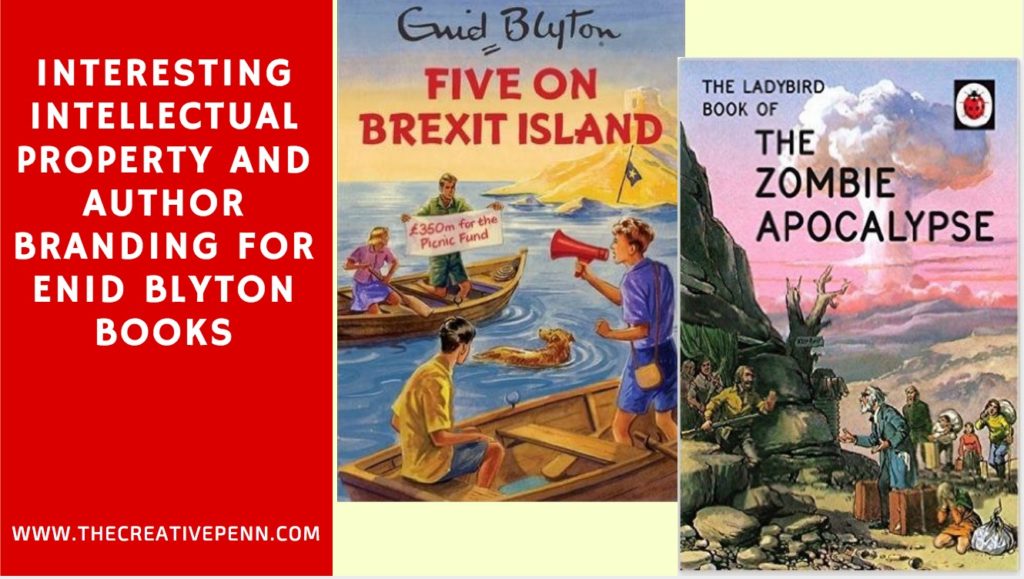 In the last few weeks, a whole stack of slim hardback books arrived on the lucrative end tables at Waterstones and other bookstores in the UK. The Famous Five and Ladybird books for adults are also dominating the hardback print charts.
But the Enid Blyton I read as a child (The Faraway Tree stories were my favorite!) would not have written Five on Brexit Island, or Five Go Gluten Free.
So the books raised interesting questions around copyright:
- Enid Blyton clearly didn’t write the books, but her name is on the front and her brand is being used to sell them. How is that benefitting the author’s estate?
- Her signature is used on the front. How is that protected?
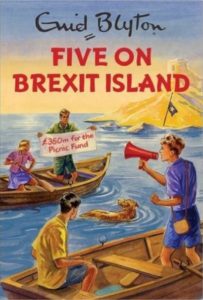 The books are parody content but the use of the name is not parody – so what is the copyright on using an author’s name?
- The Famous Five branding is used, as is the type of story inside and the characters, but it’s not for children. How is the world being used?
I checked the interior of one of the books and discovered that Enid Blyton, Enid Blyton’s signature and The Famous Five are registered Trademarks of Hodder & Stoughton Ltd. If you look very closely, there is a little black dot under the final ‘n.’ That is a tiny R symbol for the Registered Trademark.
The text is by Bruno Vincent but the text copyright is also with Hodder, which implies the author was commissioned to write in the ‘world’ of The Famous Five, but the books belong to the publisher.
Publishing houses have whole departments whose job it is to make more of the intellectual property rights they hold, and they have clearly done a sterling job with these. They are selling a truckload, making people happy for the holiday season, and exploiting the IP they own in fantastic ways. These books are the adult coloring equivalent of last Christmas season!
Are these books or products?
As I am currently setting up a small press, I’ve been thinking a lot more about products that people want to buy, as opposed to books I want to write. This is a mindset shift towards more of a commissioning editor, than an author, and something I want to play with in the coming year. I’ll still write the books I want to under J.F.Penn, but I’ll also be trying other things.
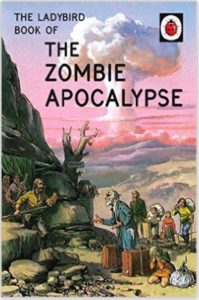 Interestingly, I’m not even sure these Enid Blyton Christmas books are meant to be read. They are more comedy gifts for bringing a smile to someone’s face as they open a present. They are products, merchandise for Christmas, not books to be treasured.
How can we apply these ideas?
Here are my takeaways:
- Over the long term, an author name becomes a brand – but only if they are known for one thing and consistently deliver on the promise to the reader. The author name resonates with readers and they will look at a book with that name associated with it, even when the author is long dead. If you start to think of your author name as a long-term brand, it can be a powerful shift.
- The signature of the author is used on the cover – and has become a trademark in itself. Perhaps instead of using a standard typeface on our book covers, a signature could be used, which in itself could become a trademark/brand in the future. I’m considering this myself, although my actual signature is a mess!
- Consider what people want to buy as well as what you want to write. In 2017, I am intending to get into some interesting print products, like premium journals, since I buy a ton of them and love them as products. There is little point in me trying to get my thrillers into high street bookstores, but I may well try to get gift style books in as that’s actually what people buy and can make more money for the bookseller. After all, if you want to get books into bookstores, you have to consider where the money is for the bookstore.
I’ll be doing more on intellectual property and small press stuff as I learn more about it. Do you have any other examples of interesting use of author IP or books that are products? Please do share in the comments below and join the conversation.