OLD POST ALERT! This is an older post and although you might find some useful tips, any technical or publishing information is likely to be out of date. Please click on Start Here on the menu bar above to find links to my most useful articles, videos and podcast. Thanks and happy writing! – Joanna Penn
People often ask me about how to be a successful indie author, or what's the best way of marketing. I seem to be replying in the same vein every time these days – it's all about collaboration and about personal relationships.
 I have a team of people I work with in my business. I have editors, a cover designer, an interior book designer, a graphic artist, a transcriber, a book-keeper, outsourced contractors for specific projects, a creative mentor, a community of twitter & blog friends and many more. Without these, I would not be able to do what I do. This is also why I self-identify as an indie author, NOT as self-published, as I am far from doing it all myself these days.
Today, author Bruce McCabe reiterates the importance of concentrating on people. His indie-published debut novel, ‘Skinjob,’ has just been acquired in a two-book deal with Random House.
I’ve been privileged to spent most of the last twenty years hanging out with people vastly smarter than myself – inventors, mavericks, scientists and innovators. Here’s a lesson from these wonderful people that I’ve found helpful on the writing journey:
It’s always about the who.
By which they mean the most important success factor in Silicon Valley is not the earth-shattering idea, nor the technology, nor money, nor access to resources, nor a myriad of other things, it is the composition of that core group of people, often very small, who truly believe in a goal and are emotionally dedicated to bringing it to fruition. Good teams care. They roll up their sleeves and get things done, take bad ideas and remake them into something worthwhile, find resources where there are none. When good teams fail they pick up the pieces and start over. Good teams, eventually, break through.
The corollary being: put most of your time into getting the who right and the rest falls into place.
People are your best investment.
Obvious? Maybe. We all know the world’s most dedicated and talented people can only get so far on their own. But it’s also true that our natural human inclination in any entrepreneurial activity is to spend more time on the what: the designing, planning, building, selling and marketing.
We sometimes have to remind ourselves to invest more in the who.
Here’s a question for Indie-authors: on your long to-do list of activities and plans and pathways to getting your next book to market (What PR should I do? What e-book platforms do I target first? What cover styles stand out? What price should I set? Etc) Does a question like “Who do I get to do X?” go automatically to the top of the list? Does it carry the importance of a multi-year investment? Or is it just another line item?
Here are some of the benefits, to my mind, of making who the priority:
Writing is no longer ‘solitary’
The objective is to write the very best novel you can. No one can write it for you, so at this stage at least, it’s all down to you. Right? Wrong. For most writers, a novel requires years of dedication to complete. The friends, family members, fellow writers and trusted test readers who understand, support and encourage you are critical to sustaining your energy. The who helps remind us that even at this stage there’s a team, and if you want to make the finish line, nurturing these relationships has to be the best investment you can make.
The publishing world simplifies
Value-judgements between self-publishing and Indie publishing and traditional publishing disappear. You stop worrying about which model is ‘right’ or ‘best’ or ‘will win’ when the goal changes to working with the most wonderful editors, cover artists, typesetters, etc available to you who believe in your books, and you expect your team to grow and evolve. So much simpler! So much less angst! In an industry re-inventing itself amidst the complexities of digital disruption and opportunity, that helps!
The economics become less critical
Effective teams share risks and rewards and are committed to the same goals, which means it’s good to share and you want others making money from your books. The focus settles firmly on who is on the team, not what dollars they may or may not earn. With terrific people, you win. By extension, you stop spending time calculating the finer economics of different distribution channels. If one does a better job reaching your readers, that’s what matters.
Recognizing your team is unique
Every book is different, when means every team is different, which means we all have the job of differentiating pretenders from our loyal allies. My mistakes illustrate!
I started marketing by reaching out to hundreds of reviewers and journalists and bloggers, but spun my wheels for weeks achieving precisely nothing. Then, after a few surprise successes, I followed up to establish where each one came from, and discovered every mention – every interview, review or recommendation – came via a loyal reader. A sharp reminder to stop chasing journalists and put the time into book groups! I also discovered my most powerful reader-advocates were bookstore managers. Ouch! Hadn’t I followed advice to the contrary? Leave bookstores alone? Too much effort, too little money? Put ’em last on the list? Now I did the opposite. These wonderful people cared. They were passionate. I hand delivered to as many as I could manage. In my case at least, they became critical members of the team.
It’s only a way of thinking, of course, but it’s nice to share it. In a rapidly changing and sometimes very confusing industry, I feel that focusing on the who has given me clear signposts at every junction on the writing journey so far.
What types of people make up your team? How did you find them? How do you work with them? Please leave a comment below and join the conversation.
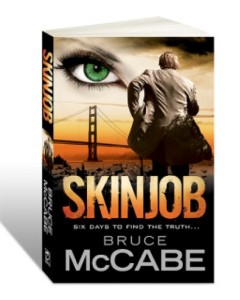 Bruce McCabe is an an incorrigible explorer, entrepreneur, writer and speaker who is passionate about people and the future.
Read more or buy Skinjob on Amazon here
Book page: http://www.brucemccabe.com/books/
Author site: http://www.brucemccabe.com/
Top image: Flickr Creative Commons Rope weave by Seldom Scene Photography

Leave a Reply