OLD POST ALERT! This is an older post and although you might find some useful tips, any technical or publishing information is likely to be out of date. Please click on Start Here on the menu bar above to find links to my most useful articles, videos and podcast. Thanks and happy writing! – Joanna Penn
An author at a conference recently asked me for tips on publishing on the Kindle and then said that he didn't actually read books on digital devices.
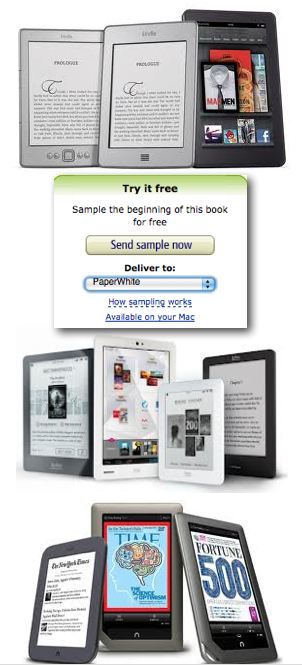 I was kind of gob-smacked because how else are you going to know if there are problems until you start getting 1 star reviews?
When you publish a print book, don't you buy it immediately to test the process and the quality? So why not do the same for ebooks?
If you're going to digitally publish, I believe you should own an e-reader, even if just to test how your book looks. They aren't expensive anymore so there is no excuse.
It's also important to understand how ebook readers shop, because they are the high-volume readers, the ones who will make up the bulk of your digital sales.
How do ebook readers shop for books?
I read around 95% digitally, on a Kindle Paperwhite and through the Kindle app on my iPhone. I don't own every device but I certainly test the .mobi format on Kindle and the ePub format on my desktop reader and my iPad and iPhone. I am also a voracious reader, getting through 3-5 books per week, more on holidays. Not having a TV helps!
This is how I shop:
a) I hear about a book on twitter, or I see one at a physical bookstore, or see a review somewhere, or find something I like in the Amazon store Top rankings for categories I like. I surf for fun in the Last 30 Days area.
b) If the book is available as an ebook, I download the sample right away and put it into a collection marked Samples. If the book isn't available as an ebook, 99% of the time I won't buy it unless it is an author I am committed to. I have other Collections on my Kindle marked ‘To Read' which are books I have bought but haven't started yet, “Reading” for ones I am reading now and “Make Notes On / Review” for those I want to revisit to write notes on or review on Amazon & Goodreads.
c) In between books I am currently reading, I go through my samples. If I make it to the end of the sample, I will usually buy the book because I am hooked. If I don't, I delete the sample. No sale. I usually give a book 3 clicks of my Kindle before I delete it. Harsh, maybe, but life is too short to read books that don't call to you.
So your marketing efforts, your book cover, your book description and reviews have helped your book get this far, but it is the sample that leads me to buy. I probably delete 60-75% of my samples so I have a harsh approach, but I don't think I am an untypical example of a high volume ebook reader (although if you are one also, I'd love to know what you think in the comments!)
Make sure your sample makes the reader want to buy
Your book has to start with something that hooks the reader.
This isn't new advice – if you want an agent, the first page has to hook them, and readers of print in bookstores may browse the first page, but because there are so many ebooks available, readers are increasingly unforgiving if a book doesn't fit what they are looking for.
Here's some tips:
- Get into the meat as soon as possible. Put all the acknowledgements and extra stuff at the back, not within the sample. I was severely annoyed recently to download an Angela Carter anthology of short stories to find that the entire sample was an essay about her work and the stories didn't come until later. I looked for a better version.
- During the editing process, make sure you pay particular attention to what will hook the reader. If non-fiction, what is the problem you're solving. If fiction, why would the reader read on? What have you caught their attention with? What loops have you opened mentally that they must close?
- Make sure the formatting is excellent and easy to read throughout. I have deleted samples straight away when they start with coding errors. It denotes a lack of respect for the reader. This is why you need to test and curiously this has happened with more traditionally published books than indie. Seriously, one book was entirely formatted in Bold. Did no-one even check it? (Make sure this doesn't happen to you!)
- If non-fiction, DO include the table of contents. If fiction, your chapters don't really add anything so aren't so necessary.
What other suggestions do you have for improving samples? How do you shop for ebooks? Please leave your comments in the notes below.
You all are much nicer than I am. First thing I check is the Look Inside feature. The writer has 3-5 paragraphs to hook me with their storytelling and convince me they can write a coherent sentence. If not, I don’t bother with the sample. Being so picky doesn’t stop me from buying and reading 3 or 4 ebooks a week, but it sure does cut down on my DNF (did not finish) pile.
A thing I’ve noticed about Look Inside on Amazon. The display is utter crap. BUT, it does tell me something very important about the ebook formatting. If the displayed text is justified or has a font other than what normally appears, I know the ebook is broken and will not work properly on my Kindle(s).
Wow, this has been a great discussion on how we all purchase online. For me, the blurb and the reviews are everything. I’m not a big sample downloader because I don’t have the time for that and because I support mostly indie authors – I don’t mind investing a few dollars in a “maybe” book.
If I don’t like the blurb, I don’t even continue on. Even if it’s an author that I’ve read and liked. If I like the blurb and I’ve read the author – I will buy. If I like the blurb but it’s an unknown author then I take a look at the reviews. If the reviews are good, then I’ll buy. Occasionally this doesn’t work out for me and I have to stop reading the book – but more often than not this works for me and I am a voracious reader.
That’s good to know, Lisa. I honestly never realized how much readers might depend on the blurb alone. Thanks for mentioning that!
Thanks for a great post, and especially thanks for including nonfiction in this discussion.
I read both paper and e-book editions at the moment. I am very aware that I shop or browse for the two types of products very differently, no matter if they are fiction or nonfiction! Rather than look at reviews for e-books, I myself tend to look over friends’ suggestions on Goodreads. Yes, those are reviews, but I think they feel different since they come directly to me in my email inbox. With other reviews, like those on Kindle, etc, I just don’t have the patience to look around. With e-books I’m in and out of the shopping cart ASAP. I am not really into browsing online. Maybe that is a failing of the interface that the online book stores use right now. They just don’t work the way my brain does. (But that might just be me.) I usually know what I want before I even get to the shopping interface. Its something someone has told me to read or something I’ve seen in an article, or heard about on NPR.
I rely very heavily on the ability to sample, and like you I am VERY annoyed if the sample is nothing but notes, etc. One recent example: I was thinking of downloading Marc Twain’s autobiography. The entire sample was nothing but notes and prologues and documents…. I got so annoyed at turning the pages to try to figure out when the real book started that I gave up and thought, well, what the heck I’ll just look at it the next time I’m in a bookstore to see if I want to read it. In reality, though, that was more than a year ago and I have been to the book store dozens of times and never once gone to find that book. (I may never read it. )
For the paper editions I tend to be a lot less harsh. I’ll try all kinds of things from the library, and spend loads of time paging through things at the book store before deciding to buy. I do not know why this is… and one could speculate. But your posting has prompted me to ask around and find out how others shop or choose books so that when I get my book finished and out there I’ll be ready to address all kinds of shoppers.
Samples are so important and I buy both e-books as well as hardcovers the same way. I recently met a writer in my writers group who published her first book and did not do that and I tried to tell her how important it was. Being a traditional published author she left all her power up to the publisher and agent. Guess what? I didn’t buy the book. Another very good friend of my, (self-published) set her selling site up on Amazon so well that she included 6 chapters! I was so hooked I bought the book. As a reader, of both paper and e-books I like to know I’m getting quality before I plunk down my hard earned cash. Makes sense to me. Anyone who doesn’t do this is missing out on sales. Thanks for the post
I completely agree–samples are a MUST for me. It’s like standing in a bookstore–of course, you want to read the first few pages and see if the book is in a voice/style you’d enjoy. My process for buying ebooks is quite similar to yours. I buy print copies of books only if it’s an author I truly enjoy and know I’ll want to either read the book again or share with someone else. New authors are best checked out via ebooks (less commitment!)
I’m ruthless and glad to know I’m not alone 🙂 I sample on my computer before buying and do get annoyed at the long list of chapters that are simply numbers. Formatting is something I look at, but I’ve found lots of problems there with the trad publishers as well. It’s a signal, as you say, that I’m not important. Font doesn’t annoy me because I can change it on the Kindle, as well as the background color.
I also take it another step. If I get to page 100 and can’t tolerate how the work is unfolding, I return the book. There is never any question about my returns and it’s instant. I don’t know if this is because I’m such a high volume buyer, or just the way Amazon operates. I’ve even called them and asked that my free book for the month as a Prime member be removed and another free book offered (I had to haggle on that one, but they looked at my purchase history and caved).
I’ve lost my tolerance for bad writing, or putting effort and skill in the book’s “hook” and not following through. The sample is important, and you offer excellent suggestions for de-cluttering the sample, but authors need to know Amazon’s policy of extreme customer service as it extends to returns. There’s just no way to escape writing a good book from start to finish.
You are so hardcore Cyd but I think this reflects how many people feel. I think I might start returning books that don’t deliver as well – I should have returned Umberto Eco’s. I felt so hard done by and it was expensive … as authors, it is a great reminder to always deliver on the promise of the book. Obviously we won’t please everyone, but quality is so critical.
My family members always say that I am wasting my time here at net, except I know I am getting familiarity every day by reading thes pleasant posts.|
I am hardcore, but that penny has two sides. When I really like something, I give a well-considered review and do my best to promote the book. In fact, just above the email notification of a new comment on this post was an email from Amazon saying my review helped another reader decide to buy your book 🙂 As awful as it feels returning a book, the flip side is a smile of knowing good books do rise beyond pretty covers and aggressive marketing.
I am really late to this conversation, but it is very timely and I have learned a lot. I have graphic design, marketing, and advertising experience (was freelance for 16 years) as well as some publishing experience (helping others get published) so I am curious and have a question.
It seems most people are talking about how awful it is that they get the front matter in a sample and get little sample to read. How come people aren’t putting a “Sample” section at the front of their books and then front matter? I must be missing something if this isn’t an obvious solution. Front matter is great, but shouldn’t the industry adapt to the delivery model?
I am getting ready to release a “Sample” book to introduce the series, but I intend on putting a “Sample” at the beginning of each book because of the front matter issue. Should I not do that?
Thanks!
You’re not harsh, Joanna – I rarely give one click of the Kindle before deciding to delete a sample. Oh, but of course… you’ve read some of those samples, too, haven’t you?
You’ve missed a stage I go through (but I’m sure you do too).
My process is:
– Hear about a book or browse or read a review.
– Check the cover and title. If the cover looks bad I’ll likely go no further.
– Check the sample.
There are a few authors who skip this stage and I buy sight unseen, but maybe only a dozen.
Interestingly I’m reading a book at the moment through Goodreads from a well-known author and he wouldn’t have gotten me beyond the first page of the sample either.
At the moment I don’t have the budget to buy a kindle or an e-reader so it would be great if you added to your article you can download e-reader software to view your own self -published books on the ordinary PC. Unless you feel they don’t work? If so I will have to test my book elsewhere.
I published my first novel and had the formatting done by a professional. He put all the chapter numbers at the beginning of the book and I wondered if that was really important. Now after reading your post I realize my gut instinct was right. I don’t need those chapter numbers at all!! Just like I thought. How often do I even go back to a chapter in a novel Em reading anyway? Almost never. Thank you for bringing this up. Sometimes I need a professional to tell me what I already know. Confirm it so to speak. I also read in Writers Digest of a writer who put her chapter numbers in the back of the book instead. Thanks for the post.
Brighid – Joanna is absolutely right at the beginning about maximising your sample on the novel. Golden rule is non-fiction always has a numbered chapter page in the front matter, but fiction doesn’t. But your eBook version does need a Table of Contents (TOC) so readers can tap around the chapters as in most instances any page numbers disappear when formatted for the reader device. More and more indie writers now put traditional front matter like author bio, other books, and contents etc at the back. Digital publishing, marketing and promotion is rewriting all the old publishing and book design rules, that’s OK, embrace it happily.
This all makes so much sense. I wonder if my formatting professional can move the stuff in the beginning of my ebook to the back since its already published. Do you know if this can be done by simply copying and pasting to the back on my own or would that ruin the formatting?
Yes Brighid, your formatter can definitely do that – not by copying and pasting as they will need to sort out the Table of Contents, but it’s not hard. Or try Scrivener for DIY.