Podcast: Download (Duration: 45:51 — 37.4MB)
Subscribe: Spotify | TuneIn | RSS | More
How can you use AI to research, edit and handle admin and marketing tasks while still writing every single word yourself? How can you double down on being human and reach readers on a personal level? Anna McPhee shares her perspective as a software engineer, author and creative technologist.
In the intro, How to Write, Publish, and Market Short Stories out now.
This show is supported by my Patrons. Join my Community and get articles, discounts, and extra audio and video tutorials on writing craft, author business, and AI tools, at Patreon.com/thecreativepenn
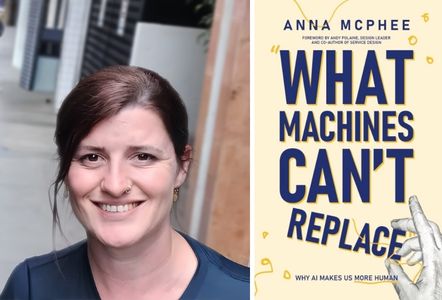
Anna McPhee is an author, software engineer, professional speaker, and creative technologist. Her latest book is What Machines Can't Replace: Why AI Makes Us More Human.
You can listen above or on your favorite podcast app or read the notes and links below. Here are the highlights and the full transcript is below.
Show Notes
- Why writing code is creative work, and what it shares with writing books
- How AI changed Anna's job as a software engineer without taking her employment
- The difference between AI assistance and generation
- How to use custom skills for editing reports, research and repeatable tasks
- Why the rise of AI makes us crave slow, imperfect, physical things
- Responding to a negative review by showing up as a human
You can find Anna at Anna.kiwi and her new book at WhatMachinesCantReplace.com.
Transcript of the interview with Anna McPhee
Jo: Anna McPhee is an author, software engineer, professional speaker, and creative technologist. Her latest book is What Machines Can't Replace: Why AI Makes Us More Human. So welcome to the show, Anna.
Anna: Hi, Joanna. Thank you so much for having me.
Jo: Oh, this is going to be a fun conversation. First up—
Tell us a bit more about you and your background in technology, as well as how you got into writing.
Anna: I have been in all of these things my whole life, as long as I can remember. When I was just a little girl, writing was my favourite thing, writing stories. It was the whole reason I went to school, to be honest. I always pictured myself as a writer before anything else.
My dad was a lecturer in software development, so when I was little, he would teach me how to code. So I've always done both, for as long as I can remember, and my mum is an artist. That's been my upbringing, at the intersection of technology and art, and then writing is my own personal passion.
It's naturally flowed throughout my life. I've been in and out of some other careers and chased all the things that have made me feel interested and passionate, but writing has always been there in the background. It's something I do, whether it's been for a hobby or for a profession, so it's always been there.
Jo: But you work in software, right?
Anna: I do. I work in software, which came to me by chance. I set out as a digital nomad about 15 years ago now. I sold everything I owned and started travelling.
The way I thought I was going to fund this was through freelance writing, which I was very optimistic about. We all know now that's a very challenging way to make an income, especially when you don't have a background in it or a portfolio.
I did have this childhood background in software engineering and coding. So I set out to be a writer and travel the world as a writer, and actually what I ended up doing was building websites and writing software, because that's what people would pay me to do. So I fell into both at the same time through this chance I took.
Jo: I think sometimes people think that programming and software development and these more technical fields are not creative. My husband was a programmer for a long time, and essentially programming is a language.
Well, there are lots of languages, but you are creating in a language with computers, right? So is there that much difference?
How do you fix these two things in your mind separately, or are they the same thing?
Anna: They're so related. Many people might put writing into more of an art, and computer development and programming more into a maths or a science, but I just think there's so much creativity in writing code, in how you choose to structure things, in the language you select for something, the way you approach it.
It's very similar to writing a book, I think. I've found a lot of things that are very similar about it, to do with architecture even. When you look at the basics, some people might write a book with no idea where it's going and see where it ends.
It's the same with software. People might go into it and not have a plan. Most people will architect their software, or they'll architect their story in the same way. I think there's a lot of crossover between the two.
Jo: And there's editing, and doing the “does this do what I want it to do?” I think with software perhaps it's more obvious when something doesn't do what you want it to do than with a book.
Anna: Perhaps. Although with AI now, it's becoming a little more vague, because you can think your software's doing what you want it to, but it might not be. It might just look like it is. I think those lines are getting a bit blurrier as technology changes.
There's a lot of things in software development that are very similar to writing. We don't have an editor, but we will have unit tests or code reviews, and maybe the CI tests, and we've got all these structures in place that are very similar to writing.
Jo: I also think what's interesting, and this has been in the last maybe decade really, is that it used to be you would get a job in the old way, but—
Now it seems like your GitHub page, which is almost like your author platform, your programmer platform, can make a real difference in how people find you and your work.
So maybe talk a bit about that, because you have a GitHub page, don't you?
Anna: I do have a GitHub page, and I've spent a lot of time on it, because you can set up your README file and make it a bit like a website, and introduce all of your projects and what you're working on.
Just to combine it a little bit, actually, I use GitHub for my writing. I use it for version control so that I can go back and see the changes that I've made to the things that I'm writing.
Even with my book, I had a copy of it backed up in a private repository on GitHub where I could track changes and never lose a backup. I have so much faith in GitHub that it extends beyond the software I write and into everything I do. I keep a copy backed up in GitHub.
Jo: That's actually quite funny because, coming into AI in the author community, one of the things that's now talked about is how do you prove that your book is not a one-click generated book? And what you've actually got there is evidence of your process.
Anna: Exactly.
Jo: Which is kind of hilarious in many ways. Well, let's get into this, because there's so much fear and witch hunting right now and negativity in the author community.
As somebody who's grown up with both art and the software side, where do you think those attitudes come from, and how have they changed in different ways?
Anna: Oh, people are really afraid. I've got a very moderate perspective, and I think I sit in a very similar position to you.
A large number of people that I hear from are either incredibly pro-AI, let it do everything for them, everything, everything, do it for absolutely everything you can think of. Or they're completely terrified and very, very negative about it, and won't use it for anything at all.
I can only assume this is going to stabilise with time. There's been a huge amount of outrage against other technologies in the past, even calculators. All technology has come with scepticism and people scared that it's going to take their jobs.
I think there's a lot of misinformation out there as well, people who think that AI is trained on books, which it is, and that's a totally valid concern with the copyright and things.
I think there's a lot of misunderstanding around what training an AI model actually means in that regard. It's not taking someone's prose and reusing it. It's looking at the underlying mathematical probability of, if you have this word, what is the probability of the next word being this? It's broken down into numbers.
I'm not 100 percent sure, but from my perspective of seeing it, the witch hunt comes from a place of fear.
I saw an author in a group I'm in recently who said, “Oh, I've written so many novels, and I've run out of ideas for names for my characters. I've used every person I've ever met, I've used their name. That's how many books I've written. How do I get more names?”
Someone suggested, “Well, why don't you ask AI for some other names?” “Oh, no, no, no. I could never let AI take over my work like that.” And it was just over the idea of using it to ask a question.
So I think there's a feeling that if you let it do one thing, next thing it's going to be doing everything, and it's going to erase you, and your ideas, and your way of doing things.
Jo: Just on that, it is interesting, though, isn't it? Because I am trying to use it, like I use Claude Code, and I'm trying to use it for more, and more, and more.
I started off using ChatGPT the day it came out in 2022, and have increasingly tried to give the AI tools all the things that will free me up to do the things I love to do. Making lists of names is not on my list of things I love to do.
Anna: Yes, exactly. I feel the same way.
Jo: So that's the thing, isn't it? The fear is really interesting because we all have fear.
One very visceral time I remember feeling very scared was in the pandemic, in those early days when there wasn't a vaccine. That's really the only reference I think I have for it, because like you, I feel like I've grown up with technology, and so I've never felt it that way.
I'm hoping that as with COVID, as with things developing over time, and obviously again, misinformation is rampant, but—
I guess we got used to it. Is that the best we can hope for with AI?
Anna: I hope it's better than that. I hope we can hope for better, that people can learn how to use it in a way that supports them.
As people become less fearful, like with COVID, they experiment a little bit here or there and start to see that there are ways to not let it take over.
In general, people are really bad at identifying AI-generated content. There are so many studies done on it, and it's 50/50 at best. Good AI now produces stuff that a lot of people don't recognise. So it's more about the idea than the reality of it.
There's this whole idea around it that AI will take our jobs, and I get asked all the time, “Well, when do you think AI's going to take your job? You work on a computer.”
Well, it can take my job, and it has. I used to write code all the time, and now I write almost no code. I work for a very large software company, and we use a lot of AI in our development protocols, and I don't write any code now, more or less, and a few years ago I did all day.
So my job has changed completely, and AI has taken my job, but it hasn't taken my employment. I found a new way of being, which is I'm more of a project manager. I review code. I make sure nothing bad gets put out into the world. My role has changed, but it hasn't been taken away.
I hope that as people start to see that this new technology is not taking their jobs, it's taking the parts of their jobs off them that are so repeatable, and giving them more room to do more with the things that they are uniquely good at.
Jo: Absolutely. So let's get into that, because you did just say there that you're not writing any code, which is different to your writing for books. In your book, What Machines Can't Replace, you talk about how you used AI assistance and how you did things in different ways.
I've been explicit about being AI-assisted since May 2023, so I absolutely am on board with the difference between what is assistance and what is generation. One-click generation of a complete book, while some people might choose to do that, that's not what you and I are talking about. So tell us—
How did you use AI tools and these assisted processes for this book?
Anna: Right. So I used AI extensively for this book. However, I wrote every single word. I don't want AI to take over my voice, and that is one area where it differs from writing code in a big way.
One-click generation, maybe one day AI will actually be very good at it, and we won't be able to tell the difference. But currently, I definitely can. If I start reading something that is one-click generated, it becomes very obvious to me very quickly.
I use AI extensively in my day. I use a Claude plan which is the Max 20x, the biggest allowance plan, and I run out of limit every week. So I spend a lot of time seeing how it forms sentences and the kind of thing it says, so I think I'm quite sensitive to when I see it.
So for now, it's not good for that, and I don't think I ever want it to be. When I put something out in the world that is software, the thing that's uniquely me is the concepts behind it or the way it functions. It's not the code itself.
When I put writing out there, when I put a book out there, the words are the thing that's me. They're my signature, they're my style.
So I used AI assistance for everything else. I used it to help me research, but then I would verify the sources myself, but it was so good at finding things.
I used it to transcribe my words. I would go out for long walks, and my ideas come to me when I'm out walking, like so many people.
So I'd just pick up my phone and voice record, “Oh, hey, I was thinking, years ago I heard about this study, and I think that would be really interesting, but I don't really know the details of it. Can you make a note of this?”
Then my AI could go and research it, come back and say, “Oh, I think you're talking about this research paper, and here's a link to it.” It could add it into my notes, and I could still verify it and read it, but it saved me hours of manual trawling through Google Scholar looking for things.
So as a first step I used it for research, but I also used it all the way through the writing process. I've set up a lot of custom skills for all the different editor types. I've got a developmental editor, a line editor, a copy editor.
None of them are allowed to make any changes. They are only allowed to create reports of what they find. So I could check for consistency, or did I reference the right thing for this chapter? Does this flow okay? I could ask it questions about my work without it actually touching the words.
Another way I used it is I'd make more voice recordings, and then it would transcribe them and suggest where in my book they would fit best, and then copy and paste my exact words, word for word, into the right spot, and then I could edit it in.
So I used it for almost everything except the actual words, which remain mine, and the design as well. I value designers a lot, so I paid a cover designer to design my cover.
Jo: Yes, and all those things you were talking about, I also do.
How do you explain skills? Because I have like 100 skills now.
I do skills for everything. I'm struggling to explain what that is to people who don't really understand.
Anna: Yes, skills are amazing, and it is difficult to explain. It's like a little package, and it can contain prompts, it can contain scripts, it can contain information, and it can be called only when needed.
So if I created, for example, my developmental editor skill, it might be a folder that's consumed by Claude and Claude Code, and only when it's asked for, then it uses all of the stuff in its context and follows a set of instructions.
They're just more powerful than a prompt because they're reusable, and they live there, and it can be clever and know when to use ones without you invoking them directly as well.
I have another skill that's just me, about me, and I keep it up to date with information about what I'm working on and who I am. If I'm doing something, I can say, “Well, don't forget, check the About Me before you answer this.”
Or, “I'm working on this project I haven't worked on in a while, but I created a skill to reference it. Before we start work on this, can you go and check in with the skill?” Kind of like a library.
Jo: It's interesting, you're talking about quite expansive skills, and I do have some of those, but a lot of my skills are really quite specific. Like, do a Shopify product in the way that we did Shopify products last time.
Or, this is how Joanna Penn wants the sales description for Amazon, so write the Amazon sales description for this. And then, say, on ChatGPT it'll be like, right, do A+ content for this book. That kind of thing.
So it can be really, really specific, almost like a little program, right?
Then it can be, as you say, with memory and all this different stuff. Anything you want to do more than once, I think.
Anna: That's a really good way to describe it. Also, because of my technical background, I trust code a lot more than I trust AI at the moment.
I really love AI, but the results vary, and you can run the same thing five times and get five different results, whereas if you run a code function five times, you will always get the same result if it's a well-written function.
So for anything like that, I add code into my skills so that I can say, “When this is called, run this script,” and I know it's always run the same way. You can get quite complex with skills and build some real programs inside them, or it can be just a few lines. Do this, this way.
I've got one I really enjoy at the moment I created called Research Me. I have so many ideas, always hundreds of ideas. So many of them are terrible. Some of them are good, and some of them are already done.
I just type Research Me, and then I just put my thought. It might be a word. It might be a line. It might be more than that.
Then it goes away and looks it up and sees if someone's done this thing, and if it's valid to me, and then creates a report and saves it in my knowledge base for me to look at another time.
Jo: I guess it's not really a skill, but it's more like part of the memory. I just say, put that in the backlog and bring it back in a month.
Anna: Oh, that's so nice, too, being able to set schedules and reminders. Like, right now is not a good time, but I don't want to let this idea go, so can you bring it back to me at this time? And it will. It's wonderful for that.
Jo: It is good. Oh, and we should also say, you don't have to write a skill. If you do something with Claude or ChatGPT or whatever, you can then say, “Create a skill for this,” and it will write it, and you can have a look at it, but you don't have to sit there typing out how to do stuff.
I think often people think that you have to drive it a lot more, where it's just so much of a conversation now, isn't it?
Anna: Yes, it can be done completely with conversation. You don't need to write out any instructions or any code, anything at all.
You could have a really positive experience doing something with Claude Cowork and then get to the end of that process and think, “Oh, that was wonderful. I definitely think I'll do that again.”
So you just say, “Oh, that was great. Can you make that a skill so we can do it again the same way next time?” And it'll create it, and you just click a button, say Add the Skill once it's done, and that's it.
Jo: There are so many things. Now, just coming back to your book, you do have at the end of each chapter some prompts, although I don't like the word prompt anymore, because I feel like prompt is from the old way, when you would type in a certain prompt and then something would come back and that would be done.
Whereas now it's much more of a conversation. So a prompt is almost a starting point. So you've used questions, I guess.
What are your recommendations for authors who want to get more into this but are still apprehensive and are worried about getting it wrong somehow?
Anna: Okay. Yes, I agree with you on prompting. That was a real buzzword for a while there. Everyone was going to be a prompt engineer, and the future of AI was prompting, prompt design. The systems are so much more capable now that it's not what it was. It is definitely more of a conversation.
I think that is the good place to start, to just have a conversation with the AI about your work. It doesn't have to touch your work. You could just ask for its opinion on something.
If you don't want it to consume your whole book, there are privacy settings, and you can stop it from training on your material if that's the concern, or you could use a local model. You could give it some of your writing and ask its opinion and start a conversation.
One thing about AI is that people forget you can just say to it, “What's the best way to use you? Hi, I'm new here. I don't know what I'm doing. I'm a writer. How can you help me?” And it will tell you.
Jo: I think one of the other ways, if people don't even want to use it for creative stuff… This morning, as we record this, I've been delving into the back end of my YouTube channel, which I've just ignored for years, actually, and Google Search Console, and there are all these errors everywhere.
I'm like, “I don't understand that message.” Or I had an error on one of my files on Draft2Digital, and I was like, “Okay, ugh.” So now I just put those errors into Claude and say, “Right, how do I fix this?” Or, “Maybe you could fix this.”
That helps so much, because as author publishers or self-published authors, we do have a lot of technical things to do. Sometimes, well, all the time now, I think, getting help with it rather than ignoring it can be great.
Anna: Absolutely. It's so good for that administrative stuff as well, especially with the addition of being able to use Claude, and a lot of the other ones as well, in your web browser now. So it can do things for you. It can fill out forms. There's a lot of repetition in publishing a book.
You have to enter your ISBN in five million places, and you want to make sure that your information is aligned and that you have the same data in numerous different places, and you can ask it to check.
You can ask it to check your metadata on your website and say, “Does the author information for me align with what you're seeing on Goodreads, or what you're seeing on StoryGraph, or in Wikidata? Do you see any gaps that I need to address?” It's really good at that stuff.
Or you can open a form and say, “Can you fill it out for me? I'm sick of typing.” And it will. It's so good for the admin. Just amazing.
Jo: So good for admin, exactly. This is the thing, this whole “AI's going to take my job.” Yes, please take 95% of my job and leave me with the bit I want to do.
Let's get back into the book, because—
You also say in the book, “The more I worked with AI, the more I wanted the slow, imperfect physical things.” So tell us about that.
Anna: Yes. So AI swept me up. I've been, also like you, an early adopter, and absolutely obsessed with it right from day one. I just started to notice I needed more and more breaks, and I was valuing different things than I used to, and I was consuming and purchasing different things than I used to.
I started to see this changing, and I would spend more and more time out in the garden. I love my garden anyway, I'm a gardener.
I was just starting to recognise this feeling, and at first I couldn't really put a name to it. What is this? Why am I searching out these things? Why do I want to create more than I did even before with my hands?
So I started looking into it, and it was very much a global phenomenon. Everyone seems to be doing this.
There's been a really strong link between the introduction of AI into the world and things like record sales or sourdough baking, although that one also came during COVID, so that one's a bit tricky to measure. But lots of other things are just getting more and more popular as the market gets saturated with AI-generated content.
People want to see things that a human has touched. The harder it becomes to actually see that in AI-generated content, the more people want other signs. If you can't just read a piece of writing and know 100 percent sure a human wrote it or an AI wrote it, you start looking for other ways to tell.
So I really felt that in myself, and it was a very unsettling feeling, as someone who's been very, very technology-forward all my life, to start valuing more and more things that weren't technology.
Jo: Yes, I absolutely get this, and I think there's also another aspect, which I feel you must feel too.
There are some days, if I use AI a lot, I almost feel like a hangover.
Because the speed at which I can now work means that my human wetware brain is overloaded. That feeling is both exhilarating and amazing, but also totally exhausting.
Anna: Yes. There's a huge comedown from it. To me, in the beginning, it started feeling like eating a lot of sugar. Really, really great eating all these lollies. “Oh, this is amazing. These are so good.” And then afterwards, “Oh, I still feel hungry. I don't feel fulfilled. I'm surrounded by lolly wrappers. What is this?”
It felt a lot like that to me, where it's just creating all this stuff, and it felt like I was the master of the universe. Wow, I can create anything and everything, and let me do this and that and this and that.
Then I'm like, well, but all of the stuff I've created isn't that great, because it doesn't feel that good, and I didn't really make it. I just pushed buttons and said yes. It's a weird disconnect kind of hangover feeling if you spend too much time and create too much that way.
Jo: It makes me think of the BCI, the brain-computer interface. With Neuralink now, there are people who are paraplegic for whom it is absolutely amazing, but the thought of plugging something into my brain that would try and make my brain go even faster, I'm like, I don't think that our human brains are designed to go this fast. I just can't.
Anna: That's fair.
Jo: I can't see that happening.
Anna: It's a tough one. Personally, I have ADHD, so already the distractions are something I have to rein in, and then with this ability to create so many things all at once, it's hard to have some self-control.
I think with time that, for me, has gotten much easier, but in the early days it was a lot. It was very overstimulating to have so many things happening so quickly, all at the same time.
Jo: Yes, and actually I'm quite grateful for the usage limits. I primarily use Claude Fable, which I just love, but I keep an eye on my usage limits, and then I almost use that as a way to stop myself from using it too much at once, and that is actually very freeing.
The other thing, I mean, you mentioned it there, creating all the things and then realising, you said, they're not that good. I think that they are becoming incredibly excellent, but for me it was like, okay, well, now, for example, I could do TikTok.
I could get AI to do loads of TikTok videos and pump them out every day, but I don't want to do that. So why would I?
Anna: Yes. I really want things that go out to feel like me, and I feel when I generate anything, whether it's content, whether it's pictures, or software as well, that AI will very quickly get me 80 to 90% of the way there, and very well these days. But the last 10 to 20%, I really put so much of myself into, and that's a really active choice.
So I end up with all these other things that I've gotten to that 80% very quickly and then thought, “I don't know if I really want to invest myself in this and what I need to get it to a place where I would put it into the world.”
So I end up with a sort of graveyard of these mostly finished projects that I'm not quite happy enough with to put out there, but I don't really want to put in the work myself, because I have limited time, and you choose your things. No human can really polish up 100 things. You have to prioritise what you want to.
Jo: That is exactly it, and this is what I want people to understand. Everything you're saying and everything I'm saying, we are talking about feeling a lot. We're excited on the one hand and we're doing stuff, and then there are other things we're not excited about.
You can feel the difference in your body, in your mind, when what you are working on excites you, and I think we just have to trust that.
So people listening, what excites you to do with these tools, and what doesn't excite you?
Just trust that feeling and put things in the world where you're like, “Wow, this is fantastic,” or, “I love that it's helping me with that.” I mean, you can just tell the difference in our conversation, right?
Anna: Right, and you don't have to put everything out there as well. Just because you build something with AI, or you use it to help you in something, it's an experiment. Treat it as an experiment.
If you get to 80%, 90% and think, “I don't want to put my name to this,” then don't. Move on. It was an experiment, and you learned something from it.
Jo: So I guess on that then, if we do put things out in the world, like we've talked about, we're happily AI-assisted, and the things we do put out we're really proud of—
How can we communicate these aspects of imperfection, the story behind the object, this real person with a real history, so that people know our humanity, basically?
Anna: I really encourage people to share their humanness behind everything they're creating. If you're writing a book, you can share the process on socials, for example. It's becoming very desired to see the not-polished, everyday videos of someone's creative process. That's just one really small way.
I think just by nature, by creating it, by not letting AI do the creation work for you, you will show through in the work that you're doing. You can use AI to support you and to do the admin and to take away all the stuff that's boring or repetitive, but if you are doing the work, it is going to be visible to people.
I know we're not very good as humans right now at necessarily distinguishing AI-generated content against not, but you can tell when someone is writing about a human experience. AI has not had a human experience. It has not had a body. It doesn't have this embodiment that leads to so much of human creativity and ideas.
It is a very clever predictive text tool, and it is very, very good at it, but it does lack true human creativity.
So I think what all creatives can keep in mind is that if they're putting themselves into it and creating new things and following their passions and their interests and their art in what they're putting out there, it will show through.
Jo: Also, I think just on the marketing side, you mentioned your garden, for example. Now, I know you're a mum, but anyone can share pictures of their garden without privacy issues for their children or their family or anything.
So I think sharing human, even like your hand in the dirt with some flowers or something, is still a very human image.
So people can share more human elements around their life.
I mean, I almost have in my Instagram a sort of proof of humanity at this point.
Anna: Yes, I think that's becoming more and more important. A few weeks ago, I got a horrible review on my book, and I know everyone has to face this, but it was someone who clearly hadn't read my book.
They just said it was all AI-generated crap, pretty much. It was a waste of time, and it should've come with a warning that it was entirely AI-generated, which is so far from the truth. I put so much time into that book that I was really quite hurt by it.
My first thought was, “I need to get rid of this. I need this review to go away. I need to complain. I need to report this review because it is false.” And once I recovered from those feelings, instead what I did was I emailed my mailing list and said, “Hey, this person reviewed this, and this is why it hurt me, because I'm a person.”
I got a really nice response. I got a lot of people writing to me like, “That person is an idiot. You're great. Your book's wonderful.” And it was so nice.
It was quite challenging to be vulnerable, and instead of trying to sweep this thing under the rug, I just showed up with my humanness to my list and said, “Hey, this is me, and this hurts because I'm a person.” It was really validating in the end to just put some humanness out there.
Jo: This is what I really hate about all this witch hunting, is that people seem to have forgotten that there are actual humans behind this, and I know how you feel. I remember, in fact, it was 2023, I was in New Zealand. We should have said, you're in Australia, if people are wondering about your accent.
Anna: I am. I'm from New Zealand originally. I'm a New Zealander, but I'm living in Australia.
Jo: But I remember walking along the waterfront from the Viaduct. I still remember it, because I was being absolutely hammered on social media and comments and all this, and I said to my husband, “I think I have to leave the internet.”
I felt like people just don't understand this, and I was getting so much hate. But as you say, it was about communicating that with my community, who are listening, and basically changing my Patreon to put a lot of it behind the Patreon paywall.
I also topped doing a lot of interviews like this because of the negativity. Now, I'm hoping that we've moved on enough that people can be more open. Doing this interview, for example, is a way of showing people your humanity and mine.
I'm just so determined that people understand the difference between assistance and generation.
As you said at the beginning, it seems to be all or nothing, but that's just not true.
Anna: Right, and there's a huge spectrum of what AI support is. A huge, huge spectrum, and I don't think they're understanding. I think it will get there, but right now people say, “Well, that was AI-generated,” or it wasn't. That's just not how it is.
Maybe it was partially AI-generated. Maybe it was fully AI-assisted, but not at all AI-generated. Maybe you decide to use AI to make your book cover, but you just make components with AI, and then you assemble it using Adobe Illustrator into a cover.
Is that AI-generated? It's a very grey area. No, it's definitely assisted. Pieces of it might be AI-generated, but it as a whole conceptually fully came from your creativity and from your mind.
It's the same with writing. If you use Grammarly to autocorrect any spelling errors in your book, it would now get flagged as AI-assisted content. But some people see that as AI-generated, and they're two very, very different things.
Jo: Well, I think your book is great. It gives some very grounded advice on things, but also you do share, like you mentioned, a lot about being a mum, about being a gardener, about life, about the human aspect. So I highly recommend What Machines Can't Replace: Why AI Makes Us More Human.
Where can people find you and the book online?
Anna: Thank you so much. My book should be just about everywhere books are sold online, and if not, WhatMachinesCantReplace.com is the website for my book.
My personal website is Anna.kiwi, A-N-N-A dot kiwi, because I'm a Kiwi, and I am very happy with that domain. I have a blog and general contact information there.
I'm also all around the internet on LinkedIn, Facebook, Instagram, everywhere. So I'm really happy to chat to anyone anytime about all things engineering, software, AI, books, toddlers, gardens, everything.
Jo: Brilliant. Well, thanks so much for your time, Anna. That was great.
Anna: Thank you so much.
Thank you for this interview, I loved the way Anna spoke about discovering more about herself during this process.. 🙏
I’m glad you enjoyed it 🙂