Podcast: Download (Duration: 1:06:36 — 54.0MB)
Subscribe: Spotify | TuneIn | RSS | More
How can you design your year around seasons of work and rest instead of waiting for financial freedom? And how do you build the money confidence to take extended time off when you come from a scarcity mindset? Brian Herriot shares his ideas on time freedom after a career as a financial advisor and consultant.
In the intro, The end of the spectrum [Seth Godin, Akimbo]; List of money books; Lessons learned from 15 years as a full-time author entrepreneur; My author timeline since 2005; Producing AI-narrated audiobooks with Simon Patrick.
Plus, please do my short How to Market a Book survey (by 7 Oct); and here's my Cathedral Zero Trailer.

This podcast is sponsored by Kobo Writing Life, which helps authors self-publish and reach readers in global markets through the Kobo eco-system. You can also subscribe to the Kobo Writing Life podcast for interviews with successful indie authors.
This show is also supported by my Patrons. Join my Community at Patreon.com/thecreativepenn
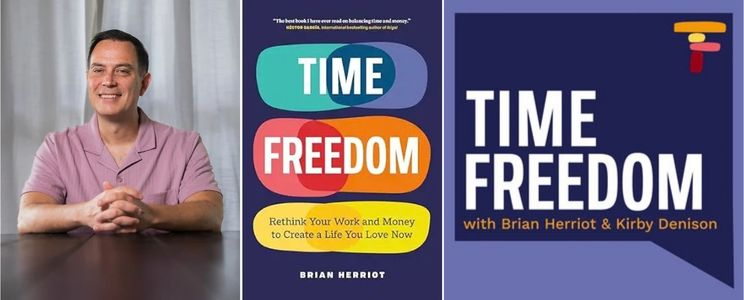
Brian Herriot is a financial advisor, professional speaker, and the author of Time Freedom: Rethink Your Work and Money to Create a Life You Love Now. He's also the host of The Time Freedom Podcast.
You can listen above or on your favorite podcast app or read the notes and links below. Here are the highlights and the full transcript is below.
Show Notes
- Why writing, speaking and podcasting can build authority without social media
- What time freedom is, and how it differs from work-life balance and financial freedom
- How to design your year around seasons of work and rest
- The three money personalities: minimiser, manager and maker
- How to build flexibility into your work whether employed or self-employed
- How a book that leaves nothing out can be the foundation of a business
You can find Brian at timefreedom.life.
Transcript of the interview with Brian Herriot
Jo: Brian Herriot is a financial advisor, professional speaker, and the author of Time Freedom: Rethink Your Work and Money to Create a Life You Love Now. He's also the host of The Time Freedom Podcast. So welcome to the show, Brian.
Brian: Thank you so much for having me.
Jo: Yes, this is a great topic. First up—
Tell us a bit more about you and how you got into writing and publishing.
Brian: I am a financial advisor, and now I am an author officially. I found writing just short of three years ago. I was actually doing some research on behalf of my wife, because she's always been an incredible writer, in the fiction side of the world.
So I was researching different writing programmes and things like that, and came across one that I thought, “Hmm, this is for nonfiction, and boy, it sounds very interesting. I think it's something maybe I need to do.”
The reason why I was looking at all, even for myself, is I was transitioning into a new line of work, and it was work where you needed to develop some authority and visibility. Everything everybody was telling me was that I needed to do a lot of social media, which I did not want to do.
I forget where I heard it, but they're like, “Or you could do the author speaking thing.” And I thought, “Ooh, that sounds a lot better.” So that's the path that I ended up on.
Jo: Interesting.
Can you tell us what that different path you were looking at was?
Brian: Well, a lot of what you see, at least online, if you're to develop a personal brand and try to attract business—in this case into my financial advisory firm—everyone says, “Well, you need to develop an online presence.”
In the business world from a long time ago, I had used LinkedIn, but not for anything like developing a personal brand.
So then all the advice started turning to, “Oh, well then you need to get onto Instagram and TikTok.” I don't know, I've always viewed all that scrolling as a waste of time, and I'd rather put my mind towards something more productive.
So I was just so apprehensive to try and get into that space, that I just kept putting it off and putting it off and putting it off until I heard a podcast. I've always listened to lots of podcasts, and I heard a podcast that said, “Well, instead of developing authority that way, the other path that you could take would be through writing.”
Because it's obviously longer form, you can put your thinking into it. Then that can lead to help getting into speaking as well.
Between those two you can develop some of the same authority that you could if you went the social media route. There was also the podcasting part, which I do love, and that's been one of the most fun things I've been doing lately.
So I do podcasting, writing and speaking instead of social media.
Jo: I love that, and I know a lot of people listening love that too. I don't think this is an age thing, I think this is an aptitude for short-form video thing. I'm the same as you. I'm not really into the short-form video. For people listening, this is an audio-only podcast partly because I don't want to do video.
Brian: And that's beautiful. That's the beauty of working on your terms, right? Which we'll talk a lot about.
Jo: Yes, exactly. So I love that from the beginning you were like, “No, I'm going to go the long-form route and reach people that way,” because you absolutely are. I personally would always rather read a book than watch a whole load of snippets or video online to learn about this kind of topic.
So let's get into the book. Let's start with that concept of time freedom.
What is time freedom, and how can we change our mindset to believe that it's even possible?
Because it feels like we're working harder than ever.
Brian: The way that I like to explain this is first by discussing what time freedom is not, because of how it fits. And I have this right up front in the book.
There's this whole concept of work-life balance, right? And work-life balance to me, at least, coming from the professional and the employed worlds, is that you're just stealing an hour during the day here to then make it up later in the night.
Sftentimes, at least when I was living with work-life balance, I was probably more busy than I even was if I would've just worked straight from 8:00 to 5:00. It's very week by week focused, day by day focused, and that is not time freedom.
On the other side is this idea of financial freedom, which time freedom also is not in my mind. Financial freedom is where, I mean, the simplest thing is you're either retired or you're independently wealthy or in some other way you do not have to work anymore.
So you've got this absolute freedom, which for me is boring, because I get a lot of joy from the work that I do. So in the middle is the idea, I think, of time freedom, where you do still have to work, but you're able to design work in a way that works for you. So you can do it on your terms.
There's a lot of choice. There's flexibility if you want it, and all of those things. I think that somebody that optimises for time freedom looks at their year and says, “This is how I want my year to go.” There's a seasonality to it.
In my personal experience, I do most of my work work, the work that I need to do to get paid and live, in what would be the equivalent of the school year, because my wife and I have a son. He's a sophomore in high school, and that's just the way that our life is lining up right now.
Then during the summer, we're fortunate enough to have this not so great cabin on a beautiful lake back where we both grew up. And in the last five years, we've designed our life so that we can go back there and live a different season during the summer.
I've always loved summer, and during that time, that's when we rest and relax, and we water-ski, and we fish, and we do all the fun things that you could do at a cabin.
Then also, there's this time when you're starting to think bigger or differently or make creative connections about things in the work that you do. I find it really rejuvenating, so that when I come back in the quote-unquote school year, then I can get back to work and do some really interesting things.
So the person who pursues time freedom is really optimising their life around this freedom and flexibility. Maybe they're working longer and later into life, but they're doing it in a way that works for them.
They're not necessarily optimising to steal that extra hour that day, or optimising for wealth, which would be the financial freedom path.
Jo: Yes, I find this very interesting. I like that it's not financial freedom because I'm an investor, as I mentioned to you, and many of us are. But that tends to take more time. So if you're aiming for financial freedom, especially if you start investing later in life, you're not going to get that at 45 or 50 or maybe even 60.
So defining this as separate is really good, because you're saying, “Well, you can start changing things now, and yes, you might have to work a bit longer, but if you love your work, it's not a problem.”
I want to come back to this idea of seasonality and planning your year around this seasonality idea. How does that work with the potential of other people's timelines or other people's possibilities, and serendipity?
I have some plans, but then, like this year, this thing came up. It was just a very intuitive thing and has changed the next few months in a completely different direction and blown all my plans out the water.
So how do you balance the planned seasonality with serendipity?
Brian: Well, first what I want to mention is, if you can figure out a way to organise your year so that you have these extended periods of time off, that's a wonderful thing, and it's not something that I think you can do with a snap of the fingers.
When I had this realisation that I even wanted to do this, of course it wasn't even me that came up with it, it was my wife. This was during a time when the stock market had crashed, and I was suggesting to her that we were not going to be financially free any time soon.
When she asked me what financial freedom looked like to me, I said that I still had wanted to work, just more flexibly, and she said, “Well, let's do it now,” right?
So back to my point, we couldn't do it now. We had to get the money confidence to be able to basically figure out how could you work for nine months and have that support 12 months of living.
So it's not immediate, but once you get there, the way that I have looked at it compared to serendipity is, if I can structure the work that I do, and again, it's so dependent on the type of work that your listener does do, right?
In my particular case, when I was able to do this, I was doing independent consulting projects. So I was able to line up projects that would never overlap in the summer.
Sometimes they would go into June because it had to, right? But I did the best that I could and tried to be as flexible as it was. Then when I had the time, then I was able to do whatever came up during that period of time.
Usually it started as just taking a break, resting and not doing so much work. But by the end of those three months, you really start to want to get back into things. I think you do have to just go with what your body's telling you and what your mind is telling you.
I don't know if that answers your specific question, but when you say something happens, right, and you want to take advantage of that opportunity, you've got to do it, right?
I think flexibility is probably the value that comes through the most in the book. Even when you think you've figured it out and you finally got that perfect seasonal year, well, something will come up and happen. I think part of what time freedom is, is being able to take advantage of the opportunity when it comes up.
Jo: Yes, being able to choose. That's the key point. I mean, I'm in a situation like you where I run an independent business, so I do get to choose.
It's just funny because I read this and I'm like, I do have time freedom, but I fill my time completely. I do have enough time, but I fill it with more and more creative projects, and I'm not very good at stopping. So while I do have flexibility, I also have a very full calendar.
Long-term listeners will know I've asked this of other people as well, and I was very interested that you took a transformative sabbatical in 2023. This is something I keep coming towards and then backing away from.
Can you tell us a bit more about that [sabbatical]? What was that, and how did you manage that?
Brian: My wife and I took a trip in, I think it was 2015 or so. We went to Italy for just two weeks. I mean, you could easily spend two years, I feel, in Italy and still feel like you missed out on things. But our vacation was so packed. It was very typical of the American vacation, I would say.
I remember coming back from that vacation going, “You know, I'm more exhausted now than I was when we left.” So we always wanted to figure out a way to do some slower travel.
The way that it worked out, after we had our revelation about how we wanted to design our lives, was that we were going to take what ended up being four weeks.
So I knew that I was going to have my first fully free summer off in 2023, and we decided to purposely go slow, and we travelled in and around Portugal for four weeks.
It's funny, on the flight back when we were going through customs, the gentleman asked how long we'd been in Portugal, and we said, “Four weeks.”
He's like, “What did you do for that?” Like, what did you do?
Jo: I love Portugal, by the way. It's great.
Brian: Lovely. “Why were you here for so long?” But the beauty of it was, if we had a day when we weren't feeling up to going to see something, we just didn't. It was wonderful. That was just a wonderful experience.
We were able to line it up so that we met other friends, so we almost had a vacation within a vacation. We had an au pair that we hadn't seen for years who flew over from France and met us.
It was just, I imagine, very not typical of the American work lifestyle that I'm familiar with. It was just anything but that, and it was just wonderful.
It really pulled our whole family out of the conventional way of thinking, and that was incredible for us, and really then triggered how we've spent the last few years of our lives.
We haven't had that same long trip yet. Part of it has to do with now our son's in high school and he needs to be here at home around his friends. But he'll be off to college soon and then we can go do it again.
Jo: Yes, it's so interesting, isn't it? Sometimes you have to really step away from your normal life and the grind of it in order to think differently. It's quite funny because as a Brit and a European myself—
I actually find coming over to America is a way to almost change my mindset. So it's often just going into a different culture, perhaps.
Brian: Yes, absolutely. I think part of this whole living with time freedom aspect for me is just leading a more interesting life.
I owe this really to my wife. I think I always, through schooling and coming out of college, I just almost had these blinders on, like, well, you're supposed to just get to work and do your work, and this is what you do.
She's the one who's always asked me, why are we doing this? Why could we not experience something a little bit different? And that's what makes for an interesting life.
Jo: Yes, and also from what you've said, you're not spending up big time. You don't sound like you're having extravagant times at the lake or when you're travelling.
So I often think that people feel like you have to have so much money in order to do something. I remember being in, oh, it must have been New York, and I was talking to someone and she said, “Oh, it's my dream to go to New Orleans,” and I'd recently been there.
I was like, “Well, why haven't you been? It's really easy. You're in America. You could just fly there.” I've even taken trains in America, which I know a lot of Americans haven't. But there are trains, and all of this.
I was like, “Well, why haven't you been?” It's like people have in their minds all these barriers.
Money is a big barrier, right? But you don't need as much as you think, perhaps.
Brian: It's true. There's all of the series of podcasts and blogs and everything about how, when you do this long travel or slow travel, I think is what they call it, you don't have to stay at hotels.
You could stay at an Airbnb and rent a place for two or three months, and it's far less per day than it costs.
The analysis that I've seen is how sometimes if you, say, maybe rented out your house back in America when you were going to Europe, and then you did your travelling, it's actually cheaper to go and take a long trip than just stay put. You actually make money on it. I mean, of course, it all depends, but it's eye-opening.
Jo: Yes, you mentioned Portugal. We're actually going to Portugal walking in a couple of weeks, and Portugal, for example, is much cheaper than Italy a lot of the time. So it also depends on where you go.
Coming back to the book, you mentioned a few minutes ago money confidence. In the book, you have these money personalities, and many of my listeners as creatives and authors, there's quite a lot of scarcity mindset in the author community, fear of financial things.
So maybe you could just talk about these money personalities and how we get to money confidence.
Brian: The track that I took in the book was, before I could just say, “Oh, go live time freedom and have inconsistent income and take these extended periods of time off,” I couldn't do it without addressing how I felt, which was like, “Well, can I afford this?”
So the money piece of it is extremely important. The money personalities is something that I feel like I learned far too late in life.
How I describe money personalities, and there are different ways of talking about this, but it's based on how you were raised and experiences that you've had with money from when you were a child, in your family, and then what happened in early life.
How has that impacted you behaviourally in terms of how you view money? So for example, growing up, we lived in a small rural part of the Midwest, and so we had money.
We didn't have a lot of money, but I can remember every Saturday morning my mom clipping coupons, right? Because that's how we bought our groceries.
So I do come from this, let's get the most value out of everything that I buy, and I'm going to restrain my spending because who knows if I'm going to have enough in the future. A constraints mentality.
Whereas I've met other people now that I've been an adult whose parents had their own business, and they had booms and busts, and so there were good times and bad times.
So when they get money, they spend it, so that they can enjoy it. I realise that people come with this—I don't want to say baggage because it's a bad thing—but people come with these experiences that influence how they think about what's possible as it relates to money.
I think that for one, people need to understand what that is for them and how that works. I also think that you can use it then to your advantage in figuring out how to gain the money confidence to step off into a life of time freedom.
So the three that I really highlight in the book are, the one that is called, what I call the money minimiser, which is the individual who doesn't like to think about money or would rather not think about money. Money is not a big part of their life, or they feel constrained by money.
I have elements of this in my background. And in this case, a lot of times you may not need as much money to live off of to be happy, which is actually a huge advantage, because if you don't need as much money to live on, then you don't have to go save up as much money, or you don't need to make as much money.
The other type is the money manager, and this is someone who's much more into saving and investing and understanding how all this works. This is the type of person that a financial advisor loves to address, because they have money to invest.
This is someone who's getting into their 401(k) right out of, in their first job immediately, and compounding their wealth over 40 years. It sounds like you have a little bit of this in you based on what you were saying. And there's some advantages to that, too.
Then there's someone like my son, who despite all of the saving and investing in our family, he wants nothing to do with it. He believes that if he wants more money, he'll just go figure out a way to make more money.
So this is the money maker. It's the entrepreneurial type, the person who's in sales, the person who can manifest money.
All of these different types of money personalities, I think if it is you, there's ways that you can leverage those to figure out how to make money work for you so that you can have time freedom.
Jo: That's really interesting. I think we have a money journey. I know some people don't like the word journey, but I like it. I come from a very scarce background, poor. Let's just say it. We were poor, for a while. Then, over time, things changed between various family members.
So I was a minimiser just by upbringing, and then I discovered the maker, and I manifested, and I worked my butt off and did all of that and understood that you can make money. You can earn it and make it in different ways. And then I learned about investing and then became more of that manager.
I absolutely was afraid of feeling stupid, so I wondered if you might address that, because this is what stopped me for a long time. I'm a pretty smart person, at least I think I am. I can learn things, but I just found the financial world just made me feel stupid.
So I minimised it because I was like, “Well, if I don't, I'm not going to understand it, therefore I'll just dismiss it.” That fear of feeling stupid, and other people might have fear of judgement or fear of all these different things.
So can you talk about that fear, and is the financial world really that difficult?
Brian: It's so unfortunate. The reason people feel stupid is because I think the financial industry wants you to feel that way, so that you then need their help to manage your money. It's full of acronyms and this and that and the other thing, and it is not that difficult.
I think there's a little bit of math involved, and numbers. I think if people lean more to the other side of their brain, there tends to be a little bit of fear there.
I believe that there are basic concepts that can be understood, like if you were to invest in something that covers a lot of stocks, it's called an index, right? And if you keep the costs low on it, you're going to earn much more money. I feel like there's 10 things that you could learn and it would get you 90% of the way there.
It's just that you need to find the right resources to explain it to you in a way that's understandable. I'll tell you, this book is the lifestyle/entrepreneurship/money book, which is a unique combination.
The money chapters are some of those that I had to revisit twice as much as the rest of them, because it was so important to me that there was not a lot of acronyms and difficulty getting through it.
I really wanted to break it down to the basics. Hopefully you felt that was the case when you read through those chapters, because it's so easy to make it sound complicated so that then people feel that they need the support of the person who's explaining it in the complicated manner.
Jo: Yes, exactly, and I totally agree with you. When I discovered the low fee index funds, I was like, sorry, what if I just put some money in that, that's a good way to start? And I was like, really? Okay, then. That's strange.
I think I had overcomplicated it in my mind, and as you say, the industry does that in a way, and the publishing industry does it too.
I mean, you've obviously been learning loads of stuff about publishing. In every single niche area, there's language that shuts out other people. And also I feel like, as a British person in the UK, obviously depending on the country you're in, there's different language as well, and yet so many of the books are American.
So for example, your Roth IRA is an ISA here, and your 401(k) is a SIPP. And then someone in Australia, it's something different. Someone in Canada, it's something different.
So that also makes it complicated, whereas once you can do some mapping and go, oh, okay, when in your book you say an IRA or a 401(k), this is what it is in my country, it simplifies it.
Brian: Yes, absolutely. I did take special care at the beginning of the book to say I'm coming at this from an American angle.
Jo: Yes. But then I would also say, I was saying this to my husband the other day, I'm very grateful, and I know this isn't true for every country, but I'm very grateful that I can invest in American indexes and stocks and all of that kind of thing.
I think you can invest globally as well as earn money globally, and I think that's really exciting. As an individual person, I can do that, and I've got investments in Australia because I lived there for a while, and that is actually a real privilege to be able to invest that way.
I don't know how many Americans invest outside of America. Is that something you talk about?
Brian: The only way that I've really seen it is through an American-based fund that invests in foreign companies in foreign countries. But no, not by buying something from the Australian market, for example.
You made me realise I need to create a little cheat sheet that just shows, okay, we're talking a company retirement account. What is it called in all of these countries? Wouldn't that be nice? Just a nice little cheat sheet for people. I'm going to do that.
Jo: Yes, because most of the time it's really a one-to-one, because as you said, it's not that complicated. When I was learning all about this, I was in Australia, and just so much of the information is from Americans, so you have to do this translation in your brain. So that'll be a super useful cheat sheet.
Okay. So in terms of other things, you've mentioned obviously enjoying your work, but you talk about different ways to build flexibility into your work so it's not all or nothing.
So what are some of the ways that people might build that flexibility?
Brian: I think this is one where you have to think, “Okay, am I employed or am I self-employed?” Because I think there is a big distinction there in terms of what you're able to do.
Again, shout-out for early readers of books, but the early readers of my book suggested that in addition to just saying, “Oh, live by a seasonal schedule and take three months off in the summer,” they said, “What are some other things that we can do to get toward that,” right? So that we can take incremental steps.
So some of these ideas can be done by anyone that's working in a more typical, employed position, and others might need to be if you're in an entrepreneurial scenario. I feel like a lot of it comes down to how you can structure the work.
So at least in America, more and more these days, there are more companies, and usually they're the smaller and the mid-sized ones, where you can find companies that are doing four by 10-hour schedules.
So you're working four days and having three days off, which then gives you a Friday every week to do something that you want to do, or start to build a skill that you could then turn into something that you could do independently, like starting as a side hustle and then moving into something different like that.
Other early strategies that I've seen people do, just to experience what it's like to take an extended period of time off, and especially in America this isn't done that much, is to take a two-week trip that you have over the holidays and put a week on the front of it and a week at the end of it and have a full four weeks off.
This could be during a time of year that's usually a little slower anyway. So it's a lot easier to perhaps have your manager approve that. These are just a couple of ideas.
On the self-employed side, I have seen more than a couple of people now work this schedule where they do three weeks on and one week off, and then three weeks on and one week off, and they've just figured out how to put the systems in place in their business to allow for that one week to be away.
I guess if you're just taking off for a week every three weeks or a week every month, you're never so far away from the work that needs to get done. It's just a different style.
What happens is, if you can do some of these different techniques and then you add them all up, it almost adds up to the amount of time of a full three months off.
So again, you just have to test and try it out and do these different strategies based on the type of work that you do and the place of employment that you have, to see what might work.
Jo: And also almost just plan it, like I said before about that person who wanted to go to New Orleans.
Choose a time next year, like six months' time or nine months' time, and—
Just book a flight. It doesn't have to be that hard, does it?
Brian: No, that's right. And there's other things… Now, I was talking schedules, but there's other things that you can try to start to create work that's more flexible.
For example, something that often happens in America at least is, you're working in a corporate setting, somebody retires, but that person has so much skill and knowledge about the business that then they immediately turn around and are hired back as an independent consultant.
Early in my career, I just saw this happen all the time, and I remember thinking, “Why do they have to wait until they turn 65 and retire before they do that?”
Couldn't you just say, “Hey, I've decided to leave my corporate position, but I'm going to become an independent consultant because I have a valuable set of skills, and I'm going to turn around and just contract back to where I used to work initially,” as that first step. That's an interesting technique.
You had highlighted the idea of a hobbyist entrepreneur. This is usually the one that a lot of existing retirees will do right out of the bat. I met a friend of my wife's parents, who had a very successful corporate career, and as soon as he finished up, again, people that are productive, I think, struggle when they immediately retire.
So he's like, “I need to figure out something to do,” so he flexed his creative side. They lived in Northern Wisconsin, where fishing is a big thing. So he would craft these large fish mouths out of wood. He would make these wooden fish that were very creative and very cool.
They would have golf tees for teeth and stuff like that. So you could sell them to people that like golf. He created them for all of his friends, and then he ended up with some sort of Etsy store where he sold a bunch of these. Then after a while he's like, “Eh, now it's too much like a job, so I'm going to do something different.”
It's just little ways that you can make money here and there that allow you to work on some things that you are interested in.
Jo: Yes, and it's interesting because the other thing about the retire and live off your pension idea is that the assumption is you'll never earn any money ever again, and so you'll just be drawing down on that money.
Even as you say, like that guy with the wooden fish, if you can make even an extra 5,000 in a year or an extra 10,000 in a year, you don't have to draw that down from the pot of money that you've saved or invested, or your pension or whatever. So that actually means that it can last longer.
So I feel like people forget that even these smaller amounts of money, which you can make as an author as well, or a speaker as you say—
These are things that just mean your retirement can potentially be better financially as well.
Brian: It does, and another thing that it gives you is the ability, when maybe the market is down for two years, and it's hard to pull money out of your savings when it is negative, right?
In those months, or in those years, or whatever it happens to be, you say, “Oh, well maybe I'm going to do my little side gig twice as much this year, because that'll allow me to spend that money instead of having to pull it out of a down market.”
Jo: Exactly. So we do talk about the business of being an author on this show. And at the beginning you mentioned that writing this book was part of developing authority so that maybe you can also get speaking.
So how does this book fit into your business?
Is it purely business card authority, or is it designed as an income stream as well? And any advice for other people who want to do something similar?
Brian: Yes. It's so interesting you said the phrase, like a better business card concept. When I think of that, I think of some of the places that will teach you how to write a book in a weekend or a month or three months or something like that.
I was very wary of that. I really wanted to have a book that stood on its own. So I think of my book as more than a business card certainly, but something that's really the foundation of my business.
So here's how it flows for me. The ultimate product that I sell is I invest people's money for them at half the cost, because that's very important to me, and in a way that is commensurate with somebody that wants to live this type of lifestyle. So that's ultimately what my service offering is.
The way that people enter my world is, I have a quiz, a little nine-question quiz. That's my little lead product that I use. But that gets them interested in this idea of time freedom. If they come across time freedom or they are interested in financial freedom, and they're searching around for a book, the book is the main thing.
I'll tell you, I've left nothing out of the book. The book contains everything that I ever did, everything that I ever do for clients. It's all there. I learned that from somebody early in the process, which is, you don't want to hold anything back in a book, a business-related book. Because, I don't know, it's just not right.
The thing is, some people will go and run with it, which is great. But some people need accountability, or they need someone to hold their hand, which is fine. Or they in some way need to connect with you, and that is then where you offer the next level.
So somebody could read my book and do everything themselves, or I also, a few times a year, offer a group coaching programme where basically we go through the book. We prepare what I call a Time Freedom Plan, which is like a financial plan, with the individuals in the group. And again, it's crazy.
There's nothing that I'm helping with that's not already in the book. So we go through the concepts. We prepare our Time Freedom Formula. We use the Time Freedom Calculator that I have that's, again, available for free. Anyone can use it, but we work on all these things together to prepare a Time Freedom Plan.
A Time Freedom Plan is what ultimately gives you the money confidence to live this lifestyle.
So you project the money that you're going to earn and spend through the rest of your life to give you confidence that you're not going to run out, and then that allows you to step off into time freedom in a year or three years or 10 years or whatever it takes.
Then as part of that process, there are a certain number of people that will have some money that needs to be invested and managed in a way, and those people can turn into customers of mine on the investment management side. So that's how it flows.
So I have a huge goal to just get this book out to as many people as possible, because I want to help as many people as possible, of course, but then also some small percentage of the people that read the book will ultimately want to work with me.
Jo: No, that's great, and that is the textbook ladder that a nonfiction author does. I also love that you've put everything into the book. I think it's super useful. I really enjoyed it. I think it's got some good questions in.
Even if you are, I guess, someone who is already investing like me, it's good to think about the time freedom as well as the financial side.
So where can people find you and the book and everything you do online?
Brian: Well, people can find the book anywhere books are sold. I do have a podcast as well, but everything is linked to from my initial website, which is timefreedom.life. So you can find everything there.
Jo: Brilliant. Well, thanks so much for your time, Brian. That was fantastic.
Brian: Thank you so much. This was a true pleasure.


Leave a Reply