
Podcast: Download (Duration: 1:13:09 — 59.3MB)
Subscribe: Spotify | TuneIn | RSS | More
How can content marketing in a tight niche build the audience that launches your book? And how do you decide whether to hand your self-published bestseller to a traditional publisher. Suzanne Smith shares what she learned in four years of going from blog to book deal.
In the intro, how to stand out as a writer in the age of AI [Nathan Barry Show; Interview with Nathan Barry]; thoughts on asset maintenance; Goodreads giveaway on Bones of the Deep (Aug 5-20, 2026)

This episode is sponsored by Publisher Rocket, which will help you get your book in front of more Amazon readers so you can spend less time marketing and more time writing. I use Publisher Rocket for researching book titles, categories, and keywords — for new books and for updating my backlist. Check it out at www.PublisherRocket.com
This show is also supported by my Patrons. Join my Community at Patreon.com/thecreativepenn
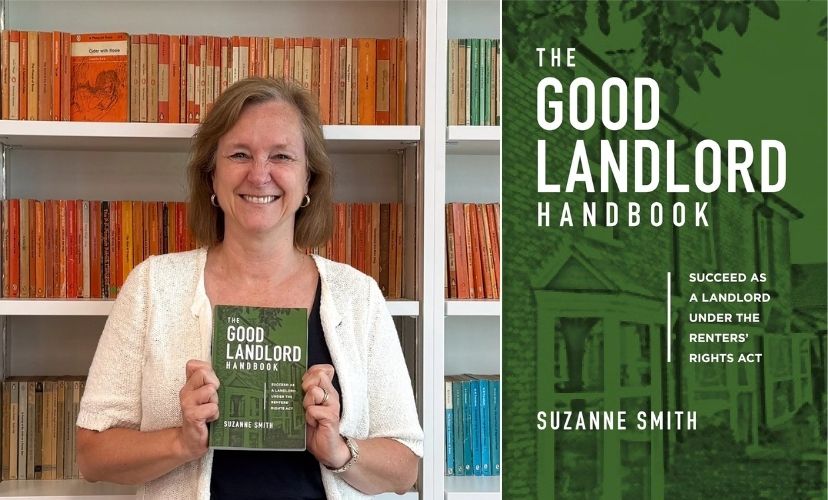
Suzanne Smith is the founder of The Independent Landlord, and the bestselling author of The Good Landlord Handbook.
You can listen above or on your favorite podcast app or read the notes and links below. Here are the highlights and the full transcript is below.
Show Notes
- How a free blog in a tight niche built the audience for the book
- Rewriting the book from scratch when the law changed
- Why speed made self-publishing the only option
- Building a paid membership after one audience member asked for it
- Negotiating a Penguin Random House deal with no agent
- Using AI as a business sidekick, with a control room and an engine room
You can find Suzanne at TheIndependentLandlord.com.
Transcript of the interview with Suzanne Smith
Jo: Suzanne Smith is the founder of The Independent Landlord, and the bestselling author of The Good Landlord Handbook. So welcome to the show, Suzanne.
Suzanne: Thank you.
Jo: Oh, there's so much to talk about today. But first up—
Tell us a bit more about you and your background, and how you got into property and writing after a legal career.
Suzanne: Well, I've always loved reading books. In fact, I recently did a French literature degree as a mature student. Being an author was never in the game plan at all. It's not something that I even thought about.
I was brought up in New Zealand, so shout out to all the Kiwis and those across the pond in Australia. The thing about it is, Jo, you've lived there yourself. Kiwis are independent, self-reliant and have this great sense of fair play. So that was a very formative experience for me.
We moved back to England when I was 16, and I have become thoroughly anglicised since then, but a Kiwi at heart.
I always wanted to become a lawyer. New Zealand in some ways on television is quite American, and there was this American programme called The Paper Chase. It was about all of these students at Harvard studying law, and the professor said, “You come here with a skull full of mush and you leave thinking like a lawyer.”
I thought, “Oh, I like the sound of that.” I didn't really know what a lawyer was, but everyone seemed to be very happy that I wanted to become one, and then that was it.
Jo: So you went into law, and then how did you get into property?
Suzanne: So I worked for 25 years as a solicitor. That's like an attorney if you're American. Started off in a law firm, and then I went into pharmaceuticals and I worked for big companies like what is now GSK, GlaxoSmithKline, and small companies as well.
When I started out, it was before the internet, before Google. When you're in house, you're very much a generalist. You do a bit of everything. So you help companies grow their business.
You're not business prevention, but you're still bound by the code of conduct for solicitors. You've got this role of keeping the company on the right side of the law.
Then I had twins, who were born about five years after I became a lawyer, and I decided to work part-time for a while and did an MBA when they were little, part-time through the Open University.
I know Jonathan is doing one at the moment.
Jo: Yes. He's finished, so that's exciting.
Suzanne: That was transformational for me, because I had probably been thinking a bit too much as a lawyer, and it helped me to broaden my view of the world and understand all sorts of things.
Sso I continued going up the greasy pole, and then for my last job, in 2015, I joined a biotech company in Cambridge, England, as general counsel and company secretary. It was a long way from home, about two, three hours' drive from home. So I decided to buy a flat, an apartment, and to stay there in the week.
I thought to myself, “Well, when I leave this company, I can let it out as a buy-to-let,” but actually as a landlord. So I stayed there for five years, and then when I left, I let out the property.
The reason why I decided to leave law after 25 years, I had what I call a sliding doors moment, like in the film. I was 50. I was on holiday with my husband, and we'd probably had one too many rum cocktails. And he said to me, “Well, what do you want to be doing with your life? What would you do if you could do anything?”
I was thinking, “Well, I've done law. I want to do something else now.” I didn't really know what that was, and I'd always been thinking about studying French properly, and that's when I left. So I decided, 18 months later, I left to do a French degree at King's College London, full-time.
I was the only old person there with lots of 18-year-olds. When I did that, I was able to cash in my share options because I was a good leaver. I retired, and so I started buying properties to let out and became a landlord, without really thinking too much about it, and I used letting agents.
They were fine to begin with, but I didn't really have a game plan or anything like that. What I realised is that when I tried to research things online, I couldn't really find anything that was terribly helpful. It was either quite general or it was very legal.
So after a while… I became a landlord in 2019. I had the idea, why don't I set up a blog? And this is August 2022, so just four years ago. My husband came up with the idea of the name, The Independent Landlord, because it's that Kiwi spirit, being very independent.
I thought, “Right, I'm not going to charge anyone for it. It's a hobby. It's not a business. I'm going to pay it forward and help, use my legal training, practical legal approach, and practical common sense, by doing this blog.”
Almost exactly four years ago, I sent my first newsletter to 13 people.
Jo: Woo-hoo.
Suzanne: And I sent one last week to over 18,000. So it's been quite a journey.
Jo: Wow, this is so great. I love this. There's so much in there. The turning 50 and then doing a degree. My master's in death is a little different to your French literature, but I like it.
So I love this, and buying properties, starting it on the side, not a business at first, and growing the audience, and obviously you've put so much work in.
Then you decide to write a book. So talk about that, because an online blog, although I'm sure your articles and everything were super useful, it's very different to write a blog than a book. So talk about your challenges in writing.
Why did you decide to do a book in the first place?
Suzanne: Again, I was an accidental landlord, is what they call it when you let a property when you didn't intend to buy it as a buy-to-let, which I did with my Cambridge flat. And I became, in many respects, an accidental author.
So I was having a conversation with my husband again and I was saying I'd done this lead magnet to get people to sign up to my newsletter, and a big new law was going through Parliament at the time, called the Renters Reform Bill, that was going to completely transform the way landlords operate.
I was saying to my husband, “Oh, I need to update my lead magnet, a little ebook, to explain the new law.” He looked at me and said, “Well, why don't you do a proper book? Write a book.”
This was on the 29th of September, 2023. The reason why I mention that is that I thought, “Wow, what a great idea,” and my head was bursting. I went onto Google, and guess what I downloaded on the 1st of October?
Jo: My blueprint?
Suzanne: Exactly. I found you immediately, the Author Blueprint, and I downloaded it. I checked: on the 1st of October, 2023.
Then I listened to almost… well, I think I went back several years on your podcast, just trying to understand. I'm like that. When I try and do something, I just try and learn everything that there is to know about it.
So I started writing the book, and I guess the first challenge was I write quickly, and I'm used to writing for people who aren't lawyers, being in-house. So I thought I needed to have a structure. The structure was easy in many respects because, a bit of business at the end, and then you can go through a tenancy.
I thought it was important to have a narrative thread all the way through it, just to bring it together. This is the literature degree coming in here.
I thought that the mission for everything I do, the reason why I started doing this, is to help landlords, but also to help the experience of renting that people have in England. It's very specific for English law. And to help improve the private rented sector.
So that's why I originally set up my blog for free, and I wanted, when people went onto Google, they could find something sensible and very detailed from me. My blog posts were… Well, I've now got over 400,000 words on my blog, so it's a substantial piece of work that is out there free of charge.
So what I decided to do was to bring this narrative thread, I call it the good landlord ethos, to the book.
Then I wrote very quickly, and I had a pretty good draft by April 2024, because we were all thinking that the law was going to change very soon. But then there was an election, and in the end the government changed and the legislation changed completely, so I had to rewrite the book and start again.
So I think that my biggest challenge was that my subject matter, the new law, changed. Because I wanted to publish this book that explained to people practically what they have to do, and make it really straightforward, keeping out of politics, because it is a very politically charged area.
I wanted to write it so it's a manual, somebody could literally follow it. So I used an editor, and I did write the book twice. I had a beta reader who is another lawyer, and a landlord as well. Then I got to the get-the-damn-thing-done stage. The really tedious bit of all the typos at the end.
Jo: Yes, the finishing energy to get it out there. So at that point, obviously you'd found my blueprint, so you were learning about the indie way of doing things.
Did you always decide to self-publish?
How did you think about publishing? What were your challenges in publishing?
Suzanne: It never occurred to me not to self-publish, because the new law came into effect on the 1st of May, 2026. The law and the details that I needed for the book were finalised in January, and I published on Amazon on the 5th of March, so I had to go so quickly.
Even though I'd got a lot of it written, the last bit came in January, and so I needed speed. I knew that for landlords to be able to have something that they can use straightaway to help get them ready for it, and then use as a manual afterwards, I had to be first.
Jo: Sorry, just on the year. Was it '24? You said '26. You meant May—
Suzanne: 2024? No, no, because I actually published it this year. What happened in 2024, I had the first draft ready, but then I had to do another draft because the law changed when the Labour government came in.
Jo: Right.
Suzanne: The Renters Reform Bill turned into the Renters' Rights Bill. So I had to rewrite the book. So I finished however many drafts at the end of January 2026. Then it went to an editor, et cetera, et cetera, and I managed to get the book ready for a proof, to get the proof printed, towards the end of February.
So it was really quick to go from the law being sufficiently finalised for me to write a book in January, and then having it ready in just over a month. There is no way that I could have done that if I'd gone to a traditional publisher.
It didn't even occur to me to go, because I didn't want to be going touting around my book and, “Please publish me,” et cetera. It's just not me. I'm the independent landlord, and that moved very easily to being the independent publisher.
So I learnt how to do all the publishing. And a huge thanks: I joined your Patreon and I was a very good student. I went through everything systematically and followed your playbook, and used Vellum and BookFunnel and all the other tools.
So I decided to go on Amazon as well as have my own Shopify store, which just about killed me.
Jo: I was going to say, you are an excellent student. You really like learning, but you also put this into practice, which is why I also wanted to talk to you.
You haven't just talked about all this. You've literally done everything.
Suzanne: Sometimes it was like my head was going to burst. Luckily, Claude upped his game earlier this year when we got the Opus 4.5. I didn't use AI really until this year.
I decided I need to do exercise all the time, and have that as a have-to-do, because my head was spinning all the time with all these different things. So I would go to the gym, go to a spin class, and then I would walk out with my phone on, with the Claude app, and dictate a stream of consciousness into it.
“Oh, I need to do this, or what about that? Oh, I just remembered about this. Oh, I've had this idea, blah.” And then said, “Make sense of it for me, Claude.”
So it was very much as a thinking partner, because when you're writing your first book, it's bad enough, but when you're learning how to publish…
Even, like, when I got the first proof of the book back from BookVault, I realised that all the footnotes—I have 114 footnotes in my book, and that, again, is the recent degree there—and the formatting had gone skew-whiff. Apparently it was an issue with Vellum, and they were really lovely and they sorted it straight out for me.
So it shows: always get a proof of the book. They were able to sort that out very quickly, and BookVault were very quick in getting me another proof, because you can shortcut it and just pay to get a very quick delivery.
Amazon, on the other hand, was really slow. It took a week. So I actually published earlier on my Shopify store for my members, of my membership, and I gave them a discount. Then I finally got it onto Amazon on the 5th of March.
There are all these different skills you're having to learn. The Shopify store I found very hard, and there was all the tax, because I'm VAT registered. So I think I'm still recovering.
Jo: You're still recovering. I wouldn't normally recommend a Shopify store for someone with their first book, doing first of everything. But, as you say, you're someone who learns a lot, puts it into practice, and—
I think you were pretty determined to do that because you had a community as well, right?
Suzanne: Exactly, yes. The big subscriber list. I think that's why the book did so well. So in the first week, because I met you at the Indie Author Lab put on by—
Jo: Yes, London Book Fair, yes.
Suzanne: Yes, the Alliance of Independent Authors. I met you there, and it was just my first week, and I had 1,000 sales in the first week. That was because of my audience.
I'd been going on about the fact that I'm writing this book for two and a half years, because that's how long it took me to do. So I had a wait list for it, and I had a thing on my website, a landing page on my website, saying how good the book was and why it's the best thing for the Renters' Rights Act.
Then I went onto Google, and I think I sent you a screenshot of this at the time. I put into Google, “What's the best book for the Renters' Rights Act for landlords in England?” And it came up with me as a featured snippet, and I hadn't even published it at that time. It was just about there.
So the blog really helped, because I'd become an authority on the Renters' Rights Act. Even though I'm not a practising solicitor any more, I spent all my time reading the damn thing, and it is a very complicated bit of legislation.
Funnily enough, I have ruffled a lot of feathers. People have even said about me behind my back, “What does she know? She's only got four properties.” But I just took no notice.
I thought, “I'm going to try and use my legal brain and my understanding of what it's like being a landlord, there with the rubber gloves cleaning an oven when people have moved out, and try and write something that's not trying to sell anything else, and to help people.” And then it got picked up.
Jo: Yes. Wait, let's just slow down. Slow down, because we will get onto that in a minute. But let's just come back to that launch.
So as we talked about, you've had a blog for five years—
Suzanne: It was three and a half by then.
Jo: Three and a half years you've been blogging, but hundreds of thousands of words of useful information. So you've essentially done content marketing. You've attracted people. You had a lead magnet. You got them on your email list. You told them that you were writing a book. You got a sort of pre-sales list up.
So that's an email list. You've got a blog. Did you do anything else in terms of marketing?
Suzanne: I had YouTube, a big YouTube channel. I'd only set it up at the end of 2024, and I'd had half a million views. And again, just very straightforward advice, and without all the scaremongering and politics. I deliberately keep out of it all. A lot of people joined my newsletter as a result of that.
Also a year ago, exactly today, I was running a Facebook group, which was a lot of hard work. There were a few thousand people in it, but there are often a lot of people going in there trying to sell things: insurance, eviction specialists and things. And there was also a lot of people just being unpleasant to other people.
I was getting fed up with it. It was taking me a lot of time, and I was doing a lot of speaking events and trying to explain what this new law was doing, and wearing myself out. I'm an extrovert, but even I find speaking events absolutely exhausting, because it's like everything gets sucked out of you. It's strange.
Then somebody came up to me in July last year and said, “Suzanne, can you set up a membership?”
I said, “Well, landlords aren't going to pay for that.”
And they said, “Yes, they will. You build it and they will come.”
I asked ChatGPT and thought about it. I asked ChatGPT, who I was dating at the time, now exclusively with Claude, but I know Claude has other people in his life. But I'm very much set with Claude Fable at the moment.
So I asked ChatGPT, how can I go about setting up a membership? And I mentioned your one and said, “Should I do it on Patreon?” And then he came back with: go for Circle. So I set up a membership on Circle, exactly a year ago. In fact, it's the anniversary of my first member yesterday.
hTe rules I had were, no selling. So I don't sell, no affiliate links, no one else can sell anything, and we have to be supportive. No negativity, no politics.
So what it's become, it's like the senior common room of the private rented sector, with landlords, lawyers, letting agents. There's a fantastic forum in there. It's not me doing it, it's peer-to-peer.
I have twice-monthly live streams where people can ask me questions. I wonder where I got that from. No, I very much modelled it on your Patreon, but on a different platform. I have courses in there as well.
So that has really grown. I launched it in July, and by September, October, I'd gone past the VAT threshold, which has complicated everything, but it means my business now is this membership. I really enjoy doing it, and there hasn't been all the negativity that you have in a Facebook group.
So I had them as… talk about your thousand fans. There are about 1,500 in the membership, and their support really helped the launch of my book, as well as the wider people who get my free newsletter.
Jo: Yes.
Suzanne: So it's all different types of content marketing.
Jo: Y, but I do love this. And of course, if people are wondering, I joined Patreon back in 2014, I think it might have even been before that, and there weren't too many places back then to run communities. It wasn't even really a community at the time, it was a sort of, almost a “give me a bit of support for the podcast.”
So things have changed a lot in terms of communities, and obviously you went with Circle, which is great. Patreon is slightly different now, and some people are using Substack for something similar.
So that's just on the platform, but on the business: early on in our conversation you said, “I wasn't going to have a business. It wasn't a business. It was just putting stuff out there, helping other people,” and then your audience asked for this membership. And so now it is a business, right?
Suzanne: Yes, it is.
Jo: And you've got a book and all of this.
So are you happy with the change to a business? Because obviously you have to treat it quite differently.
Suzanne: Yes, I am, because I think to begin with, I was just doing it one or two days a week. I was actually studying a master's in French literature part-time, and I then found that I was enjoying the blog more than the master's, so I dumped the master's after the first year.
But after getting 88% for one of my dissertations, which interestingly was on the translation of a Simone de Beauvoir book into English, and the publisher who's got that now is Random House, but that's another thing.
Anyway, so I decided to give up my master's and double down and work full-time on the blog. People were paying to help me with all the big fees and things, the big tech stack, Buy Me a Coffee. I was doing a little bit of consulting and things.
I was working six, seven days a week. I was treating it like a business in terms of quality and my effort, but it wasn't a business in terms of revenue. Then it just all came together, and this person said, “Set up a membership,” and I thought, “That's what I'm going to do. I'm now going to put it on a business setting.”
I've got an MBA, I know how to do it, and people thought I planned it, but I didn't. It just happened.
So now I do very much treat it as a business, but I still don't advertise. I don't allow people to advertise with me, because I want to be independent. If I recommend something, I want people to believe it's me recommending it, not just because someone's paying me, which can be a big issue in the landlord area.
Jo: Oh, in any industry. I get pitched every day with loads of random things that people are like, “Oh, a dollar a click or whatever, if you send this to your list.” And it's like, seriously? Just stop it already.
I did just want to add there: somebody asked you, they said, “You should have a community,” and that sparked that idea. I just wanted to acknowledge that my Patreon came from Jim Kukral. Some of you will remember, who've been around a long time. Jim Kukral came on my blog around sort of 2013.
Amanda Palmer had just put out a book called The Art of Asking, and I was doing a lot of unpaid work on the podcast at the time, and I was either going to give it up or I had to fund it somehow. Jim said, “You should do a Patreon.” And I was like, “Oh, no, I hate asking for money.” So at the time I just felt, oh, weird.
Then I was like, “No, I do all this work,” as you were saying. Now the Patreon has changed so much in terms of what it is, but it is the backbone of my business, too.
So I love that you listened to one of your fans who said what they wanted, and I love that I've listened as well.
Sometimes we just have to listen to those urges, don't we, to take things on?
Suzanne: Yes, absolutely. In some ways I didn't really back myself before. I thought, “No one's going to pay for this.” Then the more you give, the more they want.
Jo: Yes.
Suzanne: What I've been really working on now is having boundaries, because there were two big kind of mottos that I picked up when I was working in pharmaceuticals.
One was from a head of the business. He was Canadian, and he was always saying, “You've got to skate to where the puck is heading.”
Jo: That's Wayne Gretzky, is it?
Suzanne: Exactly. Yes. He would always say it, and so that's what I've done with my blog and my book.
When I write things, I don't pay for any tools. I don't do keyword searches and all that. I just think, I do one blog post per topic, and I'm going to guess what people are going to be searching for soon, and I build up all this content around it. That's why most of my blog pages are top five.
I've had no advertising. I haven't asked for any backlinks. I don't do it. People backlink to it because it's useful.
So that was the first thing, is skate to where the puck is heading, and that was my approach with the book. I knew people would need this book from around May, and they'll need it forever, because it is so complicated and regulated, the rules for being a landlord in England.
So that was the first one. The second thing was: when you take something on, you've got to let something go. One in, one out. I found that I was taking on so many different things, and I've just been cutting back, because I can't be doing all the speaking, I can't be answering people's emails.
So I now don't do emails. If people want my advice on something, they ask me in the hub, at the twice-monthly live streams. Sometimes I answer in the forums, but I don't have time.
When there are 2.4 million landlords in the UK, and even with our 18,000 on my newsletter, I could spend, and I did, I used to spend all my time replying to emails.
So anyway, there are the things. Oh, and there was a third one, which is: attract, don't chase. One of my friends gave me that advice and that's exactly what my approach has been. I just don't chase for anything. I just put the stuff there and then build it and they will come.
Jo: Yes, and I think another thing is the power of the niche. It's so clear that what you write about, the people you are aiming at, you have an extremely tight target market.
That is both a strength and obviously a weakness, because they're the only people. But as you say, there's more than enough of those people for a community, for the book you have.
From my own perspective, that's the same for me, the power of the niche. That's how I have a successful podcast, for example, because of that reason.
I think you're like a poster child of what a non-fiction author should do. What I like is that you didn't go, “Oh, where's a niche where I could make money?” and then jump in. You've gone about this in a kind of slightly accidental way, but now you're leaning in and this uses all your skills.
So this really is a great example of the power of the niche and then making the most of it. But let's move on to what then happened, and—
What happened with the book deal?
Suzanne: Wow. So you and I met each other on whatever day that was in March at the Indie Author Lab, and the following day I got an email, via my website on a contact form, from Penguin Random House saying, “We love the book. We love the mission, its values,” all this kind of thing.
And I was thinking, “Oh, it's another one of those. Must be an—”
Jo: AI spam bot, right?
Suzanne: Yes, and I remember I sent you a screenshot of it, and then I checked her out on LinkedIn and thought, “Okay, there is somebody with that name there.”
You're always saying, and Orna Ross and everyone are always saying, “Watch out for scams.” And in fact, Penguin Random House even this weekend on Instagram put out something saying, “There are lots of people impersonating us.”
So I didn't take it too seriously, and it was something like, “Oh, would you be interested in us publishing your book?” And I thought, and I laughed. It was like, no, this is too good to be true.
So I replied and said… Oh, I said, “Well, thank you so much. The Renters' Rights Act…” And so this is like the second week in March. “The Renters' Rights Act comes into effect on the 1st of May. If you want to publish it, you're going to need to get your skates on.” I literally did say that.
Then she arranged a meeting with me the next day, on the Friday. I still was very dubious about it, and I had a think about it. What helped me, and I have the little booklet here: at the Author Lab, we did some work at the beginning, and Orna said, “Put your phones away.” And it was like, “What? Put my phone away?”
Then we had to do this definition of success, and our passion, and our mission, and our purpose. I wrote down things like, I want to help landlords, and in so doing, help improve the private rented sector. I get pleasure from helping people. I want to improve standards and use my legal and practical skills, et cetera.
So I thought, “Okay, what is my purpose of doing this book?” It isn't really to make money, because going with Penguin, you wouldn't do that for financial reasons, because you'd make very little money.
So I thought, what is my why? My why is I want as many people to read this book as possible. And I've managed to sell a few thousand copies, but there are 2.4 million landlords, and they all need to understand this book, and the only way that I can get it out there, apart from doing ads, is to get it out in bookstores.
So I thought about it, and then said, “Yes, I will do it, because I want to get the book out there.” So it's distribution.
It's going to be published on the 6th of August, which is really quick, bearing in mind they contacted me in the middle of March.
It's exactly the same book, it's just got different copyright wording and different blurb, different paper. Same cover, because I managed to find a fantastic cover person to do it. So they've kept everything the same.
So we negotiated that book. I have no agent. They came to me. It's the attract, don't chase.
I just put my lawyer hat on, and because one licence is very much like another one… I did turn down their first offer.
Jo: Well done. Good negotiation.
Suzanne: My daughter said to me, who's an adult daughter, she said, “But it's Penguin.” And I said, “Well, no, but it doesn't work for me.”
So I had a call with them, and then they came up with something that worked for me a bit more. I did have to concede on a few things, like I can't sell it in my Shopify store. But in some ways, that was a blessing in disguise, because it means I don't get any more “Where's my book?” emails.
Jo: Yes, exactly. Pros and cons of everything, basically.
Suzanne: I have very clear rights to get it back. If I want it back, I can get it back and I don't have to give a reason.
They're lovely. They have been really very wonderful. When I went up there a month or so ago, they gave me this book bag, and it's got on it, “I'm published by Penguin,” and I burst into tears.
Jo: Aw. That's nice.
Suzanne: I don't know, it just seemed like such a big deal. Because up until then I was just being all very lawyerly and task-orientated. Then I thought, “Oh my goodness,” and then it dawned on me.
So I'm now in this interim period where I've taken it off Amazon and off my Shopify store, and I feel very maternalistic towards the book because, you know, it took me two and a half years, which is longer than a pregnancy.
Obviously it's not a child, but it's like my book child. I've sent it off with a backpack and a drink and some snacks, and I hope that they look after him, my book.
The day I took it off Amazon it was still number one. And a big shout-out to Publisher Rocket, by the way.
Jo: Yes. Very, very useful for niche publishing.
Suzanne: Very. It helped me choose the right niche categories. So it was number one on at least one category, often six, all the way through. I thought, “Well, it's over to them now.”
They're very lovely people. They've given me some marketing assets, as they call it, some swanky graphics and things to use. We'll have to see what we do in terms of marketing. I don't mind doing marketing. I'm on LinkedIn quite a bit, and my whole blog is marketing.
What I've been doing is updating my blog to include one of these graphics and to mention the book, and I got Claude to help me draft the code so it looked right. So I've been going through all of my blog posts and sending people to Amazon rather than to my Shopify store.
It is mixed feelings, because I care about my book. I put a lot of effort, a lot of love, a lot of tears. No, not tears, but I put a lot of effort into it, and it's out of my control now.
Jo: Yes, you said it's over to them, but obviously you will still be creating content around this topic, so you'll probably still be the biggest driver of book sales.
Suzanne: Yes.
Jo: Are they also suggesting, for example, a podcast tour, like pitching for podcasts? Are they going to assign you some PR? Because, also if people don't know, as we are recording this, we have a new prime minister who wants to do various things.
You said no politics, but this is obviously a political thing. So you have the potential to go on a lot of different podcasts, media, talking about this, becoming almost a talking head in this kind of area.
So are you angling for all that, and is that in your contract, or is it literally just going to be whatever you want to do?
Suzanne: That's not in the contract. What's in the contract is very minimal. I think I've already done what I'm supposed to do. They are pitching for me to go on podcasts and things.
I'll tell you a really funny coincidence. So we now have a new Prime Minister, Andy Burnham, and when he was Mayor of Greater Manchester, he set up something called the Good Landlord Charter.
I actually talk about it in the book, and I quote him in my book saying that good landlords mean people trying to do the right thing, or something like that. And I coincidentally came up with the same name, The Good Landlord Handbook. I'd already had the book title for a long time.
So this idea of good and landlord coming together, the adjective good as opposed to criminal or rogue, and the cover being green.
I'm wanting to change the narrative so it's the norm to have a good landlord, and to help people become good landlords. Or if they're good landlords, help them to understand the new rules, because the new rules are very complicated.
So what I don't get involved in is this right or wrong. Is it right that landlords can't do this or have to do this? Because as an in-house lawyer, it doesn't really matter what I think about the law. GDPR, goodness me.
Jo: Oh, dear. Let's not start on GDPR.
Suzanne: No, exactly. Because we've just got to suck it up. I liken it to the grief cycle, that people have been going through so much change and you have the anger, the depression—
Jo: Denial.
Suzanne: Bargaining, the denial, and then you get to acceptance.
For some people, the acceptance means they want to stop doing it. If you want to accept it and stay, you need to understand the rules. So I've deliberately just kept very practical and have kept out of all the politics of it.
I have, funnily enough, become involved because I'm now seen as an expert on the Renters' Rights Act. I've worked behind the scenes with the government to help, and give comment on government guidance for landlords.
I was even invited to a reception to mark the passing of the Renters' Rights Act at Downing Street with the previous prime minister, all whilst staying apolitical.
I won't let anyone make me be a mouthpiece for their political view. It's more, we just have to do this if we want to continue doing it. I've been very clear on that.
Jo: It's interesting you mention the grief cycle there, and you've also mentioned Claude and ChatGPT. I wonder if you might also just comment on use of AI for authors and for marketing and all this. Also with legal stuff, because for me now, if I'm looking at a particular legal thing, I tend to ask Claude.
I'm like, “Can you just explain this?” or upload a contract or whatever. Although it is not legal advice, it can be quite useful.
So give us your thoughts on using AI as a sidekick in your author business and also for wider life.
Suzanne: I now struggle to think what life would be like without Claude. I don't use Claude to write, at all, because I have a very particular voice and a turn of phrase, and if ever Claude writes something for me, it doesn't sound like me. It flattens me, and it makes me sound a bit American. So I don't do that.
I've used it in the back end of the business. For instance, my blog was down, and there was something called a recursive bot, which I don't even know what it was, and Claude helped me fix it for free. I went through, I did screenshots.
When I did an ElevenLabs audiobook and did it all myself, I was literally, for every screenshot, showing it to Claude. Claude said, “Do this, press this, press that.”
So I have all these different projects set up. One is the control room, where it's for my strategic thinking. If I have an idea, I want to think about something, I put it in there.
I have the engine room, which is for everything techy. Like when I had the recursive bot, or if I'm wanting to have some code on the website to make it look a particular way. Then I have other things for different subjects, and I put all the resources in there, and I use it a lot as a thinking partner.
I've noticed that Fable doesn't hallucinate as much, but the Opus used to. There's something called rental discrimination, and it was proofreading and said, “No, it's not rental discrimination, it's rental income discrimination,” and that was just a load of rubbish. So I would never let it go and change things without me looking at it.
I went on one of your webinars a month or so ago about MCPs and all the connectors, which is fantastic. It can go into my community and pull out all the questions for one of my live streams and put it into a document in order, by theme, for instance.
It can look at my MailerLite, because that's where my newsletter is with, and analyse the different open rates and click rates and things. It's so good for analysing everything, all the book sales. It helped me with my negotiation with Penguin, and it is pretty good on law.
It has sometimes hallucinated things, but not so much now. I think with anything, you've always got to go back to the primary source, and this is what we learn in academia: you have to check the primary source yourself.
I have a bit of a magpie brain. I'm very much a discovery writer, like you, and things occur to me as I'm doing it. I think that Claude, at the moment, is incredible. I've been quite open about it on social media that I have Claude as a business partner.
I'm a solopreneur, or whatever the word is. I have quite a big business now, and lots of different things, and it's just me doing it, because I can ask Claude how to do this, and how to do that. Claude can go and check my emails and tell me, is there somebody I've not replied to, which helps a lot.
Jo: Yes. I think it's empowering as a solopreneur as such. You talk there about the fixing the tech stuff. I have my web host come to me and say, “Look, you're getting so much traffic and bot stuff, and we need to put this thing in, and it's going to be $120 extra a month.”
I was like, “Can you just give me an hour? I'll get back to you.” And then I just had Claude code up, and I was like, “Analyse this and tell me what we can do.” It was like, “No, you just need to flip this switch and do that.” And I'm like, “Okay, fair enough.” Then the guy said, “Oh, no, okay, actually you don't need it.” Just stuff like that.
As a solopreneur, you're either going to pay somebody technically quite a lot of money, or you can get Claude or ChatGPT.
We should say, the ChatGPT Sol is very good, like the Claude Fable, for example. So, yes, using it as a sidekick.
I love your control room and your engine room projects as well. That's a great way of doing it.
Suzanne: I wouldn't be without it now, and I would have published the book a lot later without Claude, because Claude was helping me with the Shopify store and all the many steps of things. It saved me real time. It is just fantastic.
I think, like now when I'm updating my blog, I have a connection between Claude and my blog. Claude can go in, I can give it my Google Search Console results for the page: what should I change, are the headings right? All this kind of thing. And it will give me a view on every single page, which is incredible.
Jo: And YouTube, and just everything. Just super useful for that business sidekick.
That's what I want authors to think. I feel like authors get so obsessed with the creative side with AI, whereas actually, people like you and me, we're using it as that engine room for the solo business, which is what I love.
So we're out of time. I did want to ask one more thing, which is, one of the biggest issues with a specific book like yours is when they change the law again.
So do you have a plan in place for if, say, a new government changes the law again? Will you just be updating the book over time?
Suzanne: I think that there'll need to be a new edition of the book in three years' time, and I've spoken to Penguin about it. Not all of this new law has been implemented, and there's going to be case law and things. So I expect that I will update the book every few years.
I have some other ideas for books as well, but for the moment, I'm just taking a bit of a break. You always say we've got to refill our creative well. I really feel like that at the moment.
Recently I've just got myself a personal mobile phone so that I can turn off my work one when I'm on holiday and actually take time off. Because for all the time that I was doing the book, basically from Christmas until May, I didn't have one day off. That is not good. So I'm just trying to be a bit more balanced.
I had an idea to write another book for summer, but I've just decided not to, and I'm going to leave it until I feel the urge again.
Jo: Oh, well done.
Suzanne: Which will come.
Jo: Yes, well done.
Suzanne: I think there's nothing wrong with that. We just need to think what's right for us. I'm 58. So I want to be able to have time to enjoy things and not be working all the time.
Jo: No, that's great. It's a sustainable business.
So where can people find you and the book and your community online?
Suzanne: The easiest way to find me is theindependentlandlord.com. Or if you put Suzanne Smith and landlord into Google, you'll find me as well, and there's a link on there to the book, The Good Landlord Handbook. In the community, there's a link to that on my website as well.
Jo: Brilliant. Well, thanks so much for your time, Suzanne. That was great.
Suzanne: Thank you.

Leave a Reply