“Almost all good writing begins with terrible first efforts. You need to start somewhere.” Anne Lamott, Bird by Bird
When you haven’t written a book before, you assume it’s easy enough to do, until you try it!
I still find first drafts challenging after more than thirty books, but I have some specific processes and tools that help me get it done.
(1) Give yourself permission to write badly
One of the life-changing moments in my writing life was when I learned that the first draft is just that. The first draft. A reader will never see it. An editor should probably never see it. This draft is for you.
The myth of writing is that an author sits down and creates a perfect, fully formed sentence on the page, followed by another and another, until they have finished a superb story in one attempt. But that’s not how writing works. You will never see the first draft of your favorite book, so don’t compare someone else’s finished novel to your rough first attempt.
It helped me to reframe my first draft as Anne Lamott’s “shitty first draft.” It took away the fear that my writing might be terrible because it didn’t matter anymore. It might be terrible, but I could fix it later. Give yourself permission to write whatever you want in that first draft, with the knowledge that only you will see it.
(2) Schedule time blocks for writing – and ONLY write in that time
Scheduling writing time is the secret weapon because if you get your butt in the chair, or stand and dictate, for consistent periods of time, you WILL finish a draft.
Get out your calendar and schedule time for writing, as you would for any other important commitment. Then turn up for that meeting with yourself, and write. It doesn’t matter if the words aren’t very good. You can clean them up in the editing process, but you need to get black on white and finish that first draft in order to edit it into something useful later.
Don’t do anything else in that time block. No email, no social media, no Slack or messaging. Just get words on the page.
If you’re struggling to find the time to write, then revisit the reason why you’re writing in the first place. Does it really mean that much to you? Because we all make time for the things we value. If you’re not making time for writing, then you don’t truly value it.
“The routine produces … And the routine of doing this six days a week puts a little drop in the bucket each day, and that’s the key. Because if you put a drop in a bucket every day, after 365 days, the bucket’s going to have some water in it.” John McPhee, Draft No. 4
(3) Find a location that will help you create
Our brains get used to specific locations for specific things. If you always watch TV from the couch, you’ll sit down on it and automatically turn the TV on. If you use the home office for email or accounts, or if it’s cluttered with children’s projects, or unfinished DIY or artwork, you’ll find it hard to write in there.
I write most of my first drafts in a local café these days. I get there when it opens at 7 am and write until 9.30-10 am, when I go and exercise.
I wear noise-canceling headphones and listen to rain and thunderstorms on repeat. I drink one black coffee per hour, leaving when it starts to get busy so they can use the table for higher-paying customers.
If I’m dictating a draft, I book a room in a local co-working space and create there.
Both of these options cost some money, but the act of getting out of the house and committing to a different location can make all the difference in getting you to write.
Of course, you could use a library or an office space at work if you go in early. I used to write in the London Library when we lived there, and when I had a day job in Australia, I would write from 5 am in the spare room in our house. It was the only way I could fit creative time in before my brain was taken over by the job.
The point is to find somewhere you can focus on your book.
Once you are in the location at the specified time, make sure you won’t be disturbed. Turn your phone to Do Not Disturb or airplane mode. Turn off social media and email. You can even use an app like Freedom to block your Internet access for a limited time. If you’re working from home, put a sign on your door that you should only be disturbed for emergencies. And if you are still disrupted, then get out of the house!
(4) Use timed writing sessions
Pretty much all productivity books talk about the importance of focused work followed by breaks. Timed writing sessions are the best way to chunk it down. Some authors like to use the Pomodoro Technique – 25 minutes writing, 5 minutes break – then repeat several times per session.
If you want a structured companion for the whole journey, my book How To Write A Novel covers the process from idea to finished draft, including how to keep going when the middle gets hard.
Setting a timer can help you focus more intensely on the writing period, then make sure you take a short break.
You’ll achieve more than if you try and write for an hour or two with no scheduled breaks, especially if you haven’t yet acquired the stamina for long writing sessions.
When the timer starts, don’t wait for inspiration. The muse doesn’t arrive when you sit around wishing it would. It turns up when you start creating, so get writing.
If you’re an outliner, you can get the basics of the plot down first, then fill in the blanks later. If you’re a discovery writer, get your characters into a setting and write what happens next.
“Don’t wait for the Muse … Your job is to make sure the muse knows where you’re going to be every day from nine ’til noon, or seven ’til three. If he does know, I assure you that sooner or later he’ll start showing up.” Stephen King, On Writing
(5) Write in any order
If you’re struggling, don’t try to write the opening scene first. It’s fine to jump around and write in any order. You might get ideas for other chapters as you focus on a different one, so write down those thoughts and carry on. You can always re-order later.
As a thriller writer, I will often write multiple point-of-view characters, following one arc of the story in one location and another character somewhere else and then interweave them later. I rarely write in a linear end-to-end way, although other writers swear by it!
(6) Try to keep critical voice out of the first draft process
At times, you will feel like your words are a pile of crap. That’s completely normal. We all feel that way, and to be honest, sometimes they are!
Don’t worry. You have the editing process to help you clean it up, but for now, just get the words down. After all, you can’t edit a blank page.
Click here for more resources on the author mindset.
(7) Track your progress
A novel can be a daunting prospect, especially if you feel like the words are hard to produce and you haven’t managed much in a particular session.
But writing a book is just a series of sentences gathered together into chapters collected into book form. So, if you have managed a sentence, you have taken a step on the journey.
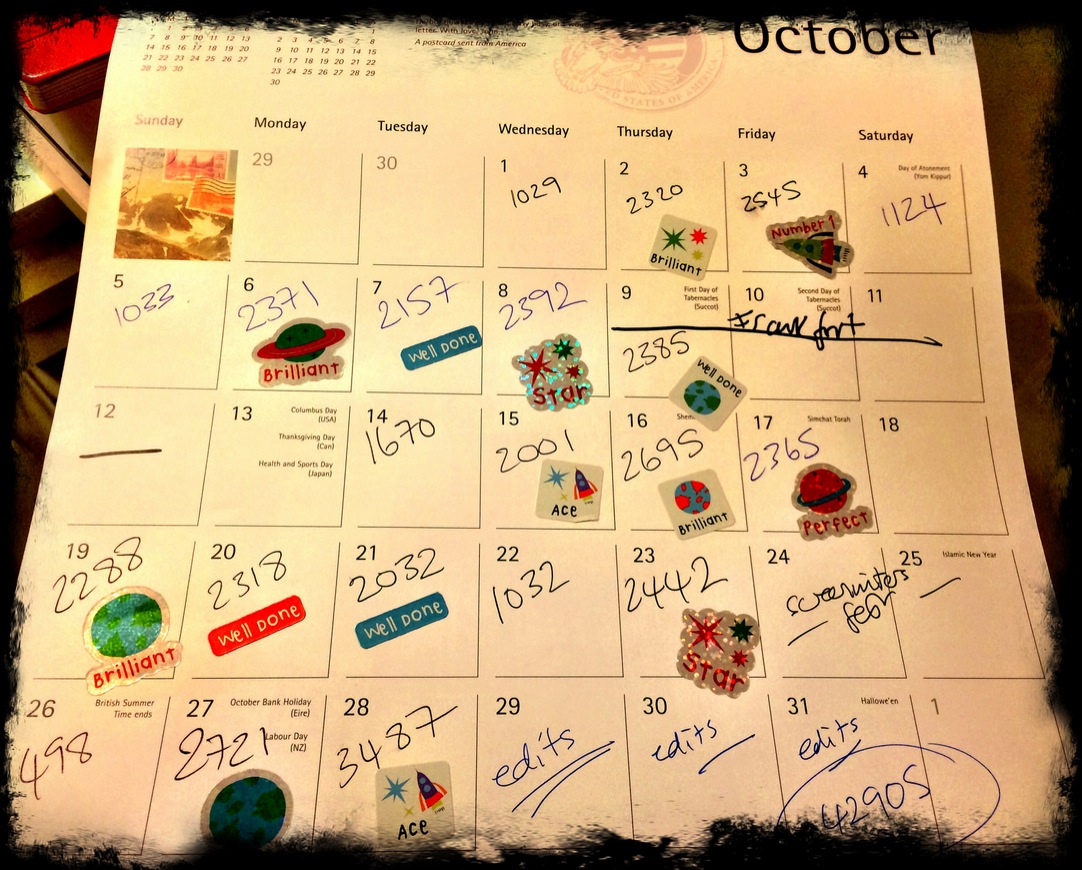
Tracking your progress can help to make you feel like you’re achieving.
Some authors use spreadsheets to track time writing and/or number of words. You can also just write them on a wall chart, or in an app.
I use Scrivener to write all my books, and it has a Project Targets section where you can set and track word count per session. I also use colored flags, turning the chapters yellow when I have finished the first draft.
I turn them blue after editing and green when they are finished and ready to publish. This makes a huge book more visually manageable, and if I can turn one flag yellow by the end of a session, I feel like I have won the day.
Stay focused and beware of shiny object syndrome
“You must finish what you start.” Robert A. Heinlein
There will always be distractions, and finishing a novel has a lot to do with your ability to focus over a period of time.
“Ooh look, a new story idea! That is so cool, much more interesting than this old idea I’m working on over here. Why don’t I just spend a bit of time on that new, shiny story?” If you feel this urge and give in to it every time, you will never finish your novel.
You will always have other ideas as you write. It’s part of the creative process. If a new shiny idea strikes in the middle of your novel, write it down in a couple of sentences wherever you keep your idea lists, then turn back to your work in progress. And beware of trying to write multiple books at the same time, as you may not finish any of them.
Write fast, cycle through, or write slow
Authors approach first drafts in different ways, and it’s worth experimenting to find what suits you.
Write fast and rough. Clear your schedule and produce words daily, or at least every couple of days, so you stay in the world of the story and keep your momentum. Don’t edit as you go. You might have more to do in edits later, but at least you will have your block of marble to work with.
Write fast, cycle through. Write your words fast, but at the start of each session, circle back over the last scene and lightly edit before continuing into new words. Your draft will be tighter, and some authors finish with a clean draft on the first pass this way.
Write slow. Some authors focus on making each sentence the best it can be before moving forward, which means fewer, more polished words per day. But beware: if you engage the critical editor brain too early, you may pull your story apart before it has even come to life.
“If your goal is to become a faster writer, the single most efficient change you can make isn’t actually upping your daily word count, but eliminating the days where you are not writing.” Rachel Aaron, 2,000 to 10,000
When is a first draft finished?
My definition of a first draft is a version of your book that can be read end to end and stands as a coherent whole. It doesn’t have “fill this in later,” or “write a fight scene here,” in it.
Yes, it will be rough, and it will need editing, but to get to a finished book, you need a first draft to work on.
Your finished book can be equated to Michelangelo’s David, a perfect statue that emerged from a rough block of marble. But first, you have to create that block of marble, and for authors, that’s the first draft.
How long does it take to write a first draft?
It’s impossible to give one answer because there are so many variables: how developed your story is, your experience, the genre, the length of the book, and how much time you set aside for writing. But you can estimate it.
If you write 1,000 words per session and you’re aiming for a 70,000 word novel, that’s 70 writing sessions of first-draft material. At four sessions per week, the first draft will take around eighteen weeks, or four to five months.
Remember Parkinson’s Law: work expands so as to fill the time available for its completion. If your goal is to finish your novel, set a deadline and schedule your writing time accordingly, otherwise you could spend years, or even decades, working on it.
My first novel took around nine months of early mornings, evenings, and weekends for the first draft, and about sixteen months from idea to finished book. I’ve improved my process and speed a lot since then, and you will too.
When you get there, celebrate. A first draft is a tremendous step toward a finished novel. Non-writers won’t understand what this means, but I do. Congratulations!
For more details, check out How to Write a Novel: From Idea to Book
Next Step: Editing
Editing, revisions and proofreading: What happens after the first draft?
How to Find and Work With a Professional Editor
My list of recommended editors
Tips for Editing your Book with Natasa Lekic from NY Book Editors
Need more help?
If you’d like some more help on your author journey, check out:
- My Books for Authors
- The Creative Penn Podcast, interviews, inspiration and information on writing, publishing, book marketing and creative entrepreneurship every Monday
- My videos at YouTube.com/thecreativepenn