Is it your dream to write a novel? Are you unclear on the process?
Perhaps you’ve read a ton of books on writing or done a class, but you’re still confused about the way forward.
Don’t worry. I know how you feel!

I’m Joanna Penn and I write award-nominated, bestselling thrillers, crime, horror, and dark fantasy as J.F. Penn. I’ve been writing and publishing fiction since 2009, and I make a living with my writing.
I’ve made a lot of mistakes along the way, so hopefully I can help you avoid them and finish your first novel.
The writing craft is like an iceberg, with hidden depths you can spend your whole life exploring. When you’re writing your first novel, it can be overwhelming to try to learn everything at once.
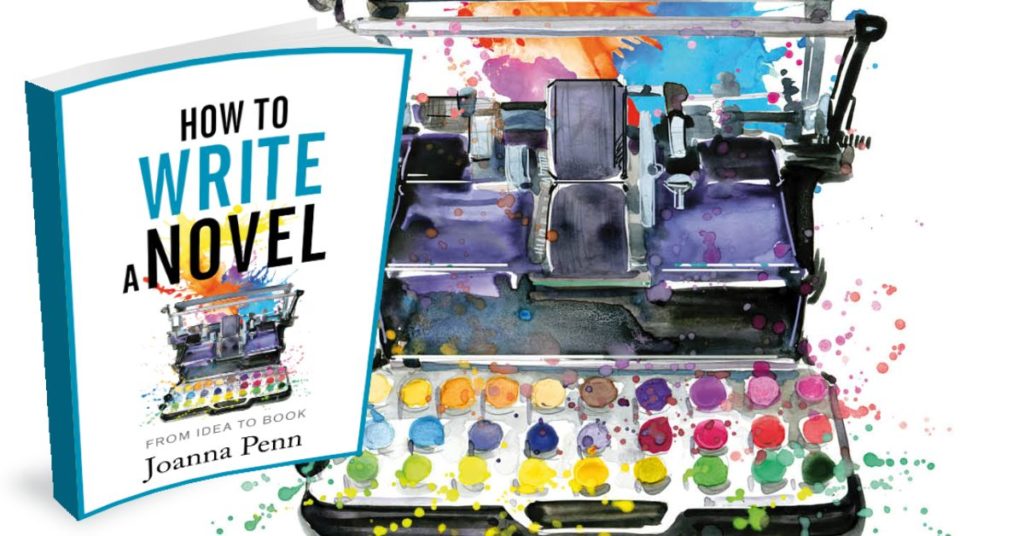
But you only need to know about the small section of the iceberg above the water to get that first book written. Here are the seven steps, and if you want to go deeper, everything here is expanded in my book, How to Write a Novel: From Idea to Book.
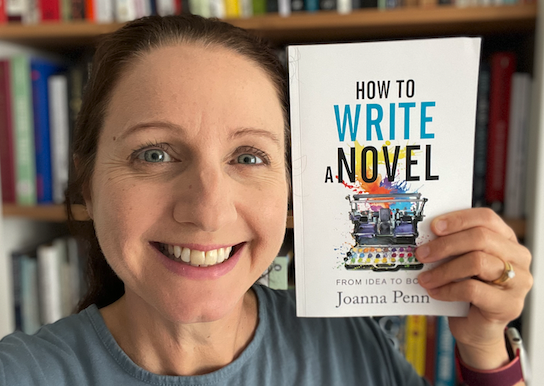
Listen to the full audiobook of How to Write a Novel free on YouTube:
How to write a novel in 7 steps
- Understand why you’re writing and what you’re writing
- Fill your creative well
- Decide how you’ll write: outline, discovery write, or both
- Write a story, not just a pile of words
- Create a character with a goal, conflict, and a setting
- Get words on the page for your first draft
- Rewrite and edit
Plus answers to common questions about how long it takes and how long a novel should be.
(1) Understand why you’re writing and what you’re writing
Before you put pen to paper or fingers to keyboard, it’s worth stopping for a moment to think clearly about what you’re doing. Firstly about yourself, and then about the reader.
Why do you want to write a novel, anyway? What is your definition of success?
Do you just want to hold your book in your hands? Do you have a burning desire to change people’s lives with your words, or do you want to make an income from your writing?
The answers to these questions will shape what you write, how you publish, and whether you’re happy with the result.
Identify the books you love, not the ones you’ve been told to appreciate
I studied English literature at school and read the classics. I was taught that the only books worth writing were literary fiction.
But the books I loved as a teenager were the Hardy Boys adventures and Wilbur Smith’s African stories, and years later, I read thrillers on the commuter train to a day job I hated. When The Da Vinci Code hit the bestseller charts, I saw the kind of fiction I wanted to write.
As a reader, I only read books I love. As an author, I only write the books I love and want to read.
Your novel will not be a journal for your eyes only. At some point, a reader (hopefully lots of them!) will pick up your book. Who are they? Which other books and authors do they love? Where would they find your book on the bookstore shelves?
These are important questions because, however you want to publish later on, you need to understand where your book fits.
If you get an idea of this now, it will help you shape your story as you move forward.
What are the 5-10 books that are similar to the story you want to write?
Which authors write the books that you love and are similar to your future book?
Choose authors who are publishing in today’s market rather than classic literary works, so you understand what readers expect now.
Write down your list and then look each book up on Amazon. Scroll down to the Product details section and find the Best Sellers Rank, which includes the categories where the book is ‘shelved,’ sometimes described as the book’s genre.
If you know where your book sits from the outset, you know what you’re aiming for. You can write what you love, but you can also write something that will find an audience.
How long should your novel be?
Novels are anything over about 50,000 words, and length varies by genre and reader expectations.
Romance is often closer to 50,000 words, with thrillers, crime, and mystery usually around 70,000 to 90,000 words. Beware of writing an epic fantasy under 120,000 words!
Go back to your list of books like the one you aim to write. Check the page count and assume around 300 words per page, then multiply to get a rough estimate. For more on length and format, see novel, novella, or short story? Word counts explained.

(2) Fill your creative well
“Where do you get your story ideas from?”
This is one of the most common questions for authors and one I used to struggle with. I spent thirteen years working in large corporates implementing financial systems, possibly one of the least creative jobs possible! I felt like I would never have any ideas or original thoughts.
I needed to retrain myself to recognize ideas because you can’t write a book without them.
Follow your curiosity
When you walk into a bookstore, which sections do you browse? If you overhear a conversation, what do you notice about the people? When you decide what to watch, what do you choose? What interests you?
When you go to a new city, where do you want to go first? Do you like architecture, museums, or historical places? Do you want to eat the local food, go dancing, or talk to the local people?
These instincts are often things we take for granted, but becoming aware of your curiosity is the first step to finding ideas. Once you begin to notice what you’re interested in, you can take the next step.
Write down the sparks that appear
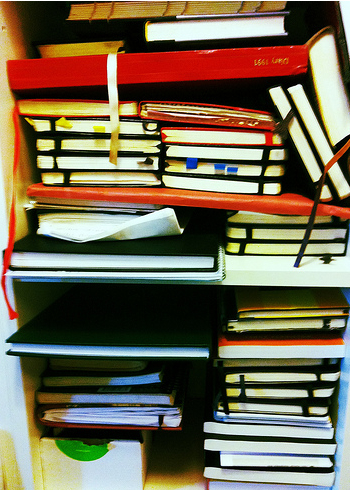
These don’t have to be fully formed ideas. They can be anything from quotes to sensations, to places or things that you see.
I use plain-paper notebooks and a notes app on my phone, and I take lots of photos when I travel.
These ‘sparks’ can become part of stories over time. For example, when I visited the Hunterian Museum in London, I wrote down the sensation I felt when I looked at the medical specimens in jars.
That location and those specimens became the basis of Desecration, my first crime thriller, a murder mystery with an anatomical theme.
One of the characters, Blake Daniel, came to me fully formed after I visited the British Museum and wondered what it would be like to work there.
For more on this, see how to find and capture ideas for your novel.
Trust that other people find the same things interesting
Whatever you’re into, there are people online who love those things too.
Your ideal reader doesn’t have to be in your town. They might even be on the other side of the world!
I always thought I was a bit weird because I enjoy visiting graveyards. I find them beautiful, peaceful places and I bring this awareness of death into my fiction.
It turns out that a lot of other people enjoy graveyards too, and when I started sharing pictures and writing about them, I found a whole new community!
Once you’ve tuned into your curiosity and started writing down your ideas, you’ll find that they coalesce into potential stories over time.
Research, but know when to stop
Research can be one of the joys of writing a novel, especially if you love learning.
But it can also become a form of procrastination. Research enough to get started, then keep researching as you write and fill in the details when you need them.
Here’s more on how to research your novel and when to stop.
(3) Decide how you’ll write: outline, discovery write, or both
There is no single right way to write a novel, but most writers sit somewhere on a spectrum between outlining and discovery writing.
Outlining (or plotting)
Writers who outline spend more time up front working out how the story will progress before they start writing the manuscript.
Some outlines are a single page, while thriller author Jeffery Deaver writes outlines of around 150 pages.
Outlining can result in more intricate plots and twists, less time rewriting, and a faster first draft, because you focus on getting the words down rather than figuring out what happens next. If you want an agent or a publisher, you may need to write an outline anyway.
The risk is that some writers get lost in outlining, world-building, and character profiles, and never actually write the book.
If you want a structured way to outline, listen to my interview with Randy Ingermanson on how to write a novel with the Snowflake Method.
Discovery writing (or pantsing)
Discovery writers start writing and work out the story along the way.
The word ‘pantsing’ comes from ‘flying by the seat of your pants,’ but I’m British, and pants are underwear, so I much prefer the term discovery writing!
If you don’t know what will happen next, the writing process has the intensity and excitement of discovery, and that can make the finished story just as exciting for the reader. Stephen King is a discovery writer, and Lee Child wrote his Jack Reacher thrillers by starting somewhere and asking, “Now what happens?”
The risk is that you write yourself into a corner, and you may have to cut or rewrite more in the editing process. That’s not wasted time.
It’s part of the discovery.
Find the process that works for you
It took me more than a decade to embrace being a discovery writer. I tried over and over again to outline because that’s what ‘everyone’ said was the best way, but it made me miserable and didn’t feel creative.
Now I start with a character, a setting, and a few one-line placeholders for scenes. I write out of order, research as I go, and when I reach around 20,000 words, I stop and reread so I can note the open questions and work out what else needs to happen.
Try different approaches, then tune into what feels right for your personality and your lifestyle. We all end up with a finished book regardless of how we get there. For more detail, read outlining vs discovery writing.
(4) Write a story, not just a pile of words
A professional editor once told me about the biggest problem he finds with manuscripts from first-time authors. “They give me a load of typing, instead of a story.”
And prize-winning writer Flannery O’Connor said, “Most people know what a story is until they sit down to write one.”
So even if you have read thousands of books, it’s still hard work to write a story that readers love.
Too many writers start a novel by writing words on the page with no direction and soon run out of steam, wondering what’s wrong.
This is where you need to understand the basics of story structure, but don’t worry, it doesn’t have to be complicated.
Keep your story simple
All you need for a story is:
- A character
- In a setting
- Who has a goal
- Who has to overcome all kinds of conflict on the way to achieving that goal, while
- Someone or something tries to stop them
- The character either achieves their goal or fails
- And along the way, they go through some kind of transformation
If you find yourself lost in too much detail at any point, return to this roadmap.
Stop and simplify.
Consider what you love about your favorite books as a reader
 How do the books begin and end? Why do you want to turn the pages? Is the book part of a series? Why do you crave these types of books?
For example, I write supernatural thrillers, and my ARKANE series has been described as ‘Dan Brown meets Lara Croft.’ Readers of my books also like Steve Berry, James Rollins, and Clive Cussler, authors of fast-paced adventure thrillers, many with an edge of the supernatural.
This type of story usually has a single protagonist who has to save the world before the bad guys destroy everything.
There’s a ticking clock that keeps the plot moving, and puzzles to solve, as well as global locations and a final confrontation between good and evil. This fits with the expectations of readers who like supernatural thrillers.
Another great example is the romance genre, where readers are some of the most voracious and demanding in the publishing business.
If you want to satisfy romance readers, you need to deliver the HEA, the Happily Ever After, as well as obligatory scenes like the first kiss.
Use classic story structure to expand on your ideas
The three-act structure goes all the way back to Aristotle’s Poetics, and many of the best-loved stories follow this tried and true path. At a high level, it’s simply a beginning, a middle, and an end.
Structure and boundaries help you to be more creative, and you’ll find it easier to come up with the various aspects of your story if you follow it.
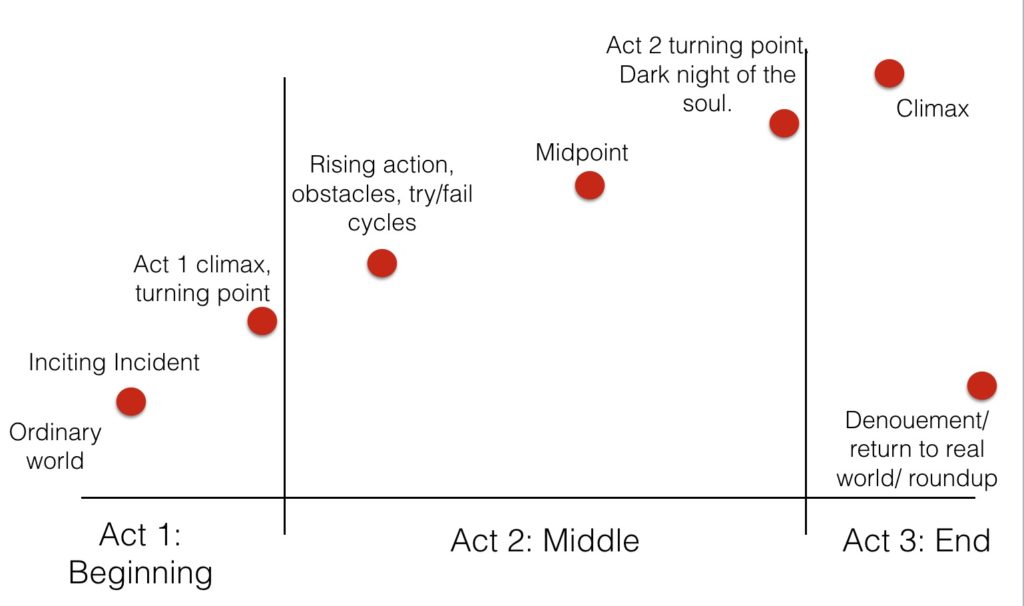
Act One: The story starts in the ordinary world of the character, then the inciting incident happens to kick-start the story.
Act Two: This is the bulk of the novel. There is rising action and conflict, complication, and progressively more difficulty. The character tries to get what they want, fails, and keeps trying. Things get really bad at some point.
Act Three: In the climax, the story reaches its peak, and the character achieves their goal or fails, depending on the genre. The story questions are resolved and there is a satisfying conclusion.
As an example, consider The Hunger Games.
The book opens in the ordinary world of District 12, where Katniss hunts for food for her family under the control of the Capitol. Then her sister Prim is chosen at the Reaping, which is the inciting incident, and Katniss volunteers to take her place.
Act Two is the preparation for the Games and the deadly arena itself, where Katniss has to fight to survive. In the climax, she refuses to kill Peeta, and together they defy the Gamemakers so that both of them survive. She returns home to District 12, forever changed.
This same story structure is used for many bestselling books and films, so it’s definitely worth using to help you finish your first book. After all, if it ain’t broke…

(5) Create a character with a goal, conflict, and a setting
If you want readers to spend their precious time on your book, you have to write a character who keeps them engaged. This doesn’t mean that you need a goody-two-shoes perfect person, but you do want a compelling, authentic protagonist who hooks the reader, so they are desperate to know what happens next.
Use one main character
The multiple character arcs of A Game of Thrones might make for compelling reading and watching, but it’s much easier to start by focusing on one central protagonist.
Consider Katniss Everdeen in The Hunger Games, or Harry Potter. There are other people in the worlds of those books, but the main characters are the ones we care about most and follow through the story.
Remember that the bad guy never thinks they are the bad guy. They are the hero of their own story.
Choose your point of view
Your character shapes the point of view (POV) you write from, and every story is different from a different perspective.
First-person POV (I walked into the bar) puts the reader in the character’s head. It’s intimate and common in YA and romance, and The Hunger Games is written this way. But the reader can only know what that character knows.
Third-person POV (Jim walked into the bar) is the most common choice for novels because you can tell the story from several perspectives, as George R.R. Martin does in A Game of Thrones. Just be aware that every extra POV character makes the book longer!
Most stories have one main protagonist, with the chapters weighted toward their POV. I write my ARKANE thrillers mostly from Morgan Sierra’s POV, with a few scenes from the antagonist and from her partner, Jake.
Focus on these questions
- What does your character want and why? What or who stops them?
- How do they overcome the obstacles along the way?
- How are they changed as a result of the journey?
Go back to the books you love the most, and you are likely to find that these are the core aspects of those stories. For more on this, see 15 tips for writing deep character. All my character episodes and articles are gathered on the How To Write Compelling Characters page.
What happens, why, and where?
Once you have a character and you’ve considered what they want and why, you can start fleshing out the details of what or who stops them from getting it.
You can also think about where this will happen, otherwise known as the setting. You can’t just have characters talking to each other in an empty white room.
There needs to be action that takes place somewhere specific.
Use setting to bring conflict to your plot
A Game of Thrones is a great example. Take Jon Snow at the Wall in the North.
The Wall keeps out the Wildlings, who fight the Night’s Watch, and then it becomes the only thing standing between the realm and the White Walkers.
The ice and snow bring a dark, cold tone to the experiences of the characters and make life much harder than for those who live in King’s Landing in the sunnier south.
The Hunger Games also uses setting to drive the plot, with much of the first book taking place in the arena, where Katniss must survive the deadly traps set for the tributes.
It doesn’t have to be all death and destruction, though! In Gone Girl, Nick must find his missing wife, Amy, and figure out the psychological games she has been playing as he falls into the domestic traps she has set.
Remember that plot and setting are experienced by the character, and the closer you get to the emotions of the protagonist, the more your readers will resonate with the story.

(6) Get words on the page for your first draft
When you read a book that makes you think, ‘I could never write something like this,’ stop for a minute. Because that is NOT what the author wrote the first time they put pen to paper. Everyone starts with a first draft, and most authors would never show that draft to anyone.
Give yourself permission to write a messy first draft
“For me and most of the other writers I know, writing is not rapturous. In fact, the only way I can get anything written at all is to write really, really shitty first drafts.” Anne Lamott, Bird by Bird
Once you understand that you will rewrite your work later, especially when you’re first starting out, you can let go of any sense of judgment over what you write.
In my experience, the amazing ideas I have in my head turn out to be a mess on the page. Finding the right words is difficult. And how on earth did my character even get into this dilemma in the first place?!
But you can’t edit a blank page, so just get as much down as possible. Don’t obsess over word choice, just get black on white and work it out later.
I try not to reread my words until I’m ready for the second draft.
Schedule your writing time
Do you schedule your gym classes? Your children’s school events? Your meetings at work? So why don’t you schedule your writing time if it is that important to you?
I use Google Calendar and schedule my writing time in blocks. When I worked a full-time day job, I would get up at 5 a.m. and write before work, because I knew I’d be brain-dead when I got home.
Now I tend to go to a café or a co-working space and write while listening to rain and thunderstorms on my noise-cancelling headphones.
Anything to quiet that critical voice!
Use focused, timed writing
Once you are in your specific place at the specific scheduled time, you need to focus. No email, no social media, no messaging.
You are there to write.
Set a timer and start small, since writing takes stamina and you have to build it up over time. Try ten minutes and just write down what your character is doing in a particular place. Allow yourself to write badly without censoring, and I guarantee there will be something worth saving!
Take a quick break and then do another ten minutes. Repeat until you have your first draft. It really is that simple (but not easy), and once you get the bug, it’s immensely satisfying and addictive!
Bonus tip: You can write by hand, or in Word or Google Docs, but many novelists use Scrivener, which helps you organize your scenes and move them around.
I have personally found it life-changing!
Know when the first draft is finished
I consider a first draft finished when it is a coherent story from beginning to end, without notes like [insert action scene] or [come back to this later].
It won’t be perfect, but the main story questions are answered, the character has changed, and it feels complete.
Take a moment to celebrate. A first draft is a tremendous step toward finishing a novel. For the detailed process, see how to write the first draft of a novel.
(7) Rewrite and edit
“Books aren’t written. They’re rewritten.” Michael Crichton
This is particularly true when you first start writing fiction, because there is a huge gap between the books you love and the first draft you have created. But that’s okay because you can now edit the manuscript into something much better!
Start with self-editing
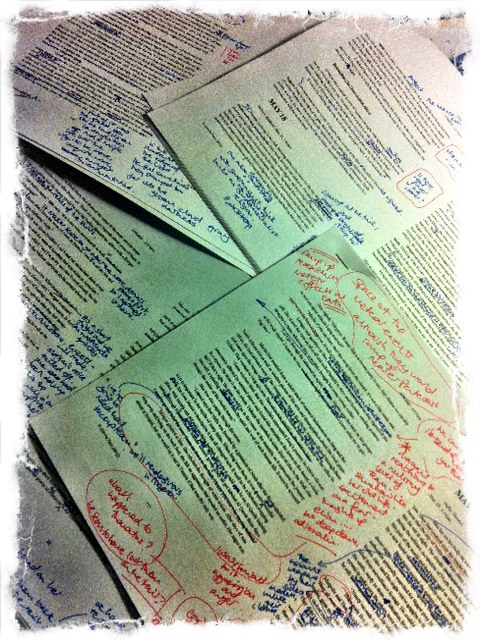
I like to print out my entire draft and edit by hand.
I end up with pages of scribbled notes, arrows, extra scenes, and strike-through marks across whole pages, as well as grammar and typo fixes.
Then I put all those changes back into my Scrivener document, remembering to back up my files along the way, of course!
That first edit is usually the most significant one, and then I go through the manuscript once more before working with a professional editor.
Use professional editors
The best way to improve your writing is to work with an editor on your manuscript.
If you want an agent, improving your manuscript before submission is a good idea. If you’re self-publishing, this step will make your book more likely to please readers.
Click here for my list of recommended professional editors, and find out more about how to find and work with a professional editor.
There are different types of edits. A structural edit, also called a developmental or story edit, checks whether your structure is working, whether your characters are engaging, and whether your plot has massive holes. You’ll receive a report with details on how to improve the book.
Too many writers think editing is about fixing typos, but that is the least important thing at this stage. Readers will forgive clunky writing if your story is amazing.
After all, Fifty Shades of Grey has sold more than 100 million copies! A structural edit is often the best way to improve your work, and then you can rewrite based on the suggested changes.
The next stage is a line edit or copy edit, the classic ‘red pen’ approach, where an editor works through your whole manuscript and you make the changes that will improve the book further.
Some authors also use beta readers, who are fans of the genre and read the book before publication to pick up any issues.
After more rewrites, the book will need proofreading, which is the final check for typos and anything else that may affect the finished product. For the whole process, see what happens after the first draft, and my lessons learned from rewriting my first novel.
 Then it’s done.
Congratulations, you can now hold your novel in your hand and say, “It’s (finally) finished!”
This article has been a whistle-stop tour through the process, but I want to reassure you again that it is possible.
You can finish your novel.
I know because I’ve done it many times, and I’m still writing more. It’s hard work, but it’s worth it!
So I wish you all the best with your book.
Frequently asked questions about writing a novel
How long does it take to write a novel?
It depends on how developed your story is, your experience, the genre, the length of the book, and how much time you set aside.
You can estimate it. If you write 1,000 words per session and aim for a 70,000-word novel, that’s 70 writing sessions. At four sessions a week, the first draft will take around four to five months, and then you need time to edit.
My first novel took around nine months to draft in the early mornings, evenings, and weekends around a day job, and about sixteen months to go from idea to finished book. Writing speeds up once you know how the process works.
How many words is a novel?
Anything over about 50,000 words is usually considered a novel.
Romance is often closer to 50,000, thrillers and crime usually 70,000 to 90,000, and epic fantasy 120,000 or more. Novellas are around 20,000 to 40,000 words. See step 1 for how to check the length of books in your genre.
Do I need to outline my novel?
No.
Many successful authors outline, and many are discovery writers, like me. Try both and use what works for your personality. See step 3.
Should I edit as I write?
Most writers find it easier to finish the first draft before editing, so you don’t get stuck polishing the opening chapters forever.
You can’t edit a blank page, so get the story down first and make it better on the next pass.
Do I need a professional editor?
It’s not compulsory, but working with an editor is the fastest way to improve your writing, especially on your first novel. Find out more about how to find and work with a professional editor.
What are you waiting for? Go write!
Do you need more help?
If you want to get started on your novel right now and go into these topics in more detail, check out my book, How to Write a Novel: From Idea to Book.
 Want to know more about publishing?
Click here to get my free Author Blueprint, an ebook that covers writing, publishing, book marketing, and making a living with your writing, along with regular emails to help you on your author journey.
Or, if you prefer audio, check out The Creative Penn podcast for weekly information and inspiration on writing, publishing, book marketing, and creative entrepreneurship.
If you have any questions, you can find me on X @thecreativepenn or contact me here.