OLD POST ALERT! This is an older post and although you might find some useful tips, any technical or publishing information is likely to be out of date. Please click on Start Here on the menu bar above to find links to my most useful articles, videos and podcast. Thanks and happy writing! – Joanna Penn
Podcast: Download (Duration: 50:48 — 40.7MB)
Subscribe: Spotify | TuneIn | RSS | More
 When I started writing fiction, I found dialogue to be one of the hardest things to write. It's rarely used outside of a fiction context, and I spent a lot of time learning all about it. I still do! Today I'm thrilled to be discussing how to improve dialogue with James Scott Bell.
This podcast is sponsored by Kobo Writing Life, which helps authors self-publish and reach readers in global markets  through the Kobo eco-system. You can also subscribe to the Kobo Writing Life podcast for interviews with successful indie authors.
 James Scott Bell is the best-selling and award-winning author of thriller novels, zombie legals, historical romance, and lots and lots of books on the craft of writing. He’s a professional speaker, teaching novel-writing and other skills for writers, and his latest book is “How to Write Dazzling Dialogue.”
You can watch the interview on YouTube here, listen above or on the podcast feed on iTunes or Stitcher, or read the transcription below. We discuss:
- Why is
 dialogue so important anyway? Can’t we just write lots of paragraphs with no one talking to each other?
 - Overuse of names and differentiating voices
- How to learn about dialogue by listening and other techniques
- Beware of stereotypes in characters
- Weaving action into dialogue
- Bad language and guidelines for swear words
- Subtext
- Humor in dialogue
- Punctuation
- On James' fiction – he writes across multiple genres
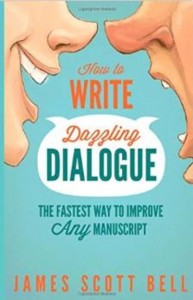
You can find James and his books at JamesScottBell.com and on twitter @jamesscottbell.
Transcription of interview with James Scott Bell
Joanna: Hi, everyone, I’m Joanna Penn from TheCreativePenn.com, and today I’m here with James Scott Bell! Hi, James!
James: How are you?
Joanna: I’m good, it’s great to have you back on the show. Just as a little introduction, James is the best-selling and award-winning author of thriller novels, zombie legals, historical romance, and lots and lots of books on the craft of writing. He’s a professional speaker, teaching novel-writing and other skills for writers, and his latest book is “How to Write Dazzling Dialogue,” which we’re talking about today, and is something that I definitely struggle with, so this is going to be a great discussion.
So, Jim, why is dialogue so important anyway? Can’t we just write lots of paragraphs with no one talking to each other?
James: Well, that would be wonderful if you didn’t want to sell books! If you wanted to bore readers to death! Of course, dialogue is a great part of what we do, and the better it is, the more readable the book is. What I’ve found, too, is, I like to tell people that dialogue is the fastest way to improve a manuscript, because agents and editors and even readers, who aren’t really analyzing it, they just know when the dialogue isn’t working, when it’s flat, when it sounds the same. But when dialogue is really crisp and differentiated and full of conflict and tension, it really stands out, and it allows the person who’s reading it to feel confident in the writer, and to get more involved in the story.
So, it’s really crucial, especially if someone is trying to pitch their novel to an agent or an editor. If they can put really good dialogue in those first few pages, it’ll make a big difference in the positive effect that they generate.
Joanna: Before we go on into the detail, even in non-fiction, now, people are telling little stories, aren’t they, in chapters, and using dialogue can even be a way to bring alive non-fiction.
James: Absolutely. The use of fiction techniques in what’s called narrative non-fiction is hugely important, and in my workshops, I’ll always have a handful of people who are non-fiction writers, and it’s great for them.
Joanna: So this is relevant to everyone.
So one of the big things that I certainly did and have to now delete from my manuscripts is the over-use of names in dialogue, which of course we generally don't do when we talk. So, can you explain what that problem is and how to fix it?
James: One of the things to watch for in dialogue in general is that when two characters are talking, they should not be giving each other information that both of them already know. Because if they do that, it sounds like the author is trying to slip that information to the reader. And names is one of the ways that you can do that, like you said: over-using names is, we wouldn’t do that, because the person I’m talking to knows their name, and so do I. So I think it’s just something to watch for, these little quirks that pop up in—not just our dialogue, but you probably find this: when you write a manuscript, and somebody else reads it, you’ll find that you’ve been using the same expression over and over again, and sometimes it changes from book to book. So that’s just something to watch for on revision, and just always be thinking that when two characters are talking to each other, they should not be feeding each other information that both of them already know.
Joanna: And that kind of applies to the back story and that exposition, right, so I shouldn’t be saying, “Hey, Jim, remember when we were both at that camp and that happened and this happened,” you know, that’s a false way of using it, too, right.
James: Yes, now that brings out an interesting point. Bad exposition dialogue, which I find sometimes that new writers are using and they think they’re being very clever and hiding the information, but it’s sort of like a character opens the door and says, “Oh, hello, Arthur, my family doctor from Baltimore.” You know, that sort of thing.
So, with back story information and especially things from the past that maybe the character wants to hide, there are ways that you can get those out in dialogue, and one of the best ways is to get the people into an argument. When the information is being thrown at another character, sort of as a weapon, it’s a much more natural way for that information to come out. So I say sometimes take your exposition and turn it into a confrontation, and then it will sound more natural.
Joanna: That’s a good one, that really is. I like that.
And how about differentiating voices in dialogue? I mean, how far should one go?
James: I think that’s crucially important. One of the things that I teach in my workshops, and something that I do very early on in any book that I write, is create a voice journal for each character. And what I mean by that is I start a document that’s like a free-form, flowing speech being made by the character talking to me. And I might even prompt with questions and so on, but I allow my imagination just to keep creating words until—and this happens every time—the character starts to take on kind of a voice of its own. And then I’m hearing that character in a new way, and that becomes the sound of it. And if I do that with all the major characters especially, but even minor characters, too, then I find that the voice differentiation takes care of itself, making sure that the characters are different.
I call this orchestration, too. One of the things that I say in my workshops is that great dialogue begins before you write it, by how you orchestrate your characters. And by creating characters that are different from each other in all sorts of ways, physically, mentally, educationally, socially, all of those ways, it, it provides areas for natural conflict between the characters. And if you do that, you’ll find that the dialogue becomes a lot more natural.
Joanna: When you’re planning or plotting, do you make these character sheets, with all of that up-front, so that would be a plotter rather than a pantser approach?
James: Well, before I can write a character, I have to both see and hear the character. So I do what a lot of writers do: back before we were all using the Internet, I would buy magazines and cut out pictures, head-shots, of the characters that kind of resonated with me. Now you can get those images on the Internet. I want to have a head-shot, one that sort of awakens a feeling in me about who this character is. And then I want this voice journal that I spoke about, and then a few basic things about the character, and back story, a little bit of that; a little bit of the timeline of their life. But once I get that in place, the, the character begins to sort of take on a life of their own.
Joanna: I think I do well with visual, because I’m a very visual person, I know I do badly with the audio stuff, which is why I struggle with dialogue. Do you research dialogue by, I don't know, listening to videos or audio, or do you listen to people on buses, if you go on buses!
How do you get that audio sense?
James: It’s a good question. You know, some people, maybe they’re born with a musical ear and so forth, but also people can be trained in music. I used to be an actor, and so I always used to love to go, when I was living in New York, I’d just go to Times Square, and I would just watch people. I’d go to diners and I’d listen. I loved to do that and just absorb, and then practice it when I was, for example, doing improvisation.
In fact, that’s one of the things I recommend to writers, is to take an improvisation class, because it forces you to use that part of your imagination that is making stuff up on the fly. But I tend to listen to conversations that are going on around me and think about the way people are speaking. I think you can do that intentionally, and that will help a great deal.
Joanna: That’s interesting that you were an actor, because I think, obviously, actors have a great voice talent, or develop that voice talent over time, so that’s really interesting.
And what about stereotypes? I think media does this to us. I was at a workshop with a lady from Nashville, and I could hardly understand a word she was saying, and I speak to Americans a lot, so I was like, “This is really odd.” And then my husband struggles with the Scottish accent, and when we hear things that we potentially don't understand, we stereotype a character.
What’s the danger of putting an accent into a character that brings a stereotype?
James: Yeah, that’s a good point, that when you’re trying to render an accent or a dialect, it can, if you allow it to overwhelm the dialogue, seem like a cliché. And so what I suggest is that when you’re talking an accent—let’s say, a Scottish accent, for example—is that you season it with a little bit of dialect, but then let the reader’s imagination fill it in from there. It’ s not a good idea to try to phonetically write out every word as if it would appear: that kind of technique is very old-fashioned and not in use any more. But readers will go along with you if you make a suggestion of it. And then, let the character himself or herself, through their actions and what they say, do the work of characterization.
Joanna: That’s what I was going to say.
So, how do we weave action into dialogue, without just using basic dialogue tags, as in “He said,” “She said”?
James: Tthat’s a strategy question, and it depends on the tone you’re going for, it depends on the pace you’re going for. Dialogue is a great way to increase the pace of a scene. If people are talking, there’s white space on the page, they say, that’s a good thing sometimes, to give readers sort of relief from large blocks of text. So, if you want a feeling of a fast pace, you would use short, crisp dialogue, and moderate the use of action. If you want to slow things down, you would increase the action. So, it’s really a matter of knowing your tools, and then knowing the feeling that you want to generate on the page, and then you just moderate that way.
Joanna: And I guess, going deeper into that, balancing a line of dialogue with “She put her head in her hands,” you know, versus she said the same line of dialogue and leaped in the air, so that you can use that kind of description to change the dialogue: would that be correct?
James: Are you talking about using, say, just a little action beat instead of something like “she said”? Is that what you mean?
Joanna: You don’t always have to put an exclamation mark, for example, at the end of every line, which obviously some people do.
James: That’s right. No, exclamation points are one thing that should be used very sparingly with writers, because it does feel a little bit like manipulation after a while.
Now let me talk about attributions, “he said, she said.” My theory on that is that the basic “he said,” or “she said” or “he asked,” “she asked,” is virtually invisible to the reader. It doesn’t pose, make them work any harder. And it does its job by telling them who’s speaking. Now, for variety’s sake, sometimes you put in, instead of that, a little action beat. But my feeling on that is that the action beat should have some relevance to the scene. I have seen some writers attempt to write a whole novel without ever using “he said” or “she said,” and instead substituting these little actions. But what happens is, every time you write an action, it, it starts to, it makes the reader work at the visualization. And if they are innocuous, the reader’s going to feel a little bit like this is a tougher read than it should be.
So I don’t advocate people doing that exclusively. Use it for variety’s sake: don’t be afraid of “he said,” “she said,” it does its work, gets out of the way, and it allows the dialogue to stand on its own.
Joanna: And what about cursing? Because I used the f-word, I think twice in one book, and I got more complaints about that than about a kind of ritual murder, of a child, actually. And I was like, “What’s going on there?”
So, are there any guidelines about cursing?
James: Well, this is a great sort of subject for controversy among writers. Some writers are saying, “Look, if I’m writing a contemporary crime novel and it’s going to be realistic, I’m going to have that kind of language.” On the other hand, back in the 40s and 50s, people wrote these great crime novels without explicit language. So my feeling on that is that the writer is in full control, the writer can find ways to stylize language and scenes, in virtually any way they choose. Now, the f-word issue is that there is a group of people out there that that offends, but the author needs to make a judgment on that. If they feel like they have to use that kind of language for their scene, then they will, and they’ll take whatever the consequences are.
My own view, my feeling is, I don’t need to do that, and I don’t really care to do it, but I just think every writer should be informed about the plusses and minuses about it.
Joanna: That’s interesting. I was going to ask about sub-text.
Can you explain what sub-text is and how that works with dialogue?
James: Well, sub-text is a great technique for creating dialogue that isn’t just plain, surface-level dialogue, there’s something more going on there that the reader will pick up. They’ll pick up that, “Hey, wait a minute, the, the way that this character’s responding is a little strange.” That’s because the reader knows what the sub-text is.
Now, sub-text can be anything from previous relationships that the characters have with each other that, that aren’t clear yet, it can be things from the past, back story, secrets, things that have happened in the story thus far.
One of the movies I like to use as an example is Casablanca. There’s a great scene in the early part of Casablanca where Rick is in his saloon, and the, the new Nazi major who has come to take over operations there, sits down with Rick and with Louis the little French captain, and another Nazi from the SS, and they have this great little surface conversation that seems all so friendly, but really the Nazi is trying to get the American to give up information. And they say things with all sorts of sub-texts, and one of the lines that Rick says, when the major says, “What happens when we get into your beloved Paris?” and Rick says, “Well, it’s not particularly my beloved Paris,” and why did he say that? We don’t know yet, but later we find out that Paris is where he met Ilse and was betrayed by her, he thought. So that’s all a way to get the dialogue to mean more than what’s just on the surface level.
Joanna: You mentioned movies there, and recently I’ve watched the True Detective series, which is absolutely amazing, and I just loved it, and I want to get hold of the, the screenplay, which I can’t, I can’t seem to get hold of it. I wondered, first of all asking you, as an actor, where do we get screenplays from if we want to read them?
James: Well, there are sites out there, you can just Google.
Joanna: I tried, I used “True Detective script”.
James: Oh, well now True Detective may not be available, because it’s recent, and they may be withholding dissemination of it. But if you’re looking for screenplays of movie classics, for example, there are sites that make those available. And it’s very instructive. I have some clips in my book from some of the classic movies, because the dialogue in those movies is so great, to show these various techniques. And they’re available, you can just take a look at them and usually they’re downloadable PDFs, and they’re wonderful ways to study dialogue.
Joanna: And then, you might think this is obvious, but if I’m trying to learn from dialogue in a script, should I be reading that out loud, because you find really great dialogue, like you say, you don’t even realize it’s happening, so in order to actually study dialogue—I’m trying to work this out—do you, would you read a script out loud, and try and work it out?
James: Yes! I think that’s a great way to do it, when you read out loud.
You can even read great dialogue in a novel out loud, as a way to sort of get that sound in your head, and it helps you to differentiate between characters and do all the things that we’ve been talking about.
There are also collections of screenplays in book form that you can find on Amazon and so on, any of those items would be good for study and, like you said, reading out loud, just kind of looking at the words on the page. One of the things I suggest in this book is to take a screenplay scene and then rewrite the dialogue but make it a scene as if you were writing a scene in a novel, adding little actions and so forth, and that’ll kind of just give you the rhythm of creating dialogue on the page.
Joanna: Do you write screenplays as well?
James: Yes, I do, I started as a screenwriter, and that’s really how I learned almost everything, structure, scene-writing, visual scene-writing, dialogue, and all of those things. When the fiction started to take off, I really concentrated on that, but I’ve been able in the last couple of years to work on a couple of screenplays that are out there in development and so forth. So, I still try to keep my hand in that.
Joanna: That’s interesting, going a bit off-topic, but I’m going to go to London Screenwriters’ Festival, because every time I talk to people like yourself, they say screenwriting can really help you with your book. And Chuck Wendig, I’m sure you know, says that only by doing a screenwriting exercise with his first book was he able to write a good book!
James: Like I said, I’ve written a book on plot and structure, as you probably know, and most of what I learned about structure, I learned from watching movies and analyzing and taking them apart and putting them back together again, and with a screenplay, first of all, you’re writing mostly dialogue, and you’re really getting into a scene and out of a scene without a lot of hesitation, and that’s really a great skill that many novelists need to learn, too.
Joanna: I’m fascinated by it, and I’m almost at the point of wanting to do an adaptation kind of idea,. Anyway, that’ll be another discussion.
But getting back to dialogue, what about humor? How does humor work with dialogue?
Because I struggle with humor as well, I’m not very funny!
James: Well, one of the nice things about dialogue is, we’ve all had the experience of driving home from a party and then thinking, “Oh, if only I had said THIS,” the perfect line comes to you, 20 minutes later, or the next day. So you can work on it. Now, we both write suspense and thrillers and have a lot of high tension. I love to have what’s called comedy relief within that structure.
Now, my favorite director is Alfred Hitchcock, and Hitchcock was a master of slipping in humorous, ideas, humorous scenes, little clips, or even just characters, within the tense action, and it’s just such a wonderful feeling for readers and audiences, because it increases the sort of emotional connection with it. So, I try to at the very least make at least one quirky character, and by playing around with a quirky character, you’ll find yourself, “Well, hey, this, this character says some funny things,” and putting them in a situation, that’s one way to do it. The other way is just to learn basics of comedy writing. I have a little booklet available on Amazon, called “How to Write Comedy,” which is based on the comedy writing notes of a, a guy named Danny Simon, who’s Neil Simon’s older brother, and he taught Neil Simon and Woody Allen, and he taught this very famous comedy writing class in Hollywood. So I took it and took all these notes, because when he died, he didn’t leave any books or anything. He’s got some very helpful ideas, too, about how you create.
Even for one great line, let me give you one example. He called it ‘curving the language.’ What you do, and I have this in my book, is that you write out a line and it, it might be a cliché, it might be plain vanilla, and then you don’t discard the line, but you tweak it, you play with the words in it. For example, Harlan Ellison, a science fiction writer, once wrote this line: “She looked like a million bucks.” Now, we’ve all heard that cliché before. So what do you do, how do you freshen it up? And the line that he came up with, he just added to it. He said, “She looked like a million bucks, tax free.” And just that little bit of adding something makes the line a little shinier. And that’s one of the ways you can kind of beef up your dialogue.
Joanna: It’s interesting, I asked that about humor because I recently saw Shakespeare’s “Henry V,” I can’t remember the name of the ridiculous character, but I was like we’ve just had this massive scene and now you’ve got this idiot coming on, and then Game of Thrones does it as well, on that show, they’ve got this awful massacre and then some kind of funny scene, and when you start paying attention to it, it’s like you say, there’s like a beat of lightness after massive death! And I need to learn that.
James: Well, Shakespeare was a master at that, right. He wanted to please the groundlings. One of my favorite characters is the Gravedigger in Hamlet. That’s, that’s a perfect example about here in this heaviness of that play, you have this wonderful character appearing. So, again, quirky characters can make all the difference.
What it does is, it elevates the emotional connection and the tone of the book. It it gives it an extra flavor, and what readers do, they don’t really analyze that, they don’t say, “Ah, he’s adding an extra flavor,” they just experience it, and when they finish the book, they think, “Wow, that was really great!”
Joanna: Great, so just one thing on punctuation. We mentioned exclamation marks, but I got the basic punctuation wrong when I started writing fiction. As a non-fiction writer, coming into fiction, there are some things that you don’t know.
So, just give us a heads-up on the correct punctuation for dialogue.
James: Well, in the book I have a whole section on punctuation, every kind of nuance that arises, you can study. Basically, all dialogue has punctuation. The punctuation goes inside the closed quotes and then, if it’s a comma, you don’t capitalize the pronoun, like “he said”; if there’s a period, you do capitalize it. There are things like that that people need to know about. For example, how do you render an interruption in, in dialogue?
Some people use the ellipsis—you know, the three dots—but that’s wrong. The interruption is the em-dash, which is the long dash. That’s an interruption, and when you put an interruption like that, the em-dash, you close quote, then the next line really needs to be the character who’s doing the interrupting, or the action that happens that interrupts. The ellipsis, the three dots, is when a voice trails off for some reason; he’s lost in thought and so on. So just knowing those little subtle differences will help.
Joanna: Even those things I remember getting really wrong, and then the editor has to clean it up. I feel that we can all have editors to fix this stuff, but the less they have to fix, the more they can get deeper into the rest of the book, right, so we should know this stuff; you shouldn’t rely on an editor to fix basic stuff like that.
James: Absolutely.
Joanna: So, the other question I had was, you write across multiple genres, and it was so funny when I went back to your website, because of course I knew you wrote thrillers, and I knew you wrote legal things, but you’ve got zombie legals and historical romance, so I was like, “Wow,” you do everything. And my question about this was, does your dialogue differ by the genre that you’re writing?
James: Absolutely it does. When I do a historical, for example, I really feel the difference. One of the craft secrets of writing historicals is knowing how to render dialogue that is not modern-sounding, but yet not so archaic that people can’t understand it. So, for the historicals, I wrote a six-book series that takes place around the turn of the century, 1900, in Los Angeles, and I just read a lot of old newspapers of the day, through microfilm and so on, and just tried to kind of put myself back, reading journals and diaries and so on. Tt was a more expansive kind of language. So, not a lot of cutting off of words, or compressing words: it was more expansive. And that’s a difference.
Then, if I write something that’s more humorous, for example I write boxing stories, written in first person, that take place in the 50s in Los Angeles, I have a whole voice that I developed for that character.
So yes, that’s one of the fun parts, I think, for me, just being able to write in different voices if the dialogue allows me to do that.
Joanna: And do you use speech to text at all?
James: I’ve done that some, but not a lot. I actually mostly prefer to type. But I’ve done some of that, and speaking out. I find it interesting. Maybe you can talk about this—I find my writing’s a little bit different when I do it that way than if I type it. Maybe that’s just my perception, but do you find there’s a different style that emerges?
Joanna: I can’t do it yet! I’m trying to practice. But I think it’s an important skill eventually to get to, because I know so many writers who get RSI and various issues, but I figure, with non-fiction it seems quite easy, but with fiction I just couldn’t even imagine it. But because you’re an actor, you’ve got the acting side, I thought maybe you could get into these voices, you could like act it out!
James: That’s actually not a bad idea! Thank you! I’ll have to think about that. You know, when I’ve used the dictation mode, it’s usually been for sections of a non-fiction project, because when I write non-fiction, I like to write in a very conversational style, so it’s easier for me to do it that way. Interesting.
Joanna: It is interesting.
James: Yes, one of the things I do say in my book, to practice dialogue, usually best done in the privacy of your own home, is to speak it out loud and improvise it verbally, as you’re developing it. I mean, start speaking the lines as the character, speak it out loud.
Do a scene between two characters, almost as if you were doing an improvisational exercise, because the auditory mode allows you to hear it in a different way in your head, and that helps to differentiate the speech, too.
Joanna: And then just one more question on audio books. I interviewed A. J. Hartley, who did “Macbeth” with David Hewson, for audio: they wrote for audio first, and they said it was a very different way of writing, and of course many of us are now using ACX and getting our books out on audio, and I’ve noticed, listening, I’m like, “Ooh, maybe I’d have written that differently.” What are your guidelines if you’re writing for audio? What do you have to do differently?
James: Interesting. I haven’t really thought about writing differently for audio. I write the books, I put some of them on Audible by ACX, and I’ve hired the narrators to do that, but I’ve thought also, if I could just get the time, I’ve got a studio space, so now, if I could just get the time, I’d like to do some of my own reading and put those out there. I might do that soon as well. And I would just imagine I would take the text that as I wrote it, and try to dramatize it.
Joanna: It’s a fascinating thing to consider, isn’t it. I interviewed my narrator the other day, and she’s an actress, and it’s such a different mode, it really is very different, when someone’s listening to it versus when they’re reading it, it’s quite different.
Anyway, onward, what was I going to ask then? How many books have you got? You have so many books!
How many books do you have out in the world right now?
James: Well, I think probably that are available, maybe thirty books or so, there could be one or two others, but, more and more, I’m doing the independent publishing, as you are, and I’m just loving that, simply because when a book is ready, you can put it out there, and there’s not a huge long wait. I do enjoy working with Writers Digest Books, for example, and they’ve been very good folks to work for. So, in the future, though, there may be still a mix of that, but, the other thing I like is, I’m a big fan of the novella form. I think that there are some stories, especially good crime, suspense stories, that are really best told in about 40,000 words. So, I’m going to be doing more of those as well, and in the traditional publishing world, those really have been a hard sell and haven’t really taken off, but in the indie world, there’s no reason why they can’t.
Joanna: I’m glad you said that, because my last book was a novella, “Day of the Vikings,” and it was so much fun, I went to a Viking exhibition, then blew up the British Museum, basically, and I had fun, it was easy to write, it was the easiest, and I felt very satisfied, and it’s selling well, and I was just like, this is great. It’s so hard to write a full-length book, isn’t it; it’s really hard just to hold everything in your head at the same time, and I feel like a novella, it’s more natural, it’s like a natural length—maybe that’s for me and for you, maybe not other people. I’m glad to hear you say that. Fantastic.
James: Well, absolutely, I mean, there are some stories, for example, one of the great er pulp noir stories was “The Postman Always Rings Twice” by James M. Cain, written in the Thirties, and I think that book is only about 30,000 words long or 35,000, which is really a novella that they put out in a little hardback, and it became a sensation, it became a movie, so it did everything it needed to do, but it only needed 35,000 words to do it. So, having the freedom to stop when you’re done is great.
Joanna: I agree. So you do write lots and lots of fiction, and actually you and I are in a box set together, aren’t we, called “Thrill Ride,” which is very exciting, and it’s out now, as, as we’re recording this, and it has eight full-length books—not novellas, full-length books—including my own supernatural suspense, “Desecration,” and your legal thriller, “Blind Justice.”
Tell us about “Blind Justice.”
James: Well, “Blind Justice” is a legal thriller, but is a straight-on legal thriller that, where the case in court is really what the book is about. There’s really two kinds of legal thrillers. One is where there’s some mega-bad guy after people like in a John Grisham, but then there are others where the courtroom battle is really the gist of it. And I’m a former trial lawyer, so I love getting into that idea. And so this is the story of a lawyer who is handling, his life is kind of crumbling, and he’s got a young daughter that he needs to salvage a relationship with; at the same time he’s defending a childhood friend who’s been accused of murder, so I’m very excited to have that book included in our set.
What a great set it is, isn’t it!
Joanna: It is, definitely, and it’s a lot of fun, and I’m asking all the authors this: it’s called “Thrill Ride,” and we’ve got a very exciting cover with a motorbike on, which is great, because my character ride, rides a motorbike in “Desecration,” so that’s really cool, so I want to know, what is most thrilling about you, Jim? Why are you in “Thrill Ride”?
James: Wow, you caught me with that! What is most thrilling? Well, I live in Los Angeles, and I know the place, so whenever any author comes out here, I can show them all the places where really famous murders took place! So if anybody wants that kind of a tour, come on out and see me! But I enjoy what I do, I enjoy where I live, I’m a third-generation Angeleno here, and all of my books are set in, in Los Angeles: if I was smart, I would set them in places like Hawaii and Ireland, and go do research!
Joanna: I was in Spain the other week on a research trip, so, yes, I do that all the time. But come on, something from your miss-spent youth! There must be something!
James: Wow, miss-spent youth! Are you trying to incriminate me, because I know that the Fifth Amendment protects me on this.
Joanna: Something, you must have had a dangerous hobby or paper cut or scars!
James: Well, I did go to the University of California, Santa Barbara, in the 70s, which was kind of a wild place. Now, I hate to say it, but my class level, when I got in there, the class before us had shown, their big political move was to burn the Bank of America, and they were into political rallies and taking over administration offices. My class? We were into streaking. That’s not very much to brag about as far as a cultural transformative moment, but it was college days, and we did that, and used to play a lot of poker.
Joanna: Oh, there we go. One day, I’ll come and have a drink with you and find out all the details!
James: OK, and then it’ll be on your international podcast, I’m sure.
Joanna: Nobody will know, it’s just you and me!
James: OK, deal!
Joanna: OK, brilliant, so where can people find you and your books online?
James: It’s at jamesscottbell.com.
Joanna: Fantastic, and people can get “Thrill Ride” now, and also your “Dazzling Dialogue” book. Thanks for your time, Jim, that was great.
James: Thank you, Joanna.
Joanna,
You can find the scripts for the first two episodes of True Detective here:
http://www.reddit.com/r/TrueDetective/comments/21ej8w/true_detective_ep_1_and_2_screenplays/
Hope this helps.
Kirk
Thanks Kirk – I did find that but it’s not an official source so I assumed it was pirated. I’d rather buy them somewhere official 🙂
Thanks, Joanna
Joanna,
I understand your concern. Screenplays seem to live in a gray area of copyright enforcement. They’re widely available on various mainstream websites that are recommended by those working in the film industry. The industry doesn’t seem to regard this distribution of screenplays as piracy in the same way they do the films and shows themselves. I guess it has to do with the fact that a screenplay is not a film. Or that the work of writers in Holly wood is not highly valued.
Even if you were to buy a copy of a screenplay through a legitimate source, I’m not sure if any of the money goes to the writer, because it’s work for hire.
I am strongly against piracy of books, but I’ve never had a moral dilemma with screenplays. But I’m no legal expert. Maybe James can enlighten us.
Kirk
That’s an interesting point – I think you’re right about the piracy of the film itself being the point. I’m not sure how much of a market there is for buying screenplays anyway 🙂
Hi Joanna! Fan girl, urban fantasy novelist, and tv script writer here, and I was just listening to your podcast with Bell. You mentioned that you didn’t know where to get the “True Detective” script, so I wanted to give you a hand! (I’m also looking for it as I LOVE crime dramas and True Detective was **phenomenal**, hands down. Very much anticipating the next season in January of 2015.)
Anyway, for the script, keep checking this website: https://sites.google.com/site/tvwriting/us-drama/pilot-scripts
And make sure you click on “US Drama –> Pilot Scripts –> 14-15 Season”, when it finally appears. (And it WILL.) True Detective will be on a list of links.
Fyi, in the U.S., we call the first episode of a tv series the “pilot”, and the owner of the site I posted specializes in getting his hands on most pilots from all the tv series that air each year. True Detective WILL be on the download site as it’s getting rave reviews over here in the States. Anyway, I can also get a hard copy of the script if it somehow doesn’t show up online, and if so, I have no problem sending it to you as an email attachment when I do. 🙂
Thanks so much Colby 🙂
LOVE that tip from James about creating a ‘voice journal’! I struggle with making my characters sound different from one another without giving them vocal ‘tics’. I’ve actually been paying attention to how people in my life talk lately, to see if I could pick up any clues about what makes us each sound unique. I’m going to try the voice journal exercise this very afternoon. Thanks Joanna and James!
A fabulous podcast as ever – thanks for all you do, Joanna – I have a couple of books by Mr. Bell and they have some really great ideas in them. Definitely worth reading.
However, I just had to say in response to your first question about why we cannot get away without having dialogue in a book and then Jame’s reply about ‘boring the reader’: As I Walked Out One Midsummer Morning by Laurie Lee has barely any dialogue and is an absolutely fabulous and absorbing read; no boring the reader there at all. And where there is dialogue, it is so paired down, it is a joy to behold. It’s truly enchanting and any more dialogue would ruin it.
It is sad that so few books are crafted as well as that one.
“As I walked out” is non-fiction, Richard – it’s a memoir, or narrative non-fiction – and we were mainly talking about fiction needing dialogue. I agree that it’s a great book 🙂 although quite controversial as he wrote it many years later and it is suspected much of it was exaggerated.
http://britishlibrary.typepad.co.uk/english-and-drama/2014/04/laurie-lees-lost-diary-discovered.html